
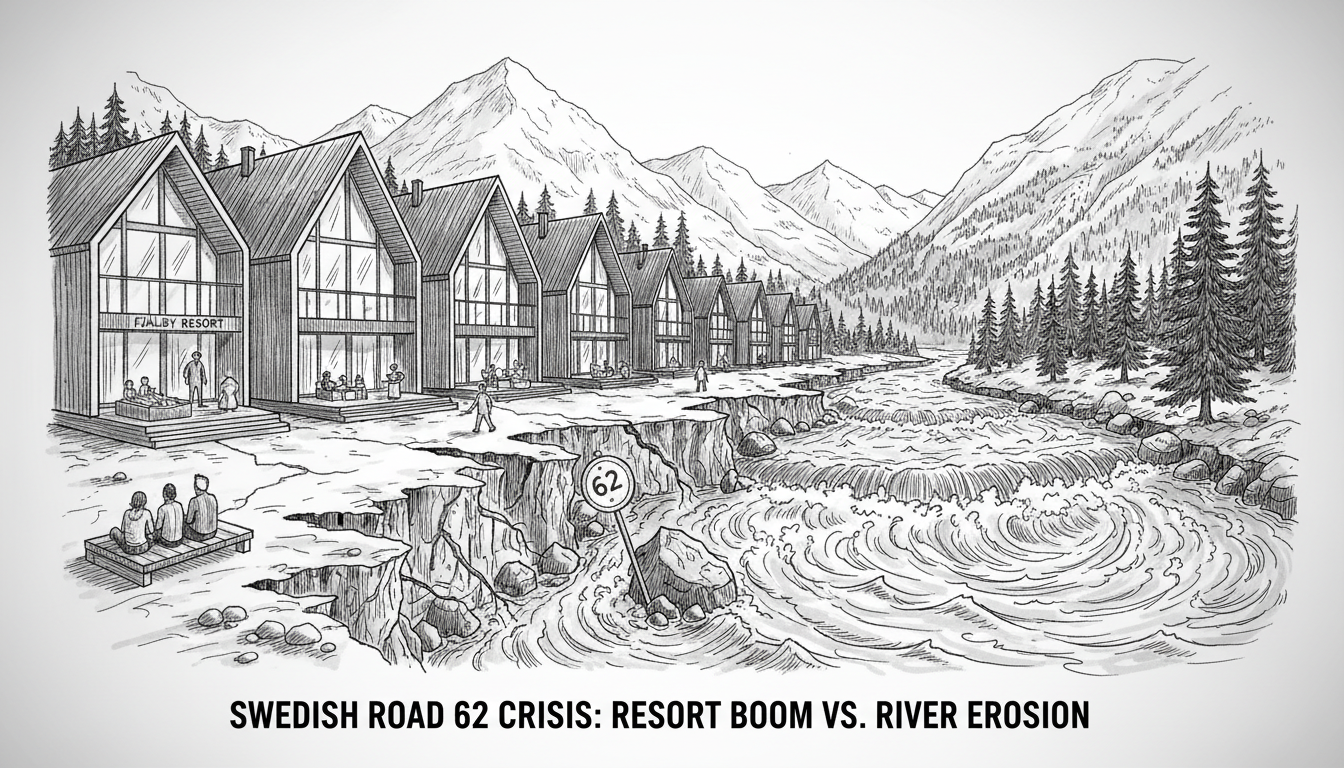
Swedish Road 62 faces an acute collapse risk from erosion along the Klarälven river, threatening a vital artery for 30% of Värmland's tourist accommodations. The conflict pits urgent infrastructure needs against strict EU nature protections, with the Swedish government potentially holding the final decision. A legal battle now delays critical reinforcement work as the popular Branäs ski resort expands.
The Geological Threat and Economic Stakes
Erosion of the riverbank slopes along the Klarälven has created a significant landslide hazard. This risk exists independently of traffic volume. However, increased vehicle numbers from tourism growth raise the potential consequences of a major collapse. "The landslide risk is not affected by more traffic," clarified Kenth Henriksson, project manager at the Swedish Transport Administration (Trafikverket). "But if you have more cars on the road when something happens, then you have a greater risk that a car will go down with everything."
The road's importance extends far beyond tourism. Route 62 serves as a crucial connection for local residents and heavy freight transport throughout the region. Its failure would isolate communities and disrupt supply chains. The situation presents a classic Swedish infrastructure dilemma, balancing environmental stewardship with economic and safety necessities.
Legal Impasse at the Heart of the Crisis
The Swedish Transport Administration prepared a plan for erosion protection to stabilize the slopes. This project was halted when the Land and Environment Court rejected the necessary permit application. The court's decision stems from the Klarälven's protected status as a Natura 2000 area. This designation originates from an EU directive, creating a binding legal framework for member states.
Swedish authorities are now seeking a legal pathway to proceed. The case has been appealed to the Supreme Court (Högsta domstolen). Officials hope the high court will refer the matter to the Swedish government. A government decision could grant a special exemption from the environmental protections, a rare but legally possible step.
"Something needs to be done very immediately," stressed Kenth Henriksson. He expressed hope for a decision before the end of the year. This timeline is critical for planning any potential construction work before further erosion occurs.
Local Government Seeks Urgent Solutions
Torsby Municipality, where the threatened road section is located, is actively engaged in the search for a resolution. Municipal Commissioner Thomas Stjerndorff confirmed the local administration's deep concern. "We are working intensively with the County Administrative Board and trying to find a solution," Stjerndorff stated. This collaboration highlights the multi-level governance challenge, involving local, regional, and national actors.
The municipality recognizes the dual pressure of maintaining public safety and supporting a key economic driver. Branäs resort accounts for a substantial portion of the county's guest nights annually. Any expansion of the resort, which generates more skier traffic on Route 62, intensifies the urgency of securing the road's foundation. The table below outlines the core conflict and key metrics.
| Aspect | Detail | Implication |
|---|---|---|
| Primary Risk | Erosion of slopes along Klarälven riverbank. | Creates acute landslide hazard for Road 62. |
| Legal Barrier | Natura 2000 protected area (EU designation). | Blocked Transport Administration's erosion protection plan. |
| Economic Factor | Branäs resort provides ~30% of Värmland's annual guest nights. | Road is critical for tourism access and local economy. |
| Next Legal Step | Supreme Court review, possible referral to Swedish Government. | Government could grant exemption, overriding court denial. |
| Stakeholders | Trafikverket, Torsby Municipality, County Board, Swedish Government. | Requires coordinated policy and legal action. |
Analysis: A Test of Swedish Policy-Making
This case sits at a complex intersection of Swedish and EU law, regional planning, and environmental policy. The Swedish government's potential role is particularly significant. A decision to grant an exemption would be a major political act, weighing concrete safety risks against established conservation principles. It would signal how the government prioritizes critical infrastructure in protected landscapes.
The process also tests Sweden's bureaucratic efficiency in crisis situations. The appeal to the Supreme Court and possible government referral is a standard legal channel. However, the described "acute" risk creates a tension with the typically slow pace of judicial and administrative review. The government's ability to act swiftly, if called upon, will be closely watched.
From an EU perspective, the case is a national-level implementation issue. The Natura 2000 network is a cornerstone of EU biodiversity strategy. While the framework is set in Brussels, permitting decisions and exemption rulings are the responsibility of member states. Sweden's final handling of this matter will be noted as a case study in balancing the directive's goals with other pressing national interests.
Implications for Infrastructure and Environment
The outcome will set a precedent for similar conflicts across Sweden, where aging infrastructure often intersects with valuable ecosystems. A government exemption could open the door for other projects in protected areas facing compelling safety arguments. Conversely, upholding the court's denial would reinforce the primacy of EU environmental law, potentially forcing a costly rerouting of the road or alternative engineering solutions.
For the Swedish Transport Administration, the limbo is operationally challenging. They have identified a clear danger and a technical solution but cannot act. This frustrates their core mission of maintaining a safe and functional road network. The situation underscores the need for earlier integration of environmental compliance into infrastructure risk assessments.
For local businesses and residents, the uncertainty is damaging. The threat of a road closure or collapse looms over future planning and investment. The expansion of Branäs, a positive economic development, is now indirectly linked to a growing safety concern. This creates a difficult position for local politicians who must advocate for both growth and security.
The Path Forward and National Significance
All parties now await the Supreme Court's procedural decision. If the case is referred to the government, ministers in Stockholm will face a difficult choice. Their decision will require a detailed justification, likely scrutinized by environmental groups and legal experts. It will involve direct engagement with the European Commission to ensure any exemption complies with the spirit and letter of the EU law.
The Road 62 dilemma is more than a local traffic issue. It is a microcosm of the larger challenges facing the Swedish state: reconciling EU commitments with domestic needs, adapting to climate change impacts like increased erosion, and funding the maintenance of essential infrastructure. The resolution, whether through court verdict or government action, will reveal the current priorities of Swedish policy-making. The coming months will determine if safety or conservation claims ultimate priority in this specific case, with lasting implications for how Sweden manages its protected landscapes and critical roads.