
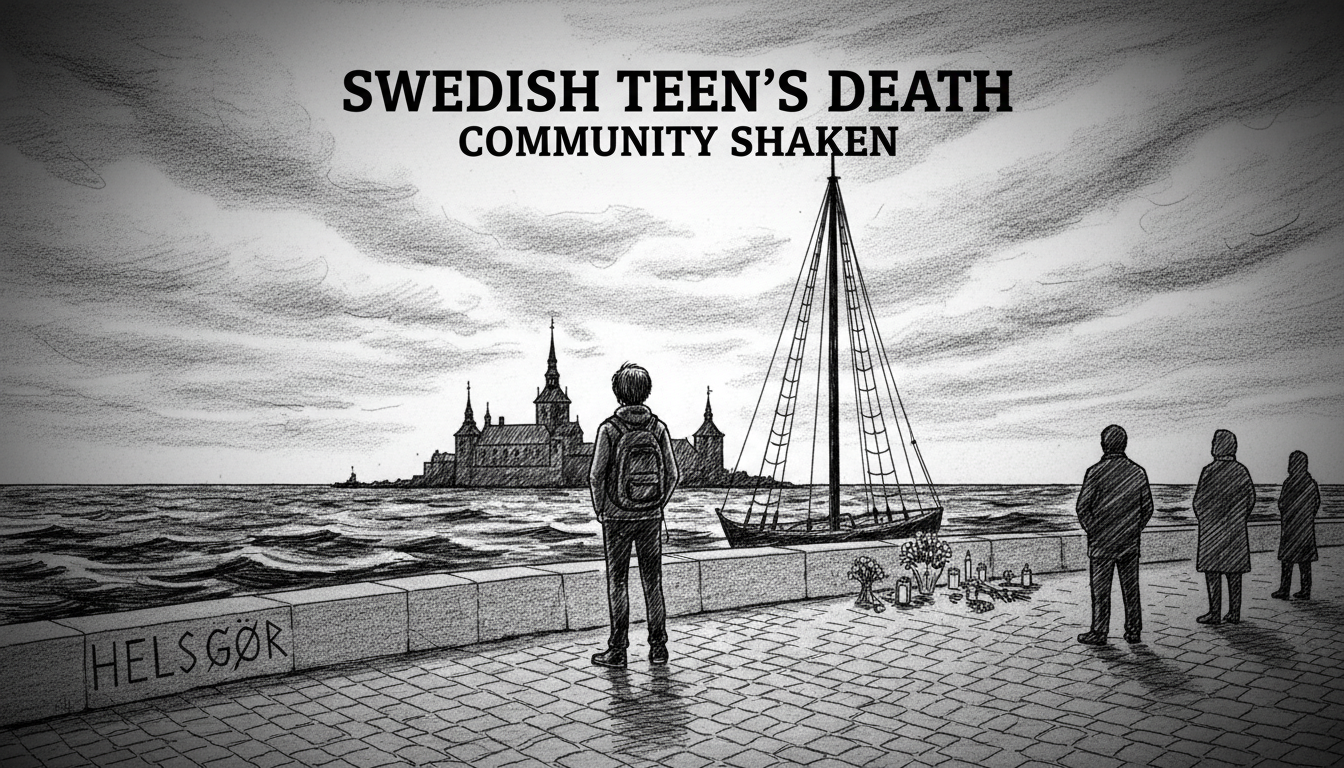
Denmark police have recovered the body of a 16-year-old Swedish boy from the bottom of Helsingør Harbor, following a two-day search. Surveillance footage reviewed by authorities shows the teen falling into the water around 12:45 AM on Wednesday, August 31st, after an evening out with friends in the Danish coastal city. The tragic discovery at 4 PM on Thursday ends a large-scale operation involving divers and water search dogs, launched after his jacket was found floating Wednesday morning.
A Night Out Turns Tragic
The sequence of events is both straightforward and heartbreaking. The Swedish teenager, whose identity has not been released, was visiting Helsingør with friends. The city, famous for Kronborg Castle, is a common destination for young Swedes from nearby Helsingborg, just a short ferry ride across the Øresund strait. After a night in the town, he approached the harbor. Police confirm the surveillance video shows him falling into the water. There was no struggle observed with another person, leading investigators to state there are no immediate indications of criminal activity. The search paused at darkness on Wednesday and resumed at first light Thursday, culminating in the grim discovery by divers.
"We can see from surveillance at the harbor that he falls in around quarter to one in the night leading into the 31st," said David Buch, duty officer with North Zealand Police. The boy's next of kin have been notified. This formal police statement underscores the procedural clarity surrounding the incident, yet it does little to convey the human loss rippling through two communities connected by water.
The Human Cost of a Borderless Region
This tragedy highlights the intimate, everyday connections within the Øresund Region, a model of cross-border integration. For decades, Swedes and Danes have moved freely across this strait for work, leisure, and social life. Young people especially use the efficient ferry links for nights out, experiencing a different country with minimal friction. This incident casts a stark light on the vulnerabilities that can exist within such seamless mobility. A fun, familiar trip for a teenager ended in an unthinkable way, raising painful questions about waterfront safety, group responsibility, and the dark side of a vibrant nightlife culture that spans two nations.
From my perspective, reporting on Danish society and integration, this case touches on complex social fabrics. The welfare and safety nets we discuss in policy debates are suddenly, brutally tested by a single event at the water's edge. It forces municipal authorities on both sides to examine protocols. How do rescue services coordinate across a national border when minutes count? The response involved Danish resources, but the victim was a Swedish citizen, a reminder that integration is not just about labor markets but about shared responsibility for human life.
The Grim Mechanics of Harbor Rescue
Search operations in harbor environments are among the most challenging for emergency services. Experts note that conditions like low visibility, cold water, boat traffic, and potential currents complicate efforts. "Search and rescue in harbors often requires specialized diving teams and water search dogs due to the difficult conditions," a source familiar with such operations explained. The use of both divers and dogs in this case indicates a thorough, multi-pronged approach by North Zealand Police. The initial find of the jacket on Wednesday morning provided a critical focal point, but the murky harbor depths ultimately required human divers to make the final recovery.
The time lapse between the fall and the recovery—over 39 hours—also speaks to the grim reality of such searches. While technology like surveillance cameras can pinpoint the location of an incident, the actual recovery operation is painstaking and slow. Every hour deepens the anguish for waiting families and friends. The police's decision to halt at nightfall is standard procedure, prioritizing the safety of rescue personnel, but it is a pause that feels agonizing for those left in suspense.
A Community Mourns Across the Water
In Helsingør, a city accustomed to welcoming Swedish visitors, the mood is somber. Local officials and community leaders are likely assessing what, if any, additional safety measures could be considered along the harbor front. While the investigation does not suggest foul play, an accidental drowning prompts its own form of public introspection. Are railings adequate? Is lighting sufficient? These are practical questions that arise in the wake of loss.
The impact is equally profound in the boy's hometown in Sweden. This tragedy transcends a simple news item about a drowning; it represents a family shattered and a circle of friends confronting mortality. It exposes the raw nerve of parental fear when teenagers gain independence and travel across borders. The very normalcy of a cross-border night out has been irrevocably changed for many who knew him.
As the formal investigation continues to finalize its report, the broader conversation continues. It touches on youth culture, the design of public spaces in historic cities, and the deep, often unspoken ties that bind the Danish and Swedish communities around the Øresund. The water that connects these two nations, facilitating culture and commerce, has also claimed a young life. The incident serves as a painful reminder that behind the statistics of integration and cross-border traffic are individual human stories, some of which end abruptly at the boundary between land and sea. The coming days will see a focus on supporting the bereaved family and friends, as two neighboring countries share in a common grief.