
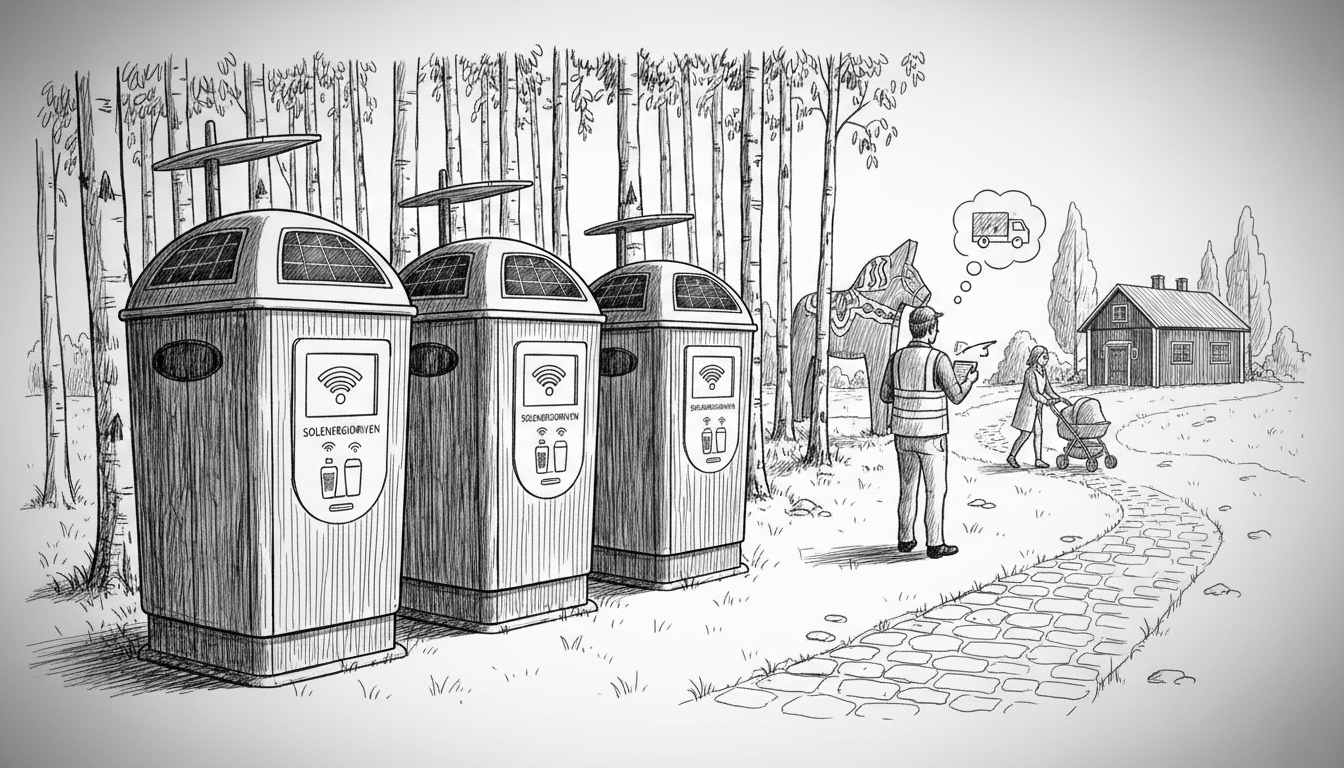
In the heart of Leksand, a picturesque Dalarna town known for its traditional red cottages and midsummer celebrations, something quietly revolutionary is happening with garbage collection. The local community park now hosts the region's first solar-powered trash compactors, marking a significant step in Sweden's ongoing sustainability journey.
Fredrik Mark, a waste management official with the local utility company, explained the technology's simple brilliance. "These bins communicate with us directly," he said in a statement. "They signal when they need emptying, which optimizes collection routes and reduces unnecessary truck trips."
The solar panels mounted on top harvest energy throughout the day, even during Sweden's darker winter months. This powers internal compactors that squeeze trash, allowing each bin to hold up to five times more waste than conventional containers. The system represents a practical solution to a common municipal challenge across Swedish communities.
This year-long pilot program in Leksand reflects Sweden's broader commitment to environmental innovation. The country has long been a leader in waste management, with less than 1% of household waste going to landfills. Most gets recycled or converted to energy through Sweden's extensive district heating systems.
For international observers, this initiative demonstrates how Swedish municipalities often test new technologies in smaller communities before wider implementation. Leksand, with its population under 6,000, provides an ideal testing ground where officials can monitor performance across seasonal changes.
The timing aligns with Sweden's accelerating green transition. Many municipalities face pressure to reduce carbon emissions from public services while maintaining cost efficiency. Solar-powered infrastructure offers a compelling solution, particularly in a country where summer brings nearly 24 hours of daylight in northern regions.
If successful, these smart bins could soon appear in Stockholm neighborhoods like Södermalm and Vasastan, where dense urban living creates unique waste management challenges. The technology addresses both environmental concerns and practical urban planning needs.
What makes this approach distinctly Swedish? It combines technological innovation with practical, commonsense design. The bins don't require extensive infrastructure changes or complex installation. They simply replace existing containers while providing smarter service.
Local residents have noticed the new additions to their community space. "I walk my dog here every morning," said Anna Lundgren, a Leksand resident. "Seeing solar panels on trash bins reminds me that environmental solutions can be part of our daily lives in small ways."
The project's success could influence similar initiatives across the Nordic region. Norway and Finland face comparable geographic and climatic conditions, making Leksand's experiment relevant beyond Sweden's borders.
For now, the solar bins stand quietly in the park, doing their work without fanfare. They represent Sweden's characteristically practical approach to sustainability—finding smart solutions that work reliably in the background of daily life.