
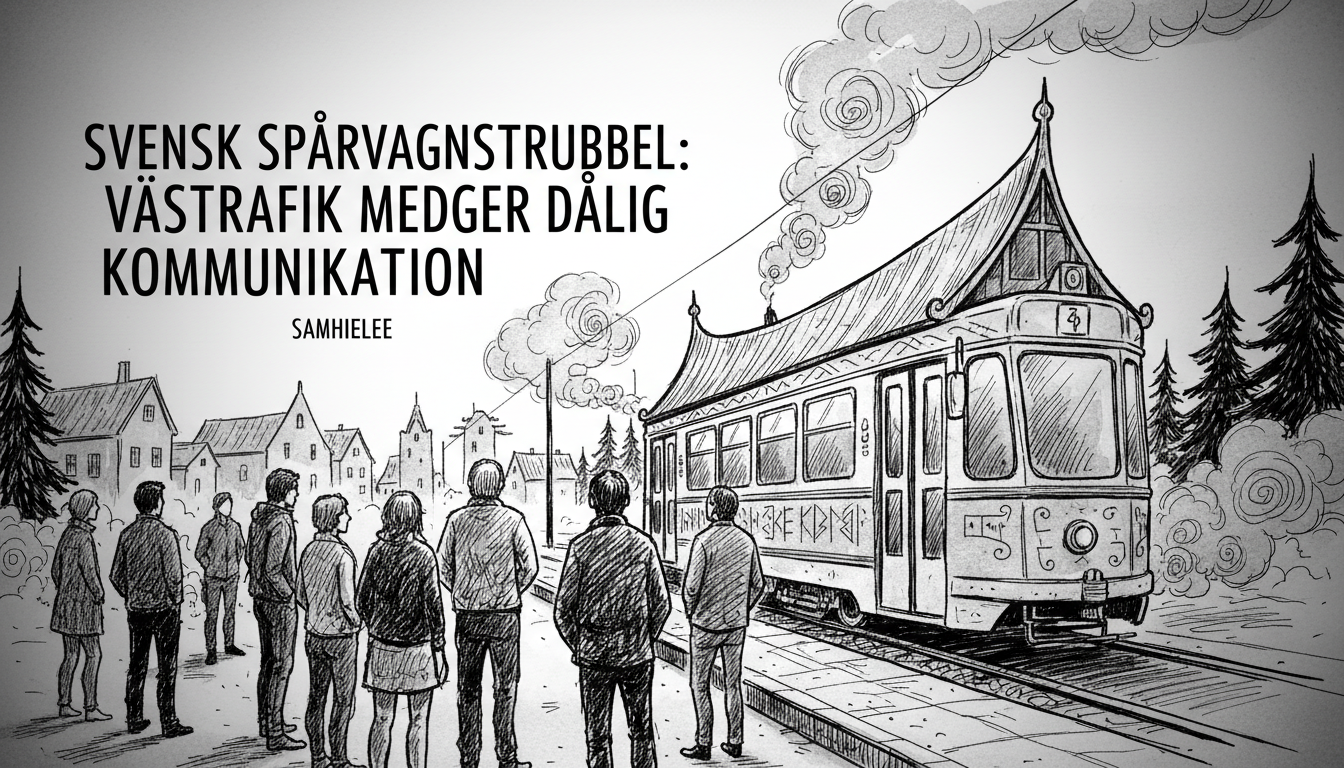
Gothenburg commuters faced a chaotic morning as all tram services screeched to a halt. The only notice on Västtrafik's website read: "Risk of disturbances in public transport due to current weather." For the city's 340,000 daily public transport users, this vague message was both unhelpful and frustrating. Now, the transport authority itself has called its own communication "poorly formulated" and promised to do better.
"It is poorly formulated," said Henrik Kjellberg, a press officer for Västtrafik. "There are better formulations." The admission came after a morning of widespread confusion across Sweden's second-largest city. The sparse announcement failed to convey the total shutdown of Gothenburg's extensive 160-kilometer tram network, one of Scandinavia's largest.
A City Brought to a Standstill
The disruption left students, workers, and visitors scrambling. At a tram stop on Avenyn, the city's main boulevard, commuters huddled against the cold, checking phones for updates that were slow to come. Anna Lundgren, a nurse trying to get to Sahlgrenska University Hospital, was among those stranded. "'Risk of disturbances' doesn't tell me all trams are canceled," she said. "I stood there for 20 minutes before a bus driver told me. It wastes people's time and trust."
This incident highlights a critical tension in Swedish society. The country relies on a deep-seated trust in public institutions and efficient systems. When that system fails to communicate clearly, it creates a ripple effect of inconvenience and erodes public confidence. In Gothenburg, where trams are the lifeblood of the city, clear information is not a luxury—it's a necessity.
The High Cost of Vague Language
Västtrafik is responsible for bus, tram, train, and boat services across the Västra Götaland region. Weather-related disruptions are common during Swedish winters, from heavy snow in Stockholm's archipelago to icy rains in Gothenburg. Experts say managing these events is as much about communication as it is about logistics.
"Clear, timely, and accurate information is the cornerstone of reliable public transport," says transportation analyst Erik Månsson. "A vague message like 'risk of disturbances' during a total network closure is worse than no message at all. It sets the wrong expectation. People assume there might be delays, not a full stop. This damages the essential trust between the provider and the public."
The authority's belated acknowledgment points to a recognition of this breach. For many residents, the apology is a first step, but the real test will come with the next snowstorm or system failure.
A Matter of Trust and Expectations
Swedish culture places a high value on transparency and predictability, known as "trygghet." This concept translates to a sense of security and reliability. Public services are expected to uphold this. The morning's events, therefore, weren't just a transport hiccup. They represented a small crack in that social contract.
At the Järntorget square tram hub, the mood was one of resigned frustration. Markus Elofsson, a café owner who depends on tram deliveries, noted the broader impact. "It's not just about getting to work," he said. "Goods are delayed, appointments are missed, the whole city slows down. When the information is bad, we can't make good plans. We need facts, not vague risks."
This expectation for precise information is deeply ingrained. From the meticulous timetables of public transport to the detailed forecasts from the Swedish Meteorological Institute, Swedes are accustomed to data they can plan their lives around.
The Path to Clearer Communication
Henrik Kjellberg of Västtrafik stated the message would be changed, indicating an internal review of crisis communication protocols. The goal is to move from generic warnings to specific, actionable information. This might include explicit statements about which lines are canceled, expected duration, and available alternative routes.
Other major Swedish transit authorities, like Stockholm's SL, often use color-coded maps and real-time alerts in their app to denote the scale of problems. The incident in Gothenburg suggests there is room for Västtrafik to adopt more direct and detailed communication strategies, especially for major network-wide issues.
Improving this is crucial for a service that facilitates nearly a third of a million trips every day. The physical infrastructure—the trams, tracks, and buses—is only half the system. The other half is the flow of information that allows people to navigate it.
Looking Beyond the Morning Chaos
The true measure of this incident will be how Västtrafik adapts. Will the next weather warning clearly distinguish between a "potential delay" and a "full cancellation"? For commuters like Anna Lundgren, the proof will be in the next morning's alert.
Public transport is more than a utility in cities like Gothenburg; it's a shared public space and a common experience. How it is managed, especially in failure, reflects broader societal values of fairness, clarity, and respect for people's time. The apology is an acknowledgment of a mistake. The city now watches for the correction, hoping for communication that matches the reliability they expect from the rails themselves. In a society built on trust, clear words are just as important as well-maintained tracks.