
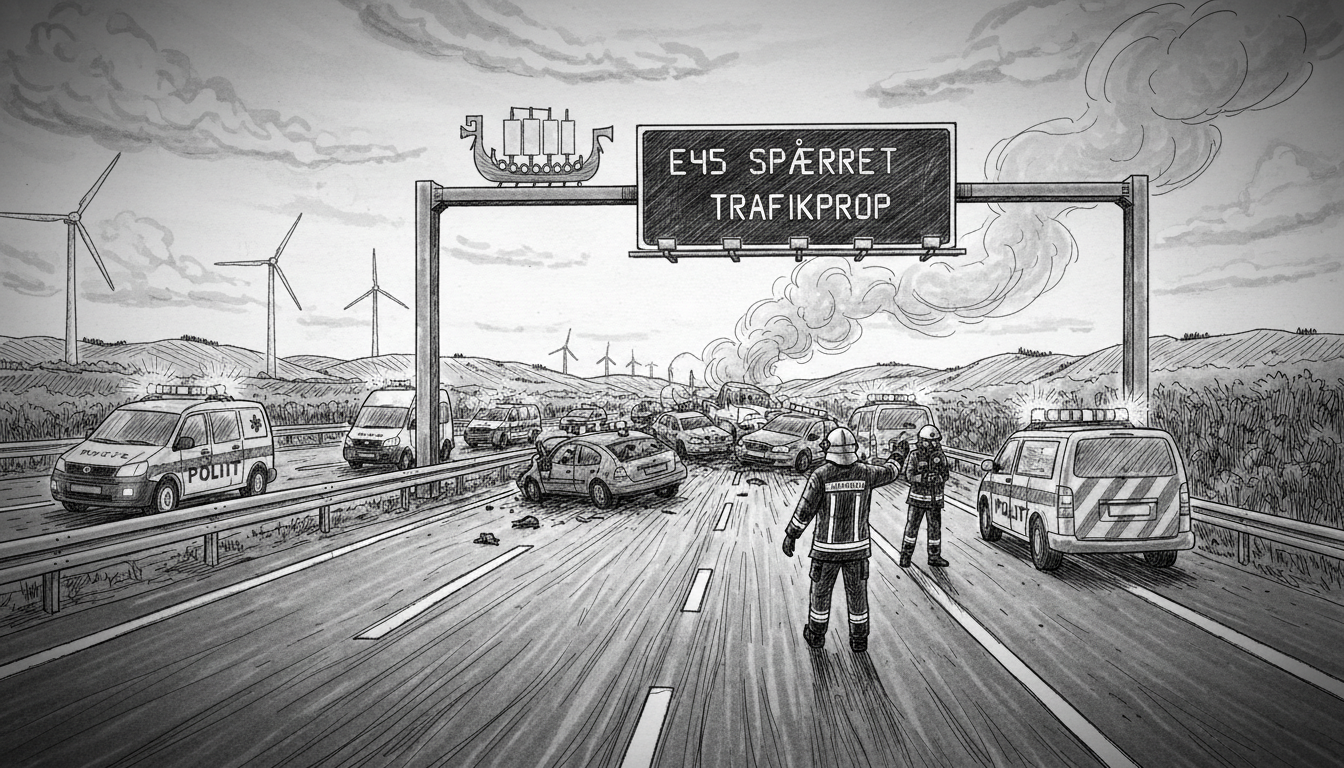
A serious traffic accident on the E45 motorway near Aalborg caused significant delays and lane closures on Thursday afternoon. Emergency services closed the right lane between Aalborg C and the Info-Teria Dall/Limfjorden junction. Police and rescue teams worked at the scene. Officials warned drivers of extended travel times up to thirty minutes. The resulting queue stretched from Humlebakken to Aalborg Syd.
While this is a traffic report, it offers a window into the daily functioning of Danish infrastructure and crisis response. The E45 is a vital artery connecting northern Jutland to the rest of Denmark and Germany. Such disruptions test the coordinated response of the Road Directorate, police, and medical services. Their efficiency is a cornerstone of the reliable society Denmark is known for.
For international readers and new residents, understanding these systems is part of integration. Denmark's social contract relies on high-functioning public services and collective patience during unforeseen events. A traffic jam is more than an inconvenience. It is a moment where trust in public institutions and fellow citizens is displayed. Drivers follow detours and information without panic.
From a social policy perspective, reliable transport links are crucial for integration and access to the labor market. Many new citizens and international workers rely on these corridors to reach jobs, language schools, and social centers in cities like Aalborg and Copenhagen. Delays can impact precarious work schedules and childcare pickups. Municipalities often work with social organizations to provide support when major disruptions affect vulnerable communities.
The response to such incidents also reflects broader Danish values of safety and order. The immediate lane closure, despite worsening congestion, prioritizes accident investigation and victim care over traffic flow. This procedural rigor, while sometimes frustrating for drivers, underscores a societal priority on thoroughness and safety over speed. It is a tangible example of the welfare state's operational logic applied to everyday crises.
What happens next? Traffic will normalize once the scene is cleared and investigators complete their work. The incident will be logged, and any necessary infrastructure repairs will be scheduled. For the average citizen, it is a reminder of the interconnectedness of Danish society. A single accident on the E45 ripples through the schedules of hundreds, yet the system is designed to absorb and manage the shock with minimal chaos. That is the often-invisible work of maintaining a stable society.