
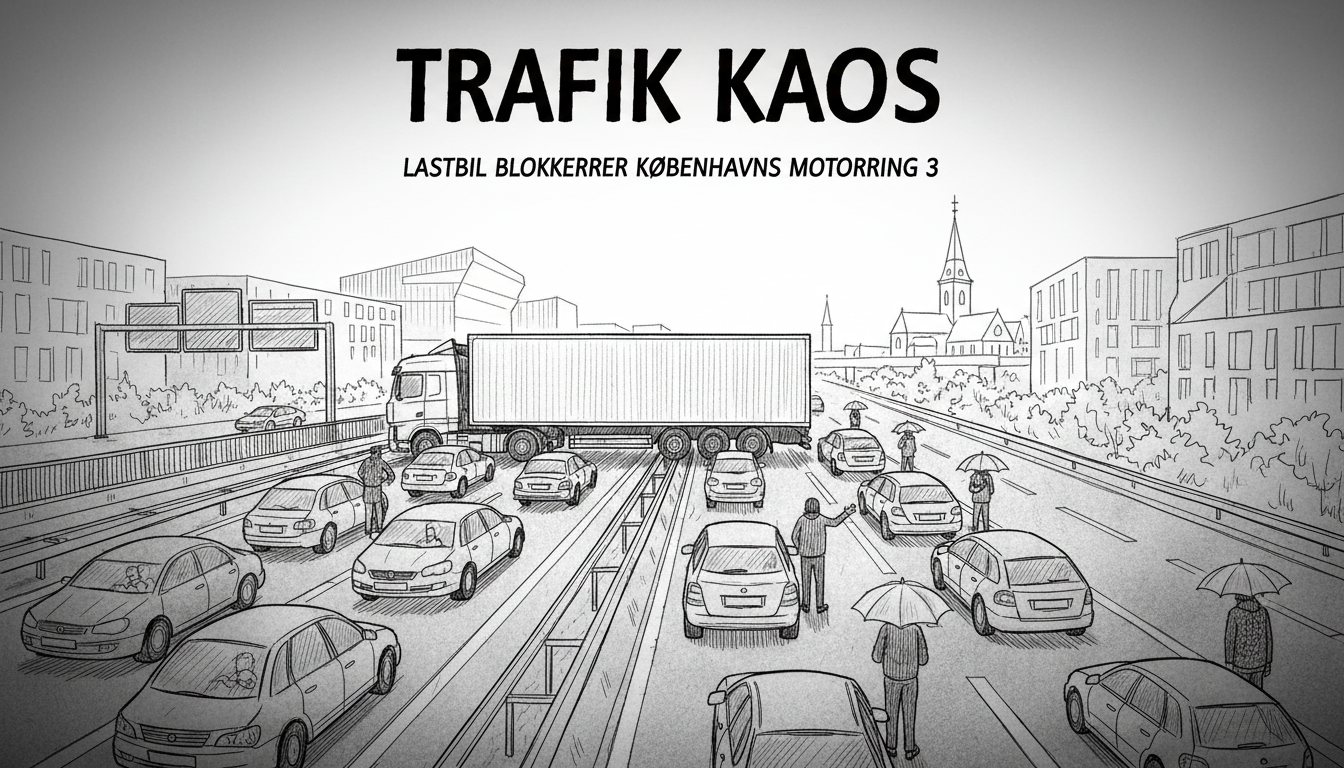
Denmark's busiest motorway faced major disruption Monday morning after a truck broke down. The incident occurred on Motorring 3 heading north, just past the crucial Brøndby Motorvejskryds interchange, snarling the morning commute for thousands. Roadside assistance teams were deployed to the scene, but the blockage of the right lane caused significant traffic congestion stretching back for kilometers during peak travel hours.
This single breakdown on a key arterial road highlights the fragile nature of modern urban mobility. For Copenhagen's commuters and freight operators, Motorring 3 is an indispensable corridor. The 42-kilometer ring connects municipalities like Glostrup, Herlev, and Lyngby-Taarbæk to the wider capital region. Any incident here creates a ripple effect, delaying everything from morning commutes to critical supply deliveries.
The Immediate Impact of a Single Breakdown
Emergency services and a private roadside assistance contractor responded quickly to the stranded heavy goods vehicle. Their primary goal was to clear the lane and restore normal traffic flow as swiftly as possible. However, the sheer size of the truck meant recovery was a complex operation, not a simple tow job. The resulting 'kødannelse' – a direct Danish term for traffic build-up – was immediate and severe.
Traffic analysts monitoring the situation noted that incidents involving large vehicles disproportionately affect congestion. A car breakdown might allow traffic to squeeze past; a truck often requires a full lane closure. On a road designed for high-speed, high-volume travel, this creates a bottleneck. The congestion not only causes delays but also increases the risk of secondary, rear-end collisions as fast-moving traffic suddenly halts.
Why Motorring 3 is Denmark's Traffic Lifeline
Understanding the scale of the disruption requires understanding the road's role. Motorring 3, also known as O3, is more than just a highway; it is the primary orbital route around the western and northern parts of metropolitan Copenhagen. It feeds into and distributes traffic from other major motorways like the E47 and E55. Tens of thousands of vehicles use it every day, including a high percentage of commercial freight trucks serving the city and its harbors.
The Brøndby interchange where this incident occurred is a particularly critical node. It connects the ring road to the south-north Motorvej Syd, creating a convergence point for traffic from Roskilde, Køge, and the southern suburbs heading into the city or towards Elsinore. A blockage here doesn't just affect one route; it strains the entire network as navigation apps redirect drivers onto already busy local roads in Brøndby and neighboring municipalities.
A National Pattern of Road Incidents
Monday's breakdown is not an isolated event. It fits into a broader national pattern of traffic incidents that challenge Denmark's otherwise efficient infrastructure. According to official police statistics, there were 42,456 reported traffic accidents across Denmark in 2022. While many are minor, a significant number occur on motorways and involve heavy goods vehicles.
These HGV-involved incidents present unique challenges. Their recovery is slower, their spillage (if carrying cargo) is more hazardous, and their impact on traffic flow is greater. Experts point to a combination of factors: vehicle maintenance standards, driver hours, and the intense pressure on logistics chains. Each breakdown on a road like Motorring 3 is a stress test for the region's contingency planning and real-time traffic management capabilities.
The Expert View on Infrastructure Strain
"A single incident like this acts as a diagnostic tool for our entire transport system," says a Copenhagen-based traffic planner, speaking on background about systemic pressures. "It shows where the pinch points are and how quickly congestion can cascade. The immediate priority is always safety and clearance, but the long-term conversation is about resilience."
That conversation includes debates about digital infrastructure, such as the speed and accuracy of traffic information dissemination to drivers via radio, apps, and road signs. It also touches on physical capacity and whether Denmark's key motorways, built for the traffic volumes of past decades, need strategic upgrades. Furthermore, analysts emphasize the need for consistent safety enforcement for commercial fleets to prevent preventable mechanical failures.
The Economic and Social Ripple Effect
The cost of a major traffic jam extends far beyond frustrated drivers. Delays in freight movement have a tangible economic impact, affecting just-in-time delivery schedules for businesses, from retail to manufacturing. For commuters, lost time translates to lost productivity or personal time. In a society that prides itself on punctuality and efficiency, these disruptions are more than an inconvenience; they represent a breakdown in the expected social contract of daily life.
Municipalities adjacent to the motorway, like Herlev and Glostrup, also feel the impact as side roads become clogged with diverted traffic. This can affect local bus schedules, increase pollution in residential areas, and delay municipal services. The incident serves as a reminder of how deeply interconnected urban and suburban mobility systems have become, where a problem in one jurisdiction quickly becomes a problem for many.
Looking Ahead: Resilience on the Road
As the truck was finally cleared and the slow process of dissolving the congestion began, the question of prevention lingered. Could better pre-trip vehicle inspections reduce such breakdowns? Could more dynamic lane management technology help mitigate the impact? The Danish Road Directorate constantly works on these issues, but Monday's event proves the challenge is persistent.
For Copenhageners, the return to normal traffic flow brings relief but also a familiar frustration. In a region continually growing and adding more vehicles to its roads, the margin for error shrinks. Each breakdown, each accident, is a lesson in vulnerability. The true test is not just how quickly a single truck can be removed, but how the system learns and adapts to prevent the next major gridlock. Will the region's infrastructure investments keep pace with its ambitions, or will mornings like this become a more frequent feature of life in the capital?