
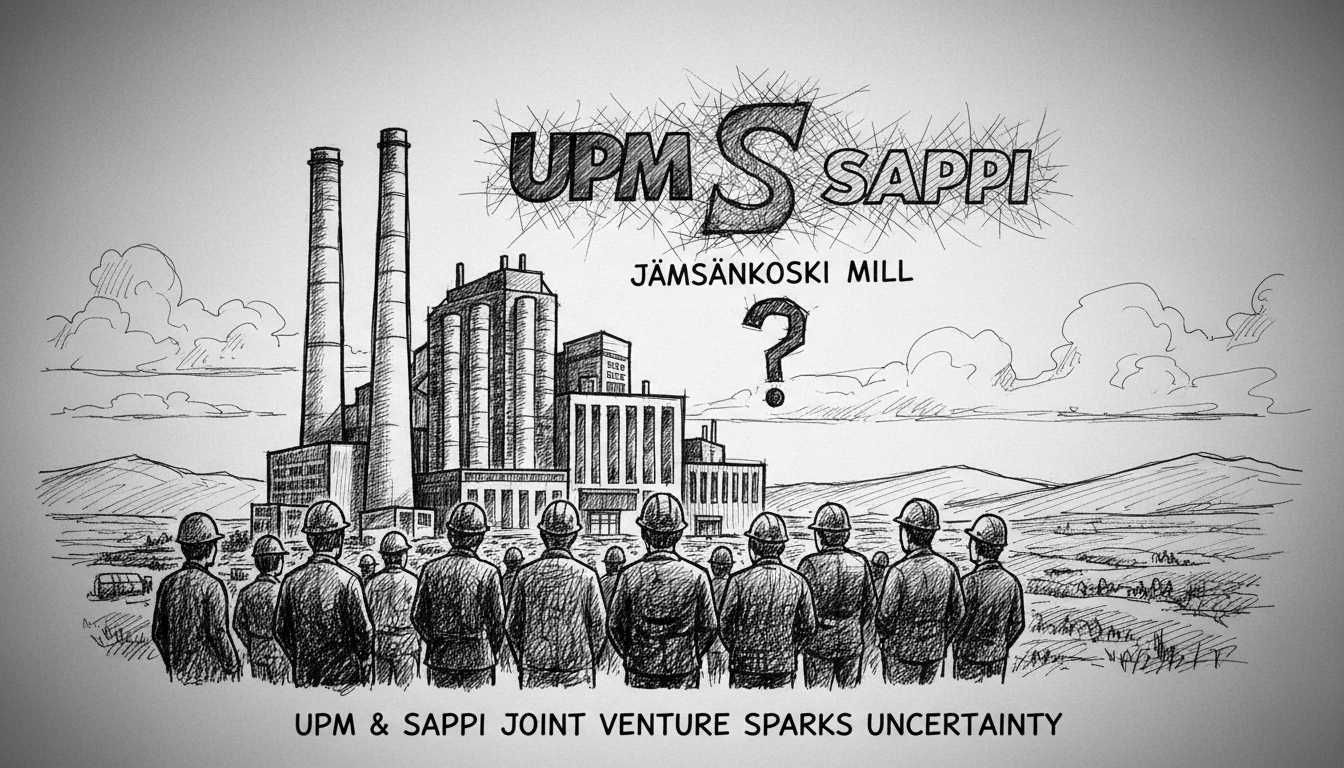
The announcement of a major joint venture between Finnish forestry giant UPM and its South African competitor Sappi has created immediate uncertainty at the Jämsänkoski paper mill in Central Finland. Timo Hietanen, the chief shop steward for UPM at the mill, stated the news came as a complete surprise to the local workforce. He described a situation filled with question marks, where no one truly knows what will happen next or how the deal will impact their future. This development underscores the volatile nature of the global pulp and paper industry and its direct effect on Finnish industrial communities.
The proposed partnership aims to combine UPM's communication papers business with Sappi's European operations. The move is a strategic response to long-term structural decline in demand for graphic paper, a trend accelerated by digitalization. For the Jämsänkoski mill, which produces magazine paper, the joint venture represents a fundamental shift in ownership and strategic direction. Workers are now left waiting for details on potential operational changes, job security, and investment plans for the facility. The Finnish government, through its ownership in state-controlled forestry assets, monitors such consolidations for their impact on national industrial policy and regional employment.
Historically, the Finnish economy has been deeply tied to its forest industry, with companies like UPM acting as major employers and exporters. The Jämsänkoski mill is a cornerstone of its local municipality. Major corporate restructurings therefore carry significant social and economic weight beyond mere business metrics. This deal follows a pattern of consolidation within the European paper sector, as companies seek scale and efficiency to remain competitive against global rivals and shifting market demands. The lack of immediate clarity for employees is a common, yet deeply disruptive, feature of such announcements.
The implications extend to Finland's trade relations and green transition goals. The pulp and paper sector is central to national bioeconomy strategies. Any changes in corporate structure can influence research and development investments in new, sustainable biomaterials. For international observers, this case highlights the ongoing transformation of Nordic industrial powerhouses. They are navigating the complex path from traditional manufacturing toward higher-value, sustainable production. The coming weeks will be critical. Union representatives and plant management will need to engage in transparent dialogue to address the legitimate concerns of the workforce and secure the mill's future in a changing market.
Aino Virtanen, Finnish Political Correspondent