
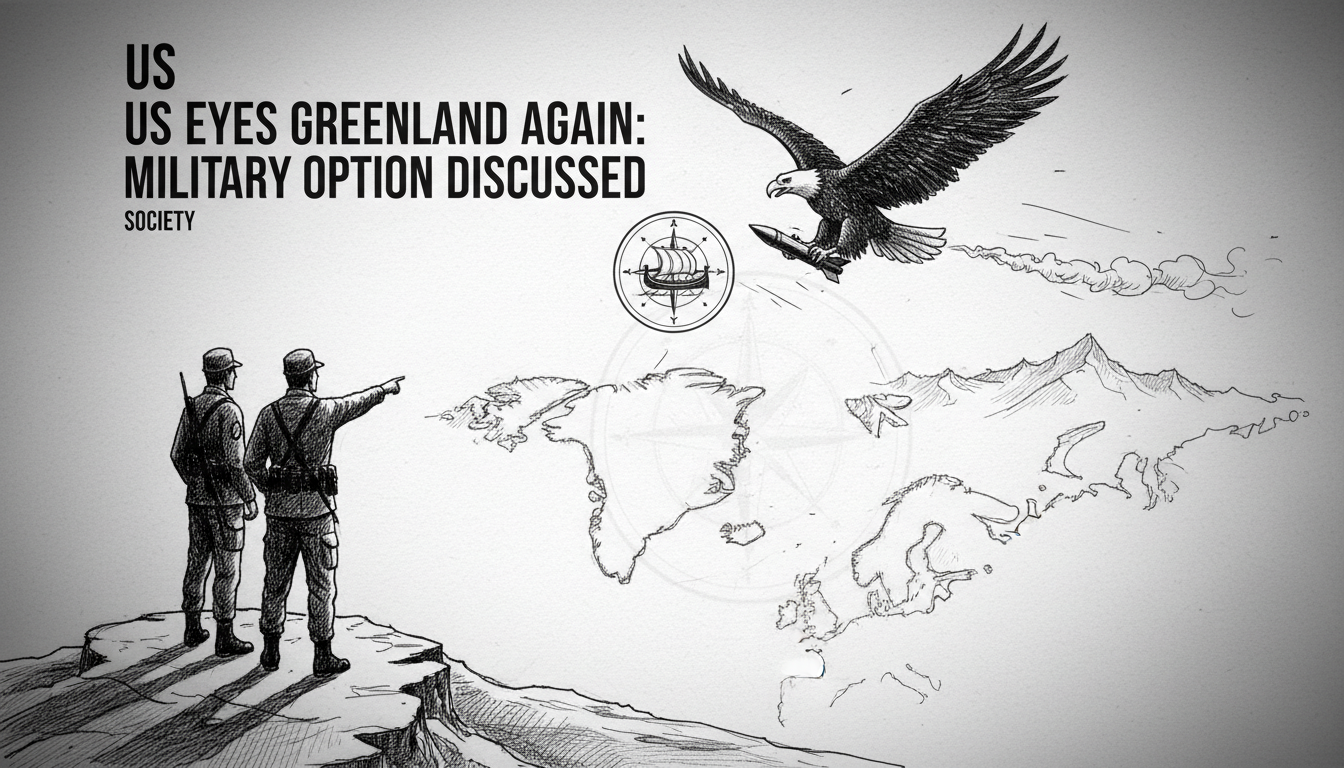
Greenland's 56,000 residents have once more heard distant talk of their homeland being a geopolitical bargaining chip. The White House recently affirmed the U.S. military is ‘always an option’ regarding the vast Arctic territory, reviving a debate that deeply offended Denmark and Greenland five years ago. For many here in Copenhagen, where foreign and Greenlandic policy intertwine, the statement is less a practical threat and more a symptom of escalating great-power competition that places a small Nordic kingdom in a delicate position. The comment tests the resilience of Denmark’s historical diplomacy and its modern commitment to Greenland’s right to self-determination.
From Cold War Asset to Modern Flashpoint
The United States has maintained a continuous military foothold in Greenland since 1951. Thule Air Base, located 750 miles north of the Arctic Circle, operates under a bilateral defense treaty with Denmark. This agreement grants the U.S. rights to the base but does not confer sovereignty. The strategic value of Greenland, positioned between North America and Europe with a commanding view of the Arctic, has only grown as climate change opens new shipping lanes and resource exploration possibilities. “The statement reflects a persistent view in some Washington circles that views Greenland as a strategic asset first and a society of people second,” notes a Copenhagen University geopolitics scholar who requested anonymity due to the topic’s sensitivity. This perspective often clashes with the political reality in Nuuk and Copenhagen, where autonomy and partnership are the guiding principles.
The Ghost of 2019 and Diplomatic Scars
The recent White House remark cannot be separated from the 2019 episode where then-President Donald Trump openly discussed purchasing Greenland. The idea was promptly and firmly rejected by then-Prime Minister Mette Frederiksen, who called the notion “absurd,” and by Greenland’s own government. The incident caused a brief diplomatic rift, with Trump cancelling a state visit to Copenhagen. While the current statement is less explicit than a purchase proposal, it strikes a similar nerve. “It demonstrates a fundamental lack of understanding or respect for the constitutional relationship between Denmark and Greenland,” says Aaja Chemnitz Larsen, a Greenlander and Member of the Danish Parliament. “Greenland is not a commodity. Its people have the sole right to decide their future.”
The Nuuk Perspective: Autonomy Above All
In Greenland’s capital, Nuuk, the reaction blends fatigue with firm resolution. The self-rule government, which controls most domestic affairs, has consistently stated that discussions about its future are for Greenlanders alone. The reopening of a U.S. consulate in Nuuk in 2020 was seen as a positive step for direct dialogue, but statements about military ‘options’ undermine that goodwill. Local politicians emphasize development, education, and managing their vast natural resources as priorities, not becoming a pawn in a U.S.-Russia-China Arctic standoff. “We have a population smaller than a mid-sized Danish city spread across the world’s largest island,” says a social policy analyst familiar with Greenlandic affairs. “Our social and economic challenges are immense and concrete. Abstract geopolitical maneuvers from distant capitals do not help us build better schools or sustainable fisheries.”
Denmark’s Balancing Act in the Arctic
For the Danish government, the situation requires a careful balance. Denmark handles Greenland’s defense and foreign policy, binding it to any international discussions about the island’s status. The official line remains unwavering support for Greenland’s autonomy and a rejection of any talk of purchase or forced acquisition. Yet, Denmark is also a founding NATO member and a close U.S. ally, reliant on American security guarantees. This creates inherent tension. “Our role is to be a stable and predictable partner in the Arctic, upholding international law and the rights of the Greenlandic people,” a senior Danish foreign ministry official stated. “Our partnership with the U.S. at Thule is strong, but it exists within very clear and agreed-upon frameworks.” The unspoken challenge is managing an ally whose strategic rhetoric sometimes veers into disruptive territory.
What ‘Military Option’ Could Realistically Mean
Experts widely dismiss any scenario of the U.S. militarily seizing Greenland as politically impossible and strategically catastrophic for NATO. The practical meaning of the ‘option’ likely refers to strengthening or expanding the existing U.S. presence at Thule. The base is already critical for space surveillance and missile warning. With Russia revitalizing its Arctic military bases and China declaring itself a ‘near-Arctic state,’ the U.S. may be seeking to signal its commitment to maintaining dominant influence. The real conversation, therefore, is not about ownership but about degree of access and operational control. Any expansion would require negotiation with Denmark and, critically, consultation with Greenland’s government, which has shown willingness to engage on practical matters but insists on respect and mutual benefit.
A Test for Social Cohesion and Integration
Beyond high politics, the recurring ‘Greenland question’ touches on deeper issues of identity and respect within the Danish realm. For the thousands of Greenlanders living in Denmark, often facing complex integration challenges, such talks can feel demeaning, reducing their ancestral home to a piece on a game board. “It sends a subtle message that some lands and peoples are still viewed through a colonialist lens,” says a community leader at a Copenhagen social center frequented by Greenlanders. “True integration and partnership mean listening to Greenlandic voices, not speaking over them about missiles and bases.” The episode becomes a lesson in why foreign policy and domestic social policy are inextricably linked in a multi-national kingdom.
The White House's brief comment has reignited a complex debate that sits at the intersection of Arctic strategy, post-colonial identity, and alliance politics. While a dramatic military takeover remains a fiction, the persistent framing of Greenland as an ‘option’ reveals a gap in perception between great powers and the small nations and territories that inhabit strategically coveted regions. The ultimate response will depend not on statements from Washington, but on the continued, firm collaboration between the governments in Copenhagen and Nuuk. As the Arctic ice continues to melt, the pressure on Greenland’s future will only intensify. Will external powers learn to see its people as partners rather than just a strategic calculation?