
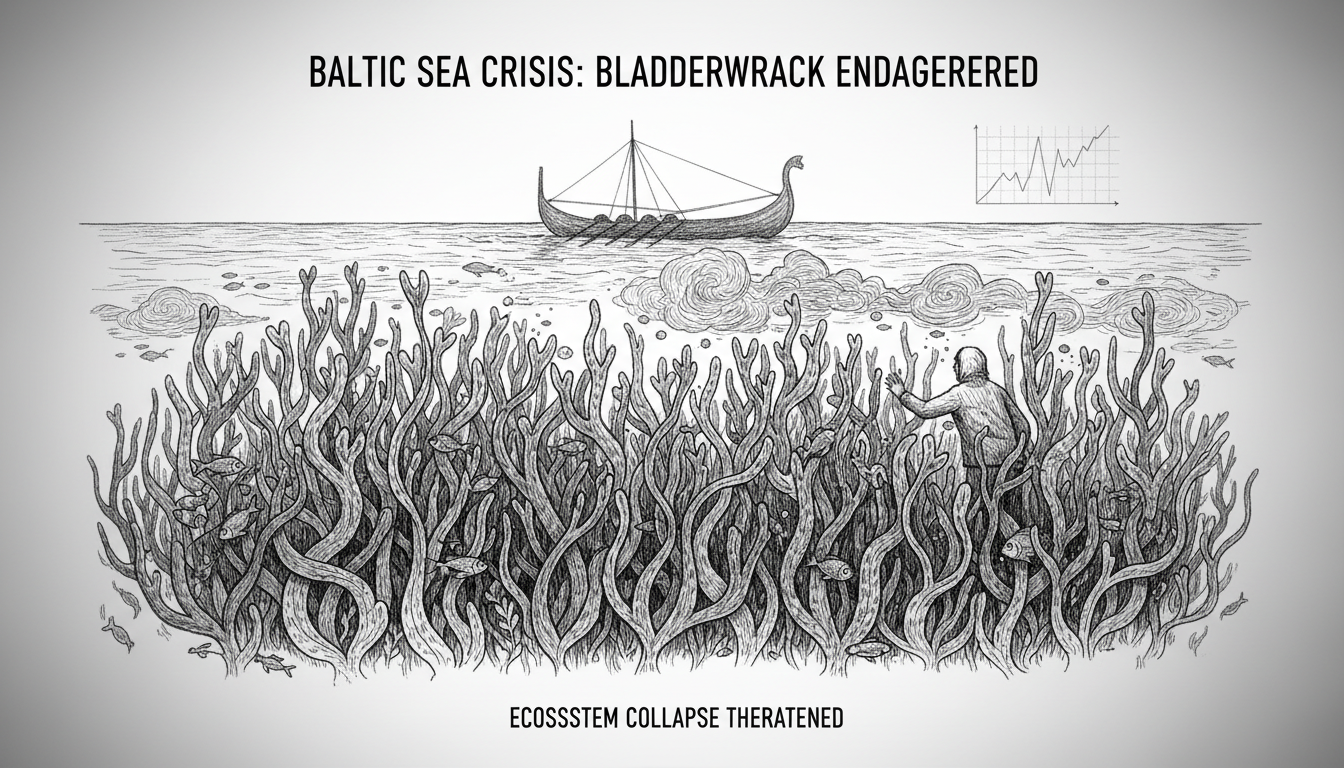
The Baltic Sea faces a critical ecological situation as bladderwrack, a foundational seaweed species, confronts multiple environmental threats. This brown algae serves as the underwater equivalent of a rainforest, supporting entire marine ecosystems along Nordic coastlines.
Marine biologist Essi Keskinen explains that eutrophication has dramatically reduced bladderwrack coverage in recent decades. The algae requires clear water and sufficient light to thrive, but murky conditions have pushed its growth boundary closer to the surface. When light cannot penetrate deep enough, bladderwrack cannot survive.
The situation shows some recent improvement as water clarity has increased in certain areas. Still, bladderwrack remains a monitored species, and the meadows it forms are classified as endangered habitats.
What makes bladderwrack so ecologically vital? Individual plants might seem insignificant, but dense meadows create complex three-dimensional structures on rocks and seabeds. These underwater forests provide crucial hiding spots and feeding grounds for small fish and invertebrates. The algae supports entire food chains by hosting bacterial films and thread algae that creatures like copepods and snails consume.
Bladderwrack's importance extends beyond marine environments. When washed ashore, it forms wrack beds that become fertile habitats for various insects. Humans also benefit directly - the seaweed serves as food, skin care serum, and when decomposed, becomes valuable garden compost.
Keskinen references Finnish cultural heritage, noting how Tove Jansson's Moomin characters collected bladderwrack from lighthouse islands for their rose garden soil in the classic story 'Moominpappa at Sea.'
The algae faces its greatest threats from excess nutrients flowing into the Baltic Sea. Single-celled algae like blue-green algae have proliferated, clouding the water and outcompeting bladderwrack. Particularly during spring growth periods, fast-growing filamentous algae cover the same surfaces and block light penetration, potentially killing the slower-growing bladderwrack.
Climate change accelerates these effects. Warmer waters favor annual algae species that can explode in growth under higher temperatures. Snow-poor winters also increase nutrient runoff into the sea, further promoting eutrophication.
What would happen if bladderwrack disappeared from the Baltic Sea? Keskinen finds precise predictions difficult but warns effects would be far-reaching. The initial impact would hit copepods, which many fish species depend on for food. Reduced fish populations would then affect predatory fish and marine mammals like seals.
The marine biologist compares the potential loss to removing all spruce trees from Finnish landscapes. Bladderwrack represents the only large brown algae along Finland's coastlines, creating magnificent golden-brown meadows that define underwater seascapes.
Decades of effort have targeted nutrient reduction in the Baltic Sea. In the 1960s and 1970s, cities discharged wastewater directly into the sea. Recent legislative changes now prohibit cargo ships from releasing waste and scrubber waters in Finnish territorial waters, though international waters still permit such discharges.
Substantial work remains, particularly addressing nutrient runoff from agriculture and forestry. Keskinen advocates for protected areas and wetlands that can filter fertilizers and other nutrient additions from water before it reaches the sea.
There is some positive news. Nutrient emissions have decreased significantly since the 1980s and 1990s. The worst period may have passed, though effects take considerable time to manifest. Despite extensive research, climate change impacts on all species remain unpredictable.
A more concerning challenge lies at the Baltic Sea bottom - a nutrient time bomb with limited solutions. Seafloor sediments contain phosphorus bound to iron. When bottom waters become oxygen-depleted, this bond breaks and phosphorus releases back into the water column.
A massive dead seabed area, approximately Denmark's size, exists at the Baltic bottom. Under suitable conditions, this area can release nutrients back into the sea. Even if every nutrient particle could be prevented from entering the Baltic Sea today, internal loading would continue affecting the ecosystem for decades.
The bladderwrack situation illustrates the complex challenges facing Baltic Sea conservation. While progress has been made reducing external nutrient inputs, internal loading and climate change create new complications. Protecting this foundational species requires continued efforts across multiple fronts, from agricultural practices to international marine regulations.
Nordic countries have demonstrated commitment to Baltic Sea protection, but the bladderwrack's precarious position shows more comprehensive approaches are needed. The algae's fate will serve as a key indicator of whether current conservation strategies can successfully address both historical pollution and emerging climate threats.