
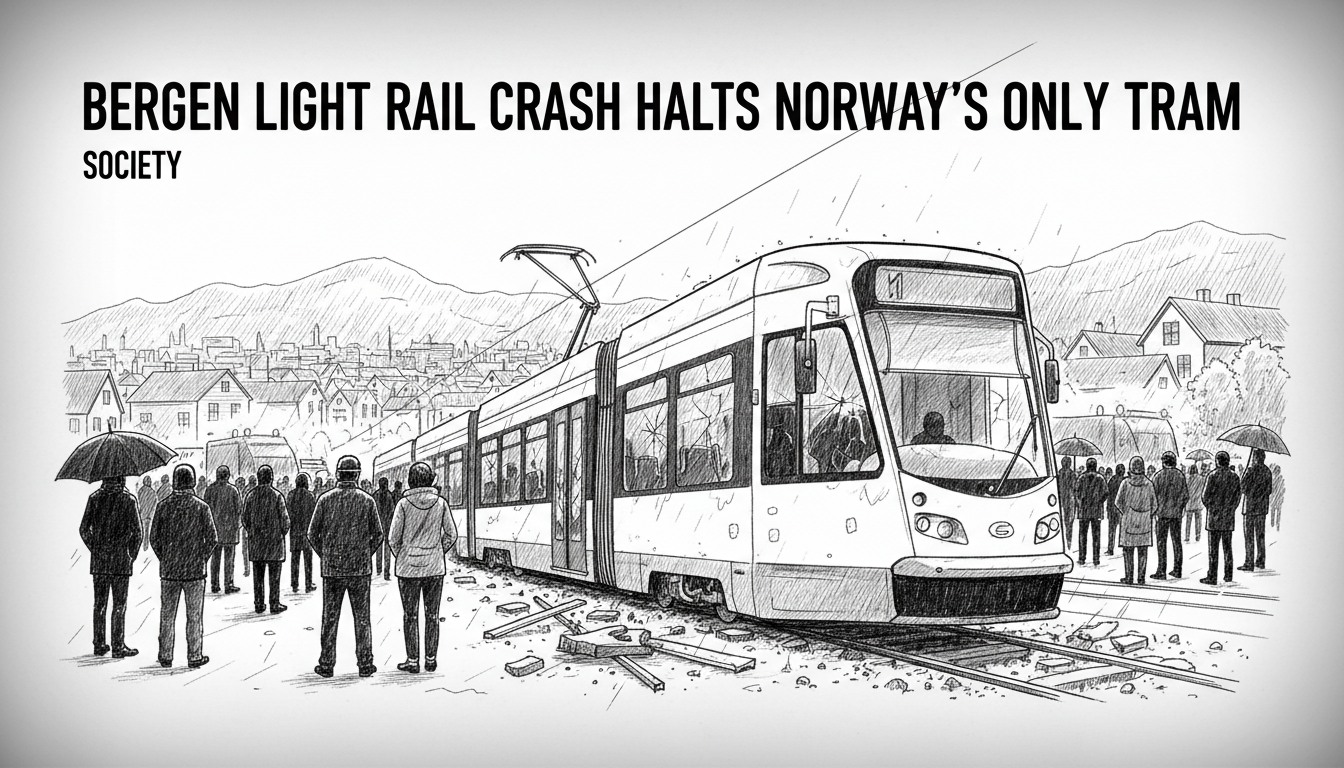
Norway's sole light rail system ground to a halt after a tram and a car collided in Bergen, disrupting the busy airport line for thousands of commuters. The accident occurred on Line 1 of the Bergen Light Rail, known locally as Bybanen, which connects Bergen Airport Flesland to the city center. Emergency services, including police and fire crews, responded to the scene. Officials confirmed no personal injuries resulted from the crash, describing the damage as solely material.
A witness described significant damage to the car involved. "The car is well smashed on the side where it was hit by the tram," the observer said. The fire service reported only minor material damage to the light rail vehicle itself. Operator Skyss announced a full suspension of service on the affected line immediately following the incident, as crews worked to clear the car from the tracks.
Immediate Aftermath and Service Disruption
The full stop on Line 1 represents a major disruption to Bergen's public transport network. This line is the busiest artery of the Bybanen system, which has transported over 150 million passengers since its inaugural run in 2010. Skyss, the public transport authority for Vestland county, manages the system with operations contracted to Keolis Norge. The suspension between the airport and downtown created immediate challenges for travelers and daily commuters, forcing reliance on alternative bus services or private vehicles.
Such incidents, while often resulting in only property damage, highlight persistent vulnerabilities where light rail tracks intersect with road traffic. The Bergen system largely runs on dedicated rights-of-way, but intersections with automobile traffic exist, creating potential conflict points. The swift removal of the vehicle from the tracks, completed by evening, was the first step in restoring service, but safety inspections and protocols would dictate the timeline for resumption.
A System at the Heart of Urban Mobility
The Bergen Light Rail is not just another transit option; it is the only light rail network in Norway, making its reliable operation a point of national interest in sustainable urban planning. Its expansion is central to Bergen's strategy to reduce city center congestion and carbon emissions. Line 1, stretching from the airport to the city's core, is particularly critical as it serves as a first and last impression for many visitors to Norway's second-largest city.
"Any prolonged stoppage on the airport line has ripple effects on the city's functionality and reputation," says transportation analyst Lars Johansen, who has studied Nordic transit systems. "It underscores the high reliability we expect from fixed-rail transit and the disproportionate impact when that reliability is broken, even for a few hours." The system's success has fueled debates about building similar networks in other Norwegian cities like Stavanger or Trondheim, making its safety record a closely watched metric.
The Persistent Challenge of Shared Corridors
This collision brings into sharp focus the ongoing challenge of integrating light rail into existing urban street grids. Unlike metro systems that operate entirely in tunnels or on elevated tracks, light rail often shares space with pedestrians and road vehicles at grade level. Experts point to a combination of engineering and behavioral measures to prevent accidents. These include clear signage, traffic signal coordination specifically for trams, physical deterrents like raised curbs in sensitive areas, and continuous public awareness campaigns directed at drivers and cyclists.
"The physics are simple: a tram always wins in a collision with a car," notes safety engineer Maria Falk. "The goal is absolute prevention through design and education. Every crossing is a point of risk that must be engineered to minimize human error. Drivers must internalize that tram tracks are not just another lane of traffic." In the wake of this incident, scrutiny will likely fall on the specific intersection where the crash occurred, examining sight lines, signal timing, and any previous near-miss reports.
Broader Implications for Norwegian Transport Policy
For Norwegian authorities, investing in public transit is a key pillar of climate and urban policy. A disruption like this tests public confidence in the transition away from private car dependency. The national government, through the Ministry of Transport, provides significant funding for local transit projects, expecting robust safety and performance in return. Incidents that cause system-wide stoppages can influence political and budgetary discussions, potentially accelerating investments in separated corridors or advanced warning systems.
The incident also serves as a real-world test for the crisis response protocols of Skyss and Keolis Norge. The effectiveness of their communication with stranded passengers, the speed of implementing bus replacement services, and the transparency around the investigation's findings will all be assessed. In an era where real-time travel apps are standard, managing information flow during a crisis is as important as managing the physical infrastructure.
Looking Forward: Safety and Reliability
As service on Line 1 resumes, the investigation by police and transport authorities will seek a definitive cause. Was it a case of a driver misjudging the tram's path or speed? Were there any external factors like weather or road conditions? The answers will inform potential safety upgrades. The Bergen Light Rail has been a success story for Norwegian public transport, but its continued growth and public support depend on an unwavering commitment to safety and punctuality.
This event is a stark reminder that even the most modern transit systems exist in a complex urban environment. For Bergen, a city navigating growth while preserving its character, the smooth operation of the Bybanen is essential. The swift resolution of this crash, with no injuries, is fortunate. It provides an opportunity to reinforce safety protocols and ensure Norway's pioneering light rail system remains a model, not a cautionary tale. The true test will be in applying the lessons learned from this material damage incident to prevent one with more serious consequences in the future.