
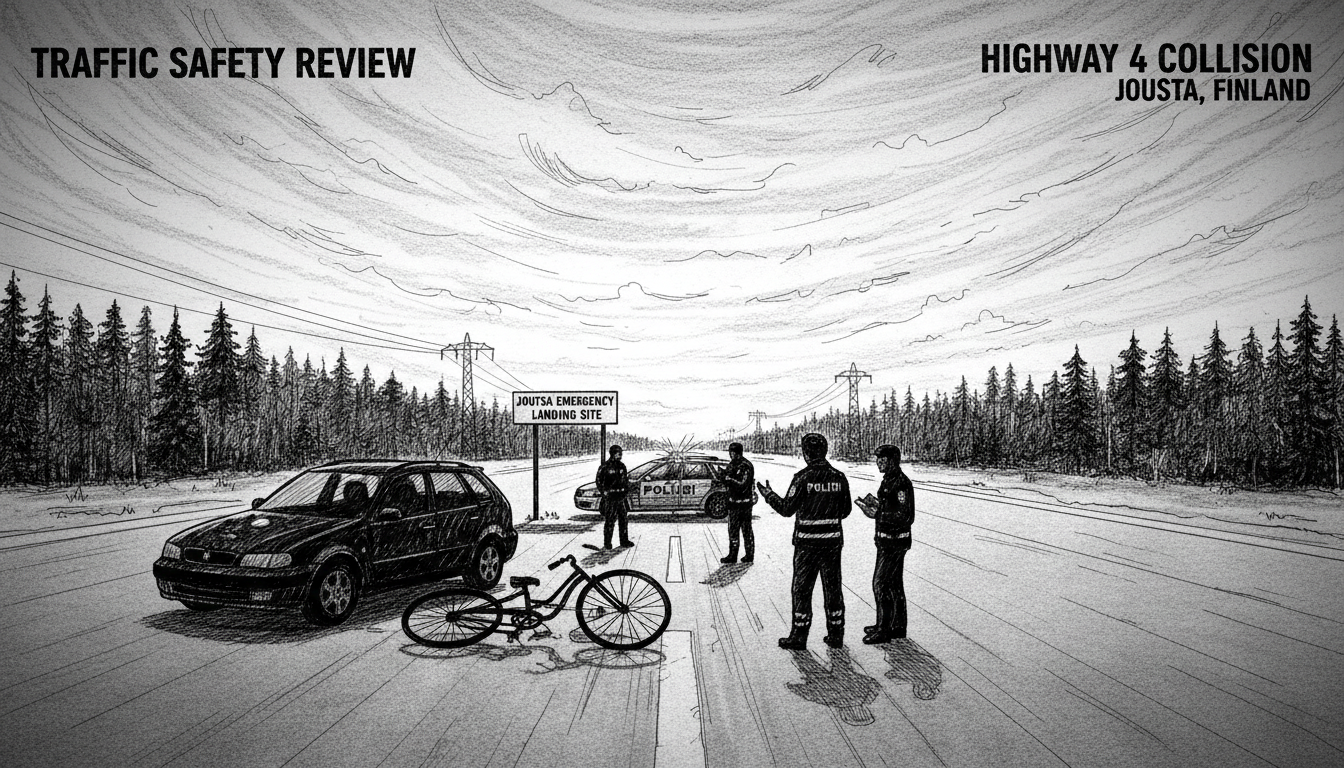
A serious traffic accident involving a cyclist and a motorist occurred on Tuesday evening at the Joutsa emergency landing site in Central Finland. The incident took place on the northbound lanes of Highway 4, near the Heinola side of the landing strip, shortly after 9:15 PM. Police Commissioner Petteri Kuorikoski, leading the preliminary investigation, confirmed the collision but did not disclose the exact number of individuals or vehicles involved. Emergency services, including units from the Central Finland Rescue Department, remained on the scene past 11:00 PM as the investigation commenced. The immediate transfer of communications responsibility to the police indicates a standard procedural shift for traffic incidents of this nature.
This accident spotlights ongoing concerns about shared road infrastructure in Finland, particularly on stretches of highway that intersect with recreational or alternative transport areas. The Joutsa varalaskupaikka, or emergency landing site, is a designated area along Highway 4 where aircraft can make emergency landings. These sites, while critical for aviation safety, often create unique traffic environments where high-speed motorways interface with other forms of local access. The incident raises immediate questions about signage, lane separation, and visibility for vulnerable road users like cyclists on major transit corridors. Finnish road safety statistics consistently show that collisions between motor vehicles and cyclists, especially in rural or high-speed zones, often result in severe outcomes, prompting rigorous post-accident analysis.
From a policy perspective, this event will likely feed into broader discussions within the Finnish Ministry of Transport and Communications. Finland has ambitious road safety targets, part of its Vision Zero strategy aiming to eliminate traffic fatalities and serious injuries. Every incident is meticulously investigated not just for fault, but for systemic improvements to infrastructure and regulation. The location of this crash is particularly noteworthy for transport planners. Highway 4 is a major national road connecting Helsinki to northern Finland, and its safety record is a constant focus. Any serious accident triggers a review of that specific section's design, potentially influencing future investment decisions from the government's transport infrastructure budget.
For international readers and residents in Finland, this underscores the importance of heightened awareness on Finnish roads, especially during the evening hours and in transitional seasons. While Finland boasts an excellent overall safety record, long, dark winters and rapidly changing conditions in spring and autumn present challenges. The direct, factual reporting from authorities, as seen here, is typical of the Finnish approach to crisis communication—focused on process and investigation rather than speculation. The next steps will involve a technical examination of the scene, witness interviews, and a determination of contributing factors. The findings could lead to recommendations for temporary or permanent changes to the traffic layout at the Joutsa landing site, demonstrating how single events can catalyze wider safety enhancements.