
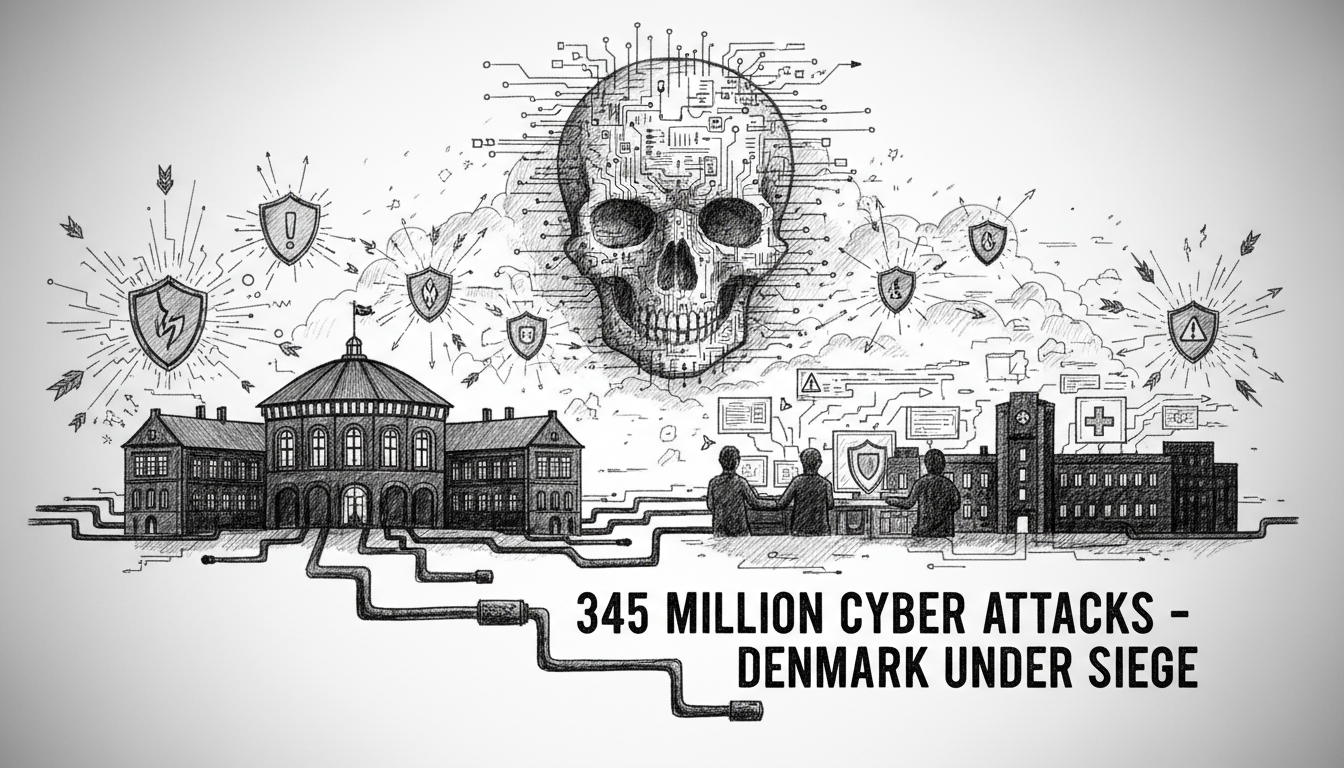
Danish public institutions are under sustained digital assault. New data reveals a staggering 345 million blocked cyber attack attempts against hospitals and municipalities in the eastern Jutland region in a single month. This intense pressure reflects a broader campaign to destabilize Western societies, according to security experts.
Region Midtjylland, which operates major hospitals, reported blocking those 345 million malicious contact attempts during November. The region also intercepted approximately 22.5 million emails containing phishing links or malware. Officials declined to comment further on the operational impact.
The threat is not confined to healthcare. Municipalities across eastern Jutland report thousands of attempted fraud and data theft emails, alongside dedicated denial-of-service (DDoS) attacks. Randers Municipality faced a 24-hour DDoS attack targeting its website just before the recent local elections. Communications chief Karen Balling Radmer stated the municipality prepared extensively. "We put on our shield, chainmail, and helmet and were ready to withstand the attack," she said. By increasing server capacity and creating website backups with their IT provider, they limited the impact to slightly slower loading times for visitors.
Aarhus Municipality was targeted by the pro-Russian hacker group NoName057(16) with a DDoS attack ahead of the elections. IT departments are operating under constant strain. Henrik Brix, IT chief for Favrskov Municipality and head of the Danish municipal IT chiefs' association, explained the psychological and operational toll. "It is a burden in itself. Regardless of whether the attack is carried out or not. Because it forces the municipalities to guard themselves all the time," he said. Municipalities receive ongoing intelligence from a shared cybersecurity unit that monitors dark web forums where hacker groups post target lists.
The Danish Agency for Social Security recently updated its national threat assessment, maintaining the cyber threat level at 'very high'. Niels Husted Kjær, CEO of the Alexandra Institute in Aarhus, a certified technological service institute advising on cybersecurity, confirms the reality matches the assessment. "There is a real and very high risk that central IT systems are shut down. It creates busyness in the municipalities' and regions' IT departments with protecting our digital foundation," he stated.
Kjær points to tangible consequences of successful breaches, like an attack on a water utility near Køge last year that left hundreds of citizens without water. He warns that compromised systems could disrupt water, heating, emergency call systems, or critical health data. "Therefore, it is important that we all take the cyber threat seriously," he concluded.
Rasmus Brun Pedersen, a lecturer in international politics at Aarhus University, clarifies the geopolitical motive behind targeting even small Danish municipalities. "It is part of a broader campaign that is about destabilizing and weakening Western societal structures. And then part of it is about showing that the engagement in Ukraine has consequences," he explained. He identifies Russia, China, and North Korea as the most persistent actors seeking to undermine Western cohesion. "They want to shift opinions, make us less critically thinking, and fundamentally disrupt and destroy so much that our ability to recover becomes worse," Pedersen said.
The scale of these attacks represents a direct operational cost and a strategic challenge to Denmark's digital infrastructure. It forces continuous investment in cybersecurity defenses across the public sector, diverting resources from other services. For international businesses in the Øresund region, this underscores the critical need for robust digital security protocols, as the same threat actors targeting public services also frequently target private sector intellectual property and financial data. The situation highlights Denmark's position on the frontline of a hybrid conflict, where economic stability and public trust are directly linked to cybersecurity resilience.