
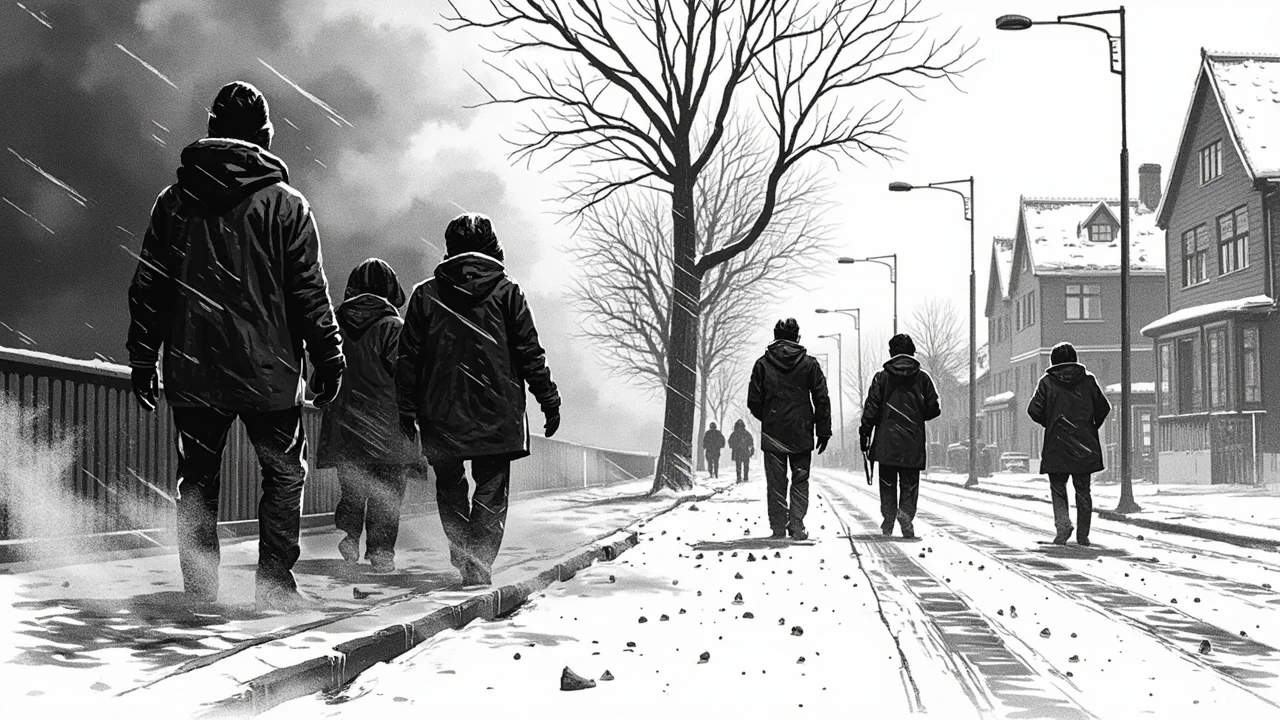
Denmark's police are warning drivers that a core winter safety measure is becoming ineffective. As a severe cold snap grips Northern Jutland, road salt loses its ability to melt ice when temperatures plunge below minus seven to ten degrees Celsius. This chemical limitation creates a hidden hazard on Danish roads, transforming treated surfaces into potential skating rinks overnight.
Vice Police Inspector Søren Pejtersen from North Jutland Police stressed the seriousness of the situation in a public statement. He urged heightened public awareness as the forecast predicts dangerously low temperatures for the next 48 hours. "Now the temperature is falling further, and that will change the conditions on the roads," Pejtersen said. "We hope we can still avoid serious accidents. Therefore, we urge people to stay informed about the weather and traffic situation, to be extra attentive, and to drive according to the conditions." His warning specifically highlights the risk of black ice and meltwater refreezing locally.
The Chemistry of Cold
This warning is not based on speculation but on fundamental chemistry. Road salt, typically sodium chloride, works by lowering the freezing point of water. It creates a brine solution that prevents ice from forming or helps melt existing ice. This process is highly temperature-dependent. As the mercury drops toward minus ten degrees Celsius, the salt's melting capacity slows dramatically and can stop completely. At these extremes, the salt granules simply sit on the ice, providing minimal grit for traction but failing to perform their primary melting function. This leaves municipalities and drivers in a precarious position, relying on a tool that no longer works as intended.
Beyond Salt: Municipal Strategies
Danish municipalities, responsible for road maintenance, now face a significant logistical challenge. Their standard winter playbook is compromised. In Copenhagen and across the country, road crews typically deploy salt spreaders preemptively ahead of snowfall or freezing rain. With salt rendered less effective, authorities must shift tactics. This often means increasing the use of mechanical methods like plowing and sanding. Sand provides crucial tire grip but does not remove ice. It also creates a substantial cleanup issue in the spring, washing into drains and requiring street sweeping. The financial cost is also higher, involving more machine hours and different materials.
A Social Contract on Slippery Roads
The police warning touches on a fundamental aspect of Danish society: collective responsibility within the welfare system. Denmark's social contract relies on clear communication from authorities and prudent behavior from citizens. The police are fulfilling their role by providing a specific, science-based warning. The onus now shifts to individual drivers, cyclists, and pedestrians. Driving "according to the conditions" may mean reducing speed far below the posted limit, increasing following distances to five or ten seconds, and avoiding non-essential travel. For a society with high car ownership and dependency, this disruption has a tangible impact on daily work commutes, school runs, and commercial transport.
Expert Analysis: A System Under Stress
While not a crisis, this situation reveals a vulnerability in Denmark's infrastructure planning. "We design our systems for predictable ranges," notes a civil engineering expert familiar with Nordic road maintenance. "Climate patterns are introducing more frequent extremes that test those design limits." This cold snap questions whether historical data on winter lows is still sufficient for future planning. Some Scandinavian neighbors, like parts of Sweden and Norway, routinely deal with colder temperatures. Their strategies involve different chemical mixes, including calcium chloride or magnesium chloride, which are effective at lower temperatures but are more corrosive to vehicles and infrastructure and have a greater environmental impact. Denmark's milder coastal climate has rarely justified that trade-off, but that calculation may be changing.
Furthermore, this event highlights the interconnectedness of Danish social policy and everyday life. Efficient transportation is the lifeblood of the economy and social cohesion. Disruptions caused by weather expose the fine balance of the system. It affects everyone from the truck driver making deliveries to the nurse commuting to a hospital shift. The police warning is ultimately a call for personal risk assessment, a temporary individualization of a usually collective safety solution.
The Human Impact of Invisible Ice
The greatest danger, emphasized by police, is black ice. This is ice that forms in a thin, transparent layer on the asphalt, making it nearly invisible to drivers. It often forms at night or in the early morning on bridges, shaded areas, and roads where meltwater has refrozen. A road that looks merely wet could be coated in a sheet of ice. This phenomenon is particularly treacherous because it violates driver expectations, especially on roads that appear treated. The psychological comfort of seeing salt granules can be dangerously misleading when the chemical reaction has stalled.
Looking Ahead: Adaptation and Awareness
For now, the solution rests on caution. Danish authorities are unlikely to change their salt-based strategy for a temporary cold spell. The environmental and economic costs of alternative chemicals are significant. The more sustainable and immediate adaptation is behavioral. This involves checking detailed weather and road condition reports before travel, ensuring winter tires are adequately rated for severe cold, and allowing for substantial extra travel time. For pedestrians and cyclists, the advice is to wear appropriate footwear with grip and to be mindful of untreated sidewalks and bike paths, which pose a significant slip-and-fall risk.
The North Jutland Police warning is a stark reminder that even in a highly organized society, nature imposes its own rules. Denmark's generally effective welfare and infrastructure systems meet a hard, physical limit defined by molecular chemistry. As the country endures this cold snap, the social response becomes a quiet test of collective responsibility. Will drivers heed the specific advice to slow down? The effectiveness of the warning will be measured not in degrees Celsius, but in the absence of collisions on Denmark's suddenly more perilous roads. How will this repeated stress from extreme weather inform long-term municipal planning and our shared expectations of safety?