
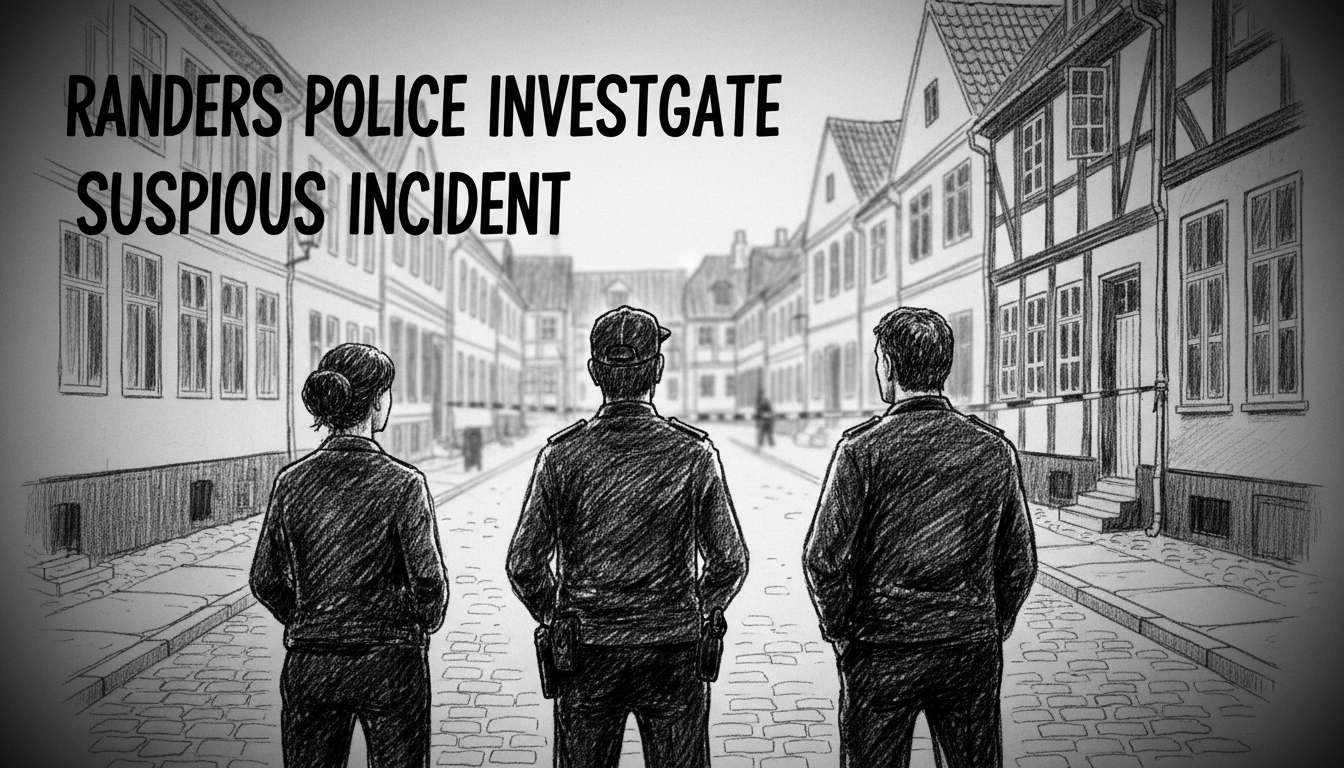
Denmark police are investigating a suspicious incident in the Vorup district of Randers, the country's sixth-largest city. Østjyllands Politi confirmed its presence at Skovlund on Monday afternoon, establishing a cordon and urging the public to avoid the area. The scene included multiple unmarked police cars, ambulances, and fire trucks, with a nearby railway bridge also sealed off. Authorities have declined to provide further details about the nature of the 'mistænkeligt forhold,' a standard Danish police term for situations requiring investigation without immediate public classification.
A Community on Edge
Residents in Vorup reported a sudden and significant police presence that disrupted the quiet Monday afternoon. The sight of emergency vehicles converging on Skovlund, a local area, sparked immediate concern and speculation within the community. Police used social media platform X to issue a brief statement, a common tactic for controlling the narrative during unfolding events. Their request for the public to respect the cordon underscores a standard procedure to preserve evidence and ensure operational security. For locals, the ambiguity is the most challenging part, living in the gap between observing activity and receiving official explanation.
This incident occurs within the broader context of Danish policing, where transparency often battles operational secrecy. The East Jutland Police force, responsible for Randers, manages a wide range of cases across urban and rural areas. A 'mistænkeligt forhold' can be a precursor to various announcements, from the discovery of hazardous materials to the opening of a serious crime investigation. The deployment of both ambulances and fire trucks suggests a response scenario that considered potential rescue or hazardous conditions, not just law enforcement.
The Mechanics of a Police Response
When Danish police declare they are examining a suspicious circumstance, it triggers a coordinated protocol. The immediate priority is to secure the perimeter, a step clearly taken with the cordon at Skovlund. This prevents contamination of a potential crime scene and protects the public from any unseen danger. The presence of forensic specialists is often implied but not visible in initial reports. Investigators will methodically process the scene, a process that can take hours or even days depending on complexity.
Communication strategy is a critical, calculated component. Police spokespersons weigh the public's right to know against the risks of compromising an investigation or causing undue alarm. In this case, the decision to withhold details indicates investigators believe premature information could be detrimental. This often frustrates citizens and media but is a standard practice rooted in procedural caution. The police rely on controlled updates, usually through scheduled press briefings or written statements, once they have a firm grasp of the facts.
Local journalists play a key role as intermediaries, observing the scale of the response—such as the number of vehicles—which offers clues to professionals. The involvement of the fire brigade and emergency medical services points to a call initially categorized as a potential accident or public hazard. This multi-agency response is typical for situations where the exact nature of the threat is unclear upon arrival. The system is designed to over-resource initially, scaling down as the situation becomes defined.
Randers in the National Context
Randers, with a population just over 60,000, is a major East Jutland hub with a mix of industry and commerce. Like many Danish cities, it experiences a low overall crime rate but is not immune to serious incidents. Vorup, southwest of the city center, is a residential district. Police activity there draws significant attention precisely because such events are relatively uncommon in Denmark's generally safe communities. Each incident tests the social contract of trust and security that underpins Danish society.
National crime statistics provide a backdrop. Denmark's clearance rate for violent crimes is high by international standards, often exceeding 70%. This success is built on thorough initial response protocols, exactly like those being applied in Randers. The system emphasizes evidence preservation and systematic inquiry over rapid public reassurance. Citizens, while anxious, largely understand this trade-off, accepting short-term uncertainty for long-term investigative integrity. Community cooperation, like staying behind police lines, is a expected social responsibility.
The Human Impact of Uncertainty
For the residents living near Skovlund, the afternoon's events translate into personal disruption and worry. The police cordon transforms a familiar space into a place of mystery and potential danger. Neighbors exchange fragmented information, while local social media groups buzz with unconfirmed theories. This period of limbo—knowing something is wrong but not knowing what—is a shared psychological experience in communities facing unexplained police operations. The welfare state's promise of security feels momentarily paused.
This incident, though currently undefined, touches on the core of the Danish social contract. Danes pay high taxes for a comprehensive safety net that includes efficient policing and emergency services. In return, they expect transparency and competence. A large-scale response with no immediate explanation creates a tension between that expectation and the realities of law enforcement. People trust the system to work, but that trust is maintained through eventual, clear communication. The coming hours, when police choose to release more information, will be crucial for maintaining that community trust.
Awaiting Answers in a Digital Age
The investigation in Vorup unfolds in an era where information vacuums are quickly filled online. Police use official channels like X to assert control, but their sparse messaging can accelerate speculation elsewhere. This places a premium on responsible local reporting that stresses the importance of official updates. Experts in crisis communication often advise authorities to provide a timeline for the next update, even if the content is unknown, to manage public expectation and reduce speculative anxiety.
Danish police have become adept at this balancing act. Their statements are typically factual, calm, and devoid of sensationalism, aiming to de-escalate public concern rather than fuel it. The term 'mistænkeligt forhold' itself is a masterclass in non-alarmist description. It signals professional concern without invoking specific fears of violence, terrorism, or major crime. This linguistic caution is intentional, designed to allow investigators space to work without triggering a media frenzy based on incomplete data.
As night falls in Randers, the cordon may remain. Forensic teams might work under portable lights, methodically searching for answers. The community will wait, relying on the quiet efficiency of its institutions. The true measure of this event will come not in the initial response, but in the clarity and truth of the conclusion police eventually provide. In Denmark, public confidence hinges on the belief that the system, though sometimes opaque in the moment, ultimately operates with integrity and in the service of justice. The people of Vorup are now counting on that.