
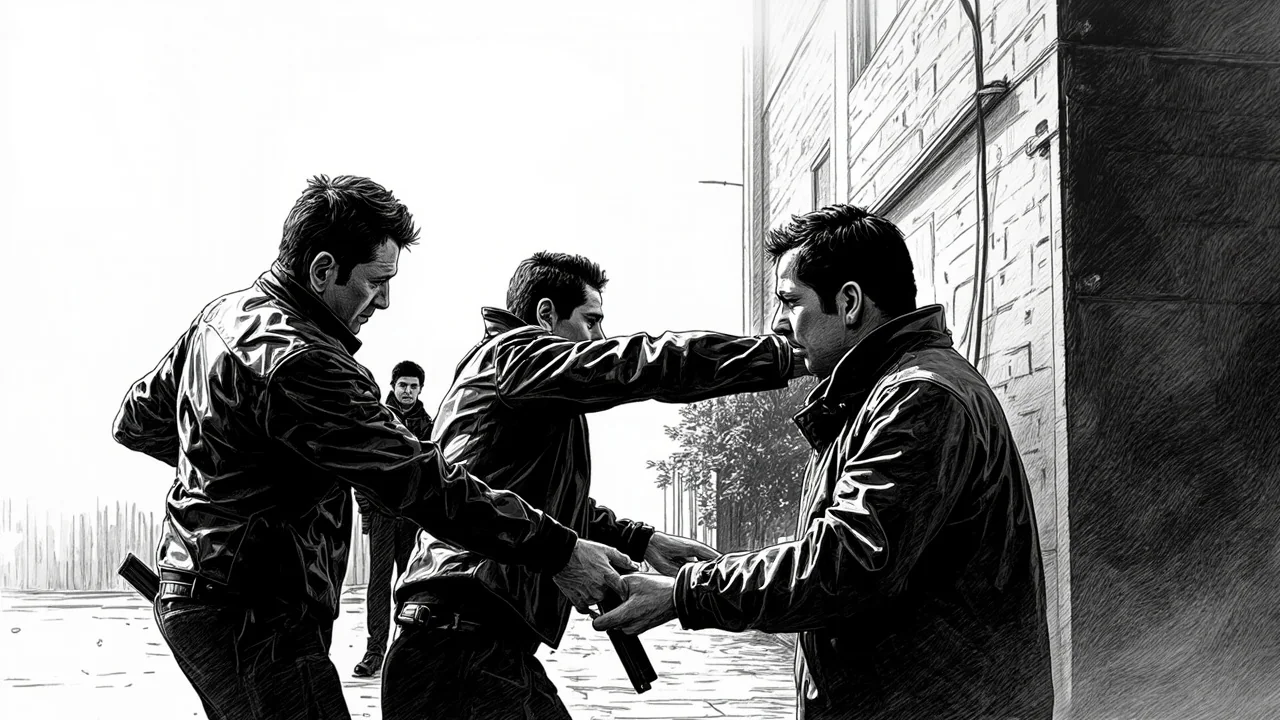
Danish police used stun guns to arrest three individuals armed with a water hose and a martial arts club in a late-night confrontation near Vordingborg, highlighting a tense dispute that escalated into criminal charges. The incident occurred late Thursday when officers from South Zealand and Lolland-Falster Police responded to a report of threatening behavior at a residence outside Vordingborg. According to the police daily report, the three suspects—a 32-year-old woman, a 35-year-old woman, and a 36-year-old man—arrived at the address unwanted and threatening, leading to their apprehension with non-lethal force. This event underscores the unpredictable nature of local conflicts in Danish municipalities, where even mundane objects can become weapons in heated altercations.
A Detailed Look at the Confrontation
The police report indicates that the dispute stemmed from an apparent disagreement with the resident, a 40-year-old man, which prompted the three individuals to visit his property with hostile intent. The 36-year-old man was carrying a totenschlæger, a type of rigid club often associated with martial arts or self-defense, while the 32-year-old woman wielded a vandhane, or water hose, which can be used as an improvised weapon for intimidation or assault. Additionally, pepper spray was found in her vehicle, adding to the severity of the situation. Upon arrival, police deemed the suspects' behavior sufficiently dangerous to justify the use of strømpistoler, or stun guns, to safely subdue and arrest them without further violence. This response aligns with standard Danish police protocols for de-escalating armed threats, especially in rural areas where resources might be limited compared to urban centers like Copenhagen.
Legal Charges and Immediate Aftermath
All three individuals were charged with threats under Danish law, a serious offense that can carry penalties including fines or imprisonment depending on the context and severity. The 32-year-old woman and 36-year-old man faced additional charges for violating the våbenloven, or Weapons Act, due to their possession of the totenschlæger and the pepper spray, which are regulated items in Denmark. The water hose, while not typically classified as a weapon, was considered part of the threatening conduct in this specific incident. After being taken into custody, the suspects were questioned by police and subsequently released, a common practice in Denmark for less severe cases while investigations continue. Their release does not imply innocence but reflects the procedural steps in the Danish legal system, where charges are formalized before potential court proceedings.
Context Within Danish Society and Policy
As a reporter focused on integration and social policy, I see this incident as a microcosm of broader issues in Danish society, where personal disputes can quickly intersect with public safety concerns. Vordingborg, a municipality in South Zealand, is part of Denmark's welfare system that emphasizes community harmony and crime prevention through social centers and local policing. However, such events reveal gaps where conflicts escalate beyond verbal arguments into physical threats, challenging the notion of Denmark as a uniformly peaceful society. While this case does not directly involve immigration or integration themes, it touches on the social fabric of rural communities, where tensions among residents can arise from various factors, including economic stress or interpersonal relationships. Danish social policy often aims to address root causes through mediation services, but immediate police intervention remains crucial for de-escalation.