
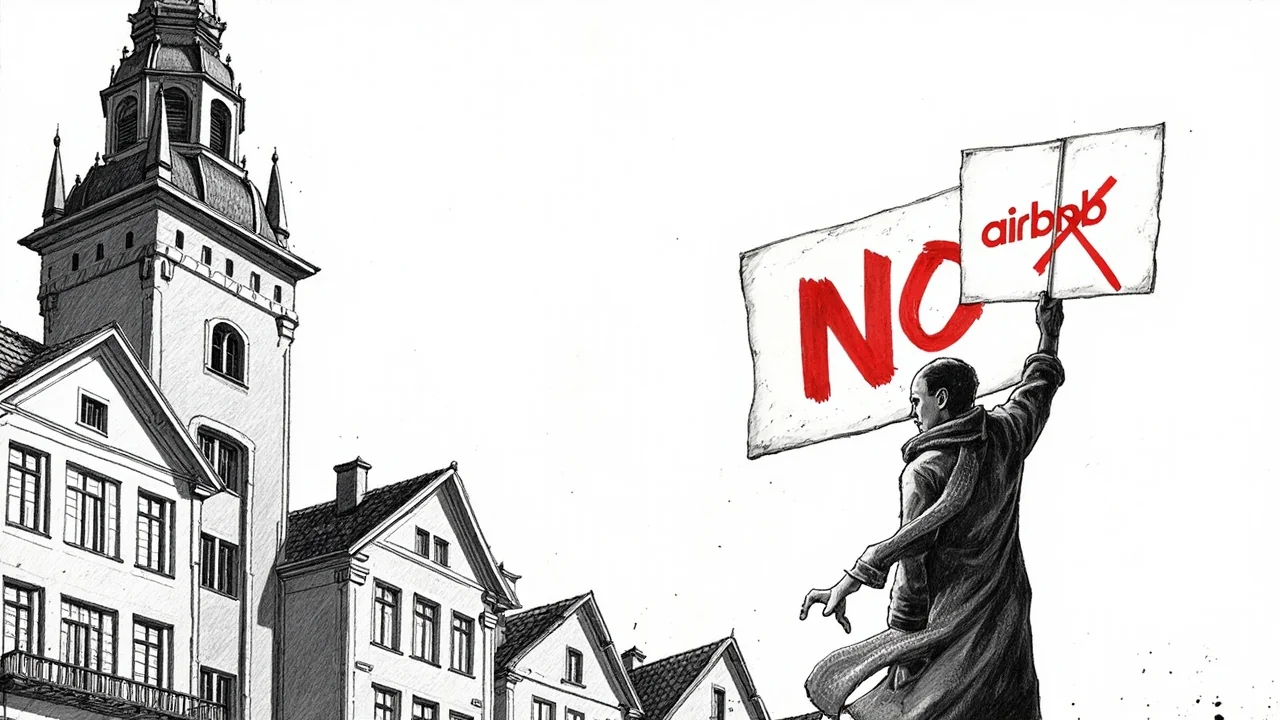
Denmark's government is unleashing a significant financial crackdown on illegal short-term rentals, introducing fines from 5,000 to 100,000 kroner in a sweeping new political agreement aimed squarely at 'shadow hotels.' The rules, backed by a large parliamentary majority, empower authorities to block bookings and force platforms like Airbnb and Booking.com to hand over user data, directly impacting property markets in Copenhagen and major cities where housing shortages are acute.
A Landlord's Dilemma Under New Scrutiny
For a Copenhagen property owner, the calculation just changed dramatically. Previously, renting out a full-year home for more than the permitted 70 days (or 100 days in some municipalities) carried limited direct financial risk. Under the new framework, exceeding the limit by just a few days triggers an immediate 5,000 kroner fine. The penalty scales sharply upwards, reaching a maximum of 100,000 kroner for severe violations where properties operate essentially as unlicensed hotels. This graduated fine system is designed to deter the professionalization of illegal rentals, a practice that has removed thousands of homes from the long-term rental market in the capital. "The sharing economy is fantastic, but of course everyone must follow the rules," said Minister for Cities and Rural Districts Morten Dahlin (V). "It is not acceptable that homes are used for illegal hotel operations, and therefore I am happy that we can gather such a broad political majority behind us to crack down harder on those who cheat and circumvent the rules."
Broad Political Consensus For Tighter Control
The agreement represents one of the widest political alignments seen on a regulatory issue in recent sessions. Joining the government are Danmarksdemokraterne, SF, Liberal Alliance, The Conservatives, The Red-Green Alliance (Enhedslisten), The Danish People's Party, The Social Liberals (Radikale Venstre), and The Alternative. This broad backing underscores the issue's political urgency, transcending traditional left-right divides. The consensus signals a firm intent to enforce existing housing laws more robustly, shifting the burden of compliance and monitoring. Crucially, the deal provides municipalities with the option to take over the supervisory role from the national Plan- og Landdistriktsstyrelsen (Planning and Rural District Authority), allowing for more localized and potentially faster enforcement actions tailored to specific urban housing crises.
New Enforcement Teeth: Targeting Platforms Directly
A pivotal shift in the new regulations is the direct leverage gained over global rental platforms. Authorities can now order companies like Airbnb to disclose "relevant information" in specific cases and can mandate them to block future bookings or remove listings that violate Danish law. This move closes a significant enforcement gap, where previously, regulators could target individual property owners but had limited tools to compel cooperation from the international platforms facilitating the transactions. This platform-level accountability is expected to streamline investigations and create a powerful compliance incentive for the platforms themselves, who now face operational disruption orders if they host illegal rentals. The mechanism mirrors growing regulatory approaches in other major European cities grappling with similar tourism-housing tensions.
Economic and Housing Market Context in Copenhagen
This crackdown cannot be separated from Copenhagen's intense housing market pressure. City officials and housing advocates have long described a "massive abuse" of short-term rental rules, with apartments in desirable districts like Vesterbro, Nørrebro, and the Inner City being leased to tourists for far more than the legal number of days. This practice converts permanent housing stock into transient accommodation, exacerbating scarcity and driving up long-term rental prices. While tourism brings economic benefits, the unchecked growth of illegal short-term rentals creates a net drain on the city's residential community and strains local services. The new fines and enforcement tools aim to rebalance this equation, making it financially untenable to systematically flout the 70-day rule and pushing those properties back into the year-round rental pool.
The Road Ahead for Denmark's Sharing Economy
The broad political mandate sends an unmistakable signal: Denmark's tolerance for the gray area of short-term rentals has ended. The agreement legitimizes the sharing economy model within strictly defined legal boundaries, seeking to protect it from being undermined by its own worst offenders. For legitimate users who occasionally rent out their home, the rules remain clear and largely unchanged. For commercial operators leveraging residential properties for full-time tourism, the business model now carries substantial financial and operational risk. The coming months will test the new system's teeth. Will the sight of high-profile fines and de-listed properties create a genuine deterrent, or will operators simply find new ways to hide their activity? The answer will determine whether this policy preserves housing in Copenhagen's central neighborhoods or becomes another well-intentioned law with limited real-world impact. The government and its unusual coalition of partners are betting that money talks, and that fines up to 100,000 kroner will speak loudly enough to be heard over the noise of the tourist trade.