
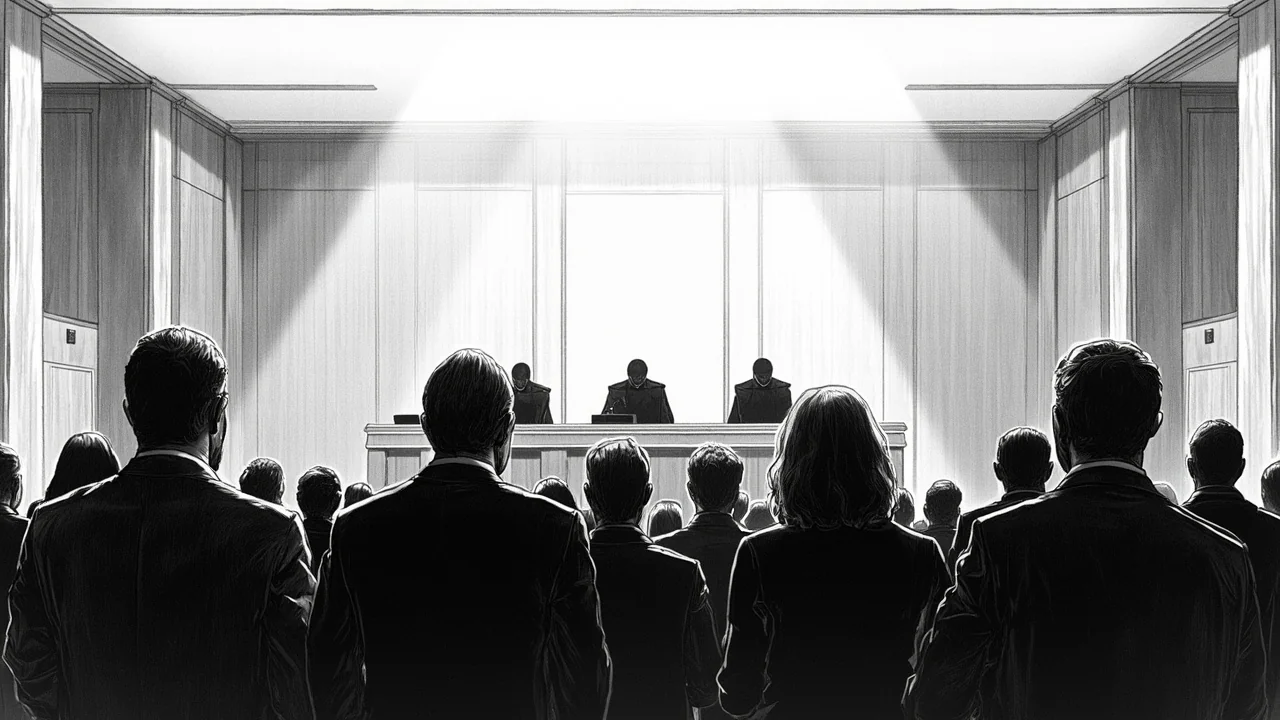
Denmark's Supreme Court convenes Thursday for a landmark case pitting the nation's racism law against its foundational freedom of speech. The case centers on one man convicted for telling racist jokes, testing the legal boundary between criminal hate speech and protected expression. This hearing represents the final appeal after a series of rulings that narrowed the charges from an initial 129 jokes down to 50.
A Decades-Old Law Meets Modern Speech
The contested law, Paragraph 266 b of the Penal Code, originated in 1939. Its creation was a direct response to the persecution of Jews and others in Nazi Germany. Danish lawmakers intended it to protect specific groups from threats, mockery, or degradation. The text makes it illegal to publicly make statements that threaten, scorn, or degrade a group based on race, skin color, national or ethnic origin, faith, disability, or sexual orientation. For over eight decades, this statute has served as Denmark's primary legal tool against hate speech, long predating the country's current debates on integration and diversity. Its historical weight adds complexity to the current case, forcing the court to interpret a pre-war law in a digital age where statements can spread globally in seconds.
The Long Path Through the Courts
The defendant's legal journey began at the Holstebro Court, which found him guilty on April 3, 2024, for 129 separate jokes. The court determined these statements publicly degraded groups based on their ethnic origin. The case then moved to the Western High Court, which issued its ruling on February 24, 2025. The appellate judges conducted a meticulous review, evaluating each joke against the stringent criteria of Paragraph 266 b. Their analysis resulted in a significant reduction of the charges, upholding guilt for 50 jokes but dismissing the allegations for the remaining 79. This reduction itself highlights the challenging, case-by-case assessment required by such laws. The High Court's decision to convict on 50 counts signals that a substantial core of the material was deemed to have crossed the legal line from crude humor into criminal degradation.
The Free Speech Counter-Argument
The defense's appeal to the Supreme Court hinges on Article 10 of the European Convention on Human Rights, which Denmark is bound to uphold. This article guarantees freedom of expression as a fundamental pillar of a democratic society. Crucially, it states that any interference with this right by public authority must be prescribed by law and necessary in a democratic society. The defense will argue that the convictions represent a disproportionate interference with free speech. They contend that the jokes, however offensive, did not reach the high threshold of severity required to justify criminal punishment under the Convention. The Supreme Court must balance the state's legitimate interest in protecting minorities from hateful rhetoric against the individual's right to express offensive or shocking ideas. This balancing act is at the heart of democratic tensions across Europe.
Implications for Danish Society and Law
The Supreme Court's ruling will set a critical precedent for how Denmark navigates the clash between social cohesion and individual liberty. A ruling upholding the convictions will reinforce the power of Paragraph 266 b and signal the judiciary's stance on the limits of acceptable public discourse. It would affirm that the state can criminalize expressions deemed to degrade protected groups, even in the guise of humor. Conversely, a ruling overturning the convictions would dramatically narrow the scope of the racism paragraph, strengthening free speech protections even for patently offensive content. It would raise the bar for prosecutors, requiring them to demonstrate an immediate threat or incitement to violence, rather than just humiliation or scorn. Legal scholars note the decision will provide much-needed clarity for publishers, social media users, and comedians alike, defining where the red line is drawn in Danish public life.
Beyond the Courtroom: A Social Reckoning
While the judges deliberate on legal texts, the case has ignited a broader conversation within Danish society about tolerance, integration, and the price of free speech. Community advocates argue that laws like Paragraph 266 b are essential safeguards for minority groups, providing a legal recourse against harassment that can poison social trust and hinder integration efforts. They point out that verbal degradation can create a climate of fear and exclusion, counter to the values of the Danish welfare system which relies on a sense of common responsibility. Free speech absolutists, meanwhile, warn against empowering the state to police language and thought, arguing that societal disapproval, not criminal law, should be the remedy for odious opinions. They fear a chilling effect where people self-censor for fear of legal repercussions. This case forces Denmark to answer a difficult question: Can a society committed to both free speech and social solidarity find a stable balance, or must one principle ultimately give way to the other? The Supreme Court's interpretation of a law from 1939 will provide a pivotal answer for the Denmark of today.