
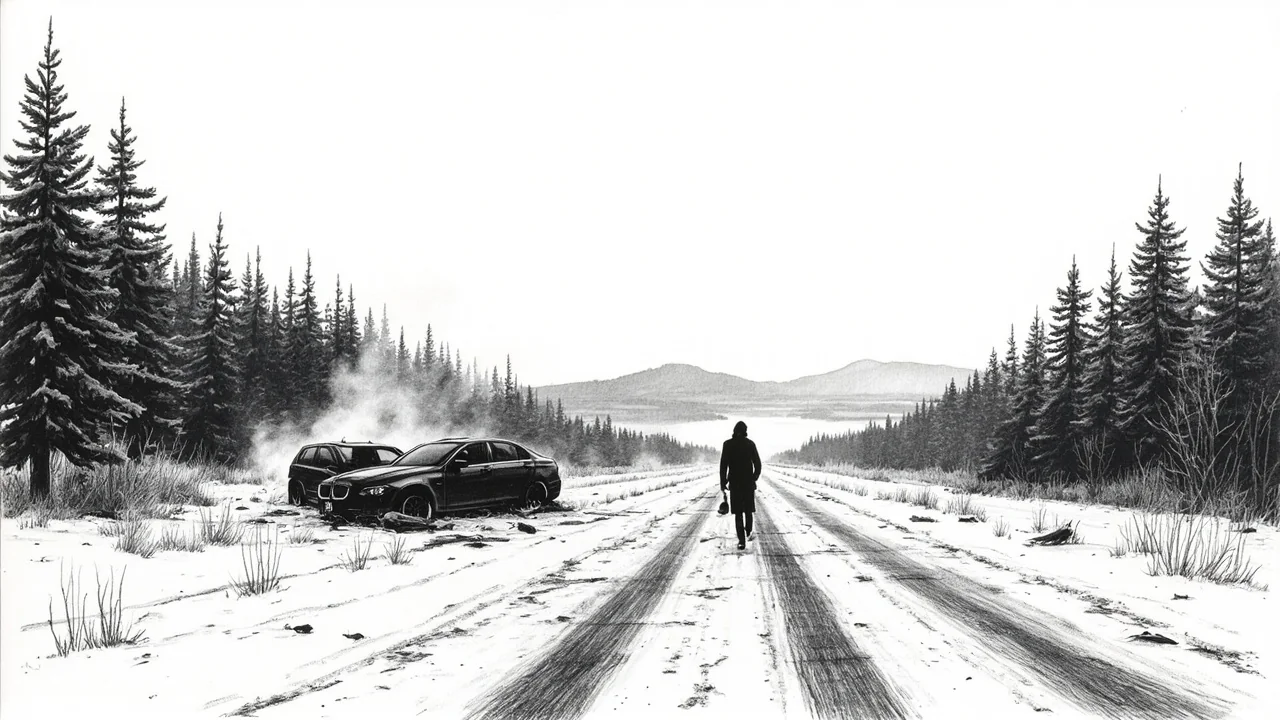
Denmark's Midtjyske Motorway became the scene of a critical accident early Tuesday morning, leaving a 25-year-old man fighting for his life. The crash occurred at 5:29 AM near Herning, where the driver's vehicle hit a guardrail before being struck by another car, ejecting him from his vehicle. He was transported to Aarhus University Hospital in Skejby in critical condition, with his next of kin notified by authorities. The incident highlights the severe dangers of winter driving conditions currently gripping the country.
Vagtchef Thomas Hald of Midt- and Vestjyllands Police described a chaotic scene. "The car ended up sideways across the left lane, and a following car drove into the side, and the driver was thrown out of the car," Hald stated. The motorway, a crucial artery in central Jutland, was closed for investigation but has since reopened. Police confirm this was not an isolated event, with multiple other incidents of vehicles skidding off roads reported across the region due to widespread black ice.
A Morning of Slippery Chaos
Tuesday morning presented a perfect storm of hazardous conditions across Jutland. Overnight temperatures dipping below freezing, combined with residual moisture on roadways, created extensive patches of black ice. This invisible threat is particularly dangerous on high-speed routes like the Midtjyske Motorway (M4), where a slight loss of traction can have catastrophic consequences. Police reports from the morning described a relentless series of calls. "Generally, we have an incredible amount of slippery conditions, and we are still getting reports from people who have driven off the road," Hald explained, emphasizing the scale of the problem beyond this single, severe crash.
The sequence of the crash points to the compounded risks of winter motoring. The initial impact with the guardrail likely caused the 25-year-old's vehicle to spin or stop abruptly in the travel lane. On a dark, icy morning, the following driver would have had extremely limited time and traction to react or stop, leading to the devastating secondary collision. The fact that the victim was ejected suggests he may not have been wearing a seatbelt, a detail police have not yet confirmed but which underscores the layered nature of road safety.
The Human Cost Beyond the Statistics
While this incident will become another entry in Denmark's annual traffic accident statistics, its true weight is borne by a young man and his family. A critical condition admission to Aarhus University Hospital, a major trauma center, indicates injuries that are life-threatening. The hospital's specialized teams are now engaged in a fight that extends far from the icy asphalt. The psychological impact on the driver of the second vehicle, the first responders, and the victim's loved ones forms an often-overlooked ripple effect from such sudden tragedies.
In Danish society, where the welfare system and a strong sense of communal safety are paramount, a single severe traffic accident resonates deeply. It challenges the expectation of security provided by well-maintained infrastructure and strict traffic laws. Accidents like this force a confrontation with the limits of systemic protection against the variables of weather and human reaction. The community of Herning and the wider region now hold their breath, awaiting news from Skejby, a reminder of how quickly normal life can fracture.
Winter Realities and Driver Responsibility
This crash arrives during a period of classic Danish winter weather, where temperatures hover around zero, creating recurrent ice. The Danish Road Directorate (Vejdirektoratet) and police annually campaign for heightened winter awareness, urging proper winter tires, reduced speed, and increased following distances. Yet, as this accident demonstrates, compliance is inconsistent. The use of winter tires, while highly recommended, is not legally mandated in Denmark, a policy some road safety advocates argue should be re-examined in light of predictable seasonal hazards.
Expert analysis often points to a behavioral gap. Drivers may be lulled into a false sense of security on main motorways, which are typically the first roads to be cleared and salted by municipal services. However, treatment cannot prevent instant glaze ice, which can form rapidly in specific conditions. "There is a shared responsibility," a traffic safety consultant might argue, "between the authorities who maintain the roads and the drivers who must adapt their behavior to the actual conditions, not the posted speed limit." This incident near Herning is a grim case study in what happens when that adaptation fails.
A Systemic Look at Road Safety
Denmark consistently ranks as one of the safest countries in the world for road traffic, a point of national pride underpinned by decades of policy. This makes individual severe crashes stand out starkly against a backdrop of generally excellent safety records. They prompt urgent, localized questions: Was this stretch of the M4 treated with de-icing agents prior to the accident? Were warning signs activated on variable message signs? The police investigation will work to determine the precise causes, but the broader question for traffic planners is whether response protocols for freezing conditions are sufficient.
The country's approach is largely reactive and education-based, rather than preemptively restrictive. Compared to some Nordic neighbors with more severe winters, Denmark's milder climate sometimes leads to complacency. The societal cost of a single critical injury is enormous, encompassing healthcare expenses, potential long-term disability support, and lost productivity, all borne by the collective welfare system. This economic perspective adds another layer to the tragedy, making prevention not just a personal safety issue but a matter of social policy.
A Community Waits and Reflects
As the investigation continues, the immediate focus remains on the 25-year-old's medical battle. His prognosis is unknown. For the local community and the nation, this event is a sobering start to a winter day. It interrupts the routine flow of news with a stark reminder of vulnerability. It reinforces the essential, yet sometimes forgotten, winter driving advice broadcast every year. In the coming days, the conversation may turn to policy—debates about mandatory winter tires or increased salting schedules. But for now, the human story dominates: a young life hanging in the balance on a slippery road that hundreds will travel today, hopefully with greater care.
The aftermath of such a crash leaves a mark. The guardrail will be repaired, the skid marks will fade, and traffic will flow again at normal speed. Yet, for those involved and for a society that prides itself on safety, the questions linger. Are the collective measures taken to protect citizens from predictable natural hazards rigorous enough? As Denmark navigates another winter, the hope is that this incident serves as a potent, painful catalyst for both personal caution and perhaps, broader reflection on how to better shield people from the ice that inevitably comes.