
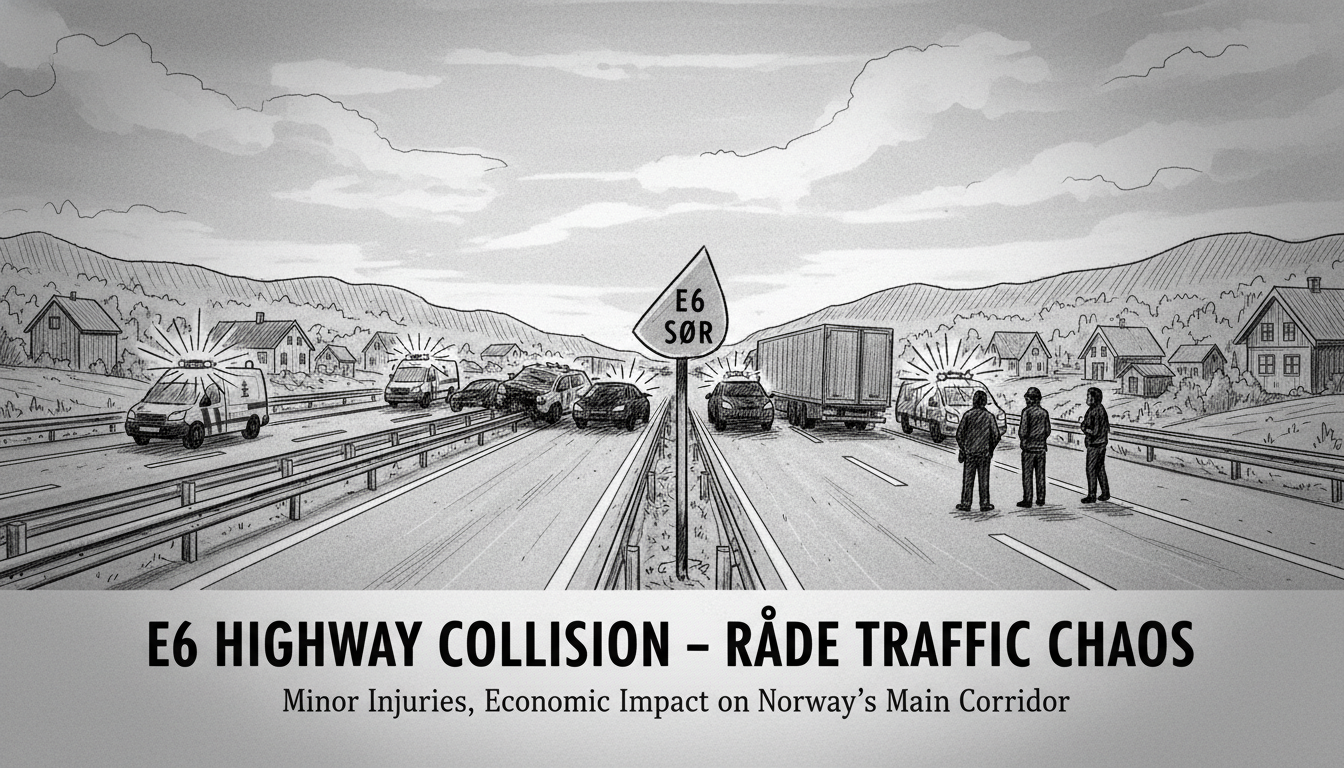
A collision between a passenger car and a small lorry on the E6 highway near Råde caused significant traffic disruptions on Tuesday afternoon. Emergency services, including police and ambulance crews, responded to the scene. According to police officials, the lorry driver was physically unharmed. The driver of the passenger car sustained minor bleeding but no serious injuries were reported. Both drivers received medical attention at the scene. Southbound traffic on the E6 was reduced to a single lane, resulting in slow-moving queues. Police confirmed all emergency units were present and managing the situation.
This incident highlights the critical importance of Norway's E6, the country's main arterial road. The E6 runs from the southern border with Sweden all the way to Kirkenes in the far north, connecting major cities like Oslo, Hamar, and Trondheim. It is a vital corridor for both personal travel and the transport of goods, including components for the offshore energy sector. Any disruption on this route has immediate economic ripple effects. Delays can impact supply chains for businesses across southeastern Norway and slow the movement of personnel to key industrial zones.
Norway maintains exceptionally high road safety standards, a point of national pride. The country's Vision Zero policy aims to eliminate all traffic fatalities and serious injuries. This philosophy influences everything from road design in cities like Oslo and Bergen to strict enforcement of speed limits. The quick and coordinated response seen in Råde is standard procedure. It reflects substantial investment in emergency services and infrastructure. Yet, accidents still occur, often reminding authorities of persistent risks on long stretches of highway, especially during variable weather conditions common in the Nordic region.
For international readers and expats, understanding Norway's transport network is key. The country's geography, with its mountains and fjords, makes major highways like the E6 irreplaceable. There are few alternative routes of similar capacity. This means a single incident can create bottlenecks affecting thousands. The system relies on efficient clearance and real-time public information, which is typically provided via traffic radio and official apps. The response in Råde appears to have followed this effective model, minimizing danger and restoring flow as safely as possible.
The direct implications of this crash are limited to local traffic delays. The broader context, however, is Norway's ongoing national debate about infrastructure resilience. As traffic volumes grow and climate change brings more extreme weather, maintaining safe, reliable roads is a constant challenge for the government. Investment in the E6 and other key routes is a perennial topic in the Storting. Every incident adds data points to arguments for further upgrades or different traffic management solutions. For now, the outcome in Råde was a best-case scenario: no life-altering injuries and a swift return to normalcy on a crucial economic artery.