
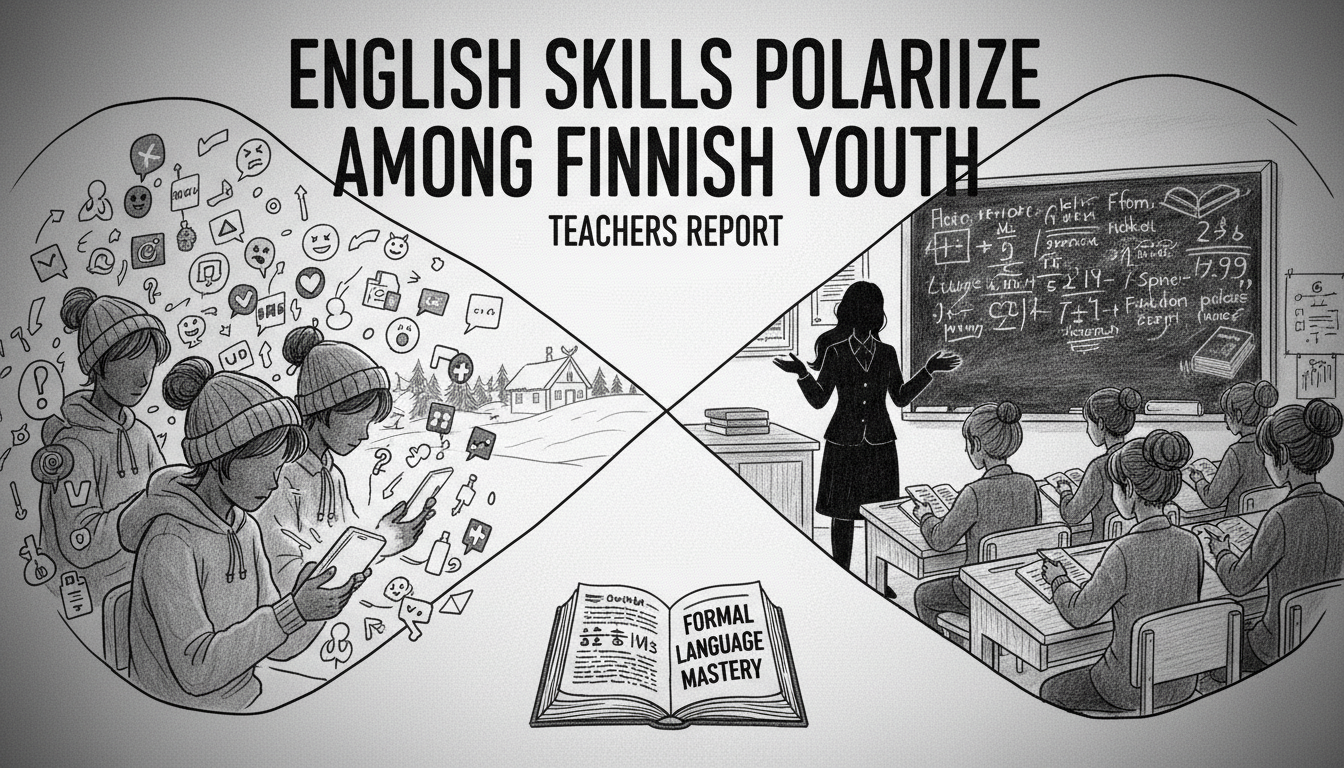
A sharp divide in English language proficiency is emerging among Finnish children and teenagers. Teachers report one group achieves near-native fluency while another struggles with basic written requirements. This polarization presents new challenges for the national education system and future workforce readiness.
Reetta Pänkäläinen, a language teacher at Puijonsarvi comprehensive school in Kuopio, observes the split daily. She notes social media has made students more confident speakers but has also fostered a 'meme-level' command of English for some. These students write everything in lowercase, use short sentences without punctuation, and rely heavily on abbreviations absorbed from platforms like TikTok.
Katja Mäntylä, a university lecturer and matriculation exam assessor, confirms the trend. She states the gap between high achievers and those at the lower end is widening. Official assessments support this. A recent national evaluation found 29 percent of ninth graders had satisfactory or weaker skills across all areas: reading comprehension, writing, speaking, and listening.
The reasons are multifaceted. Pänkäläinen points to increased learning challenges, more frequent school absences, and diminished concentration. The constant availability of fast-paced digital entertainment competes for attention. Mäntylä adds that social media can lower motivation for formal learning. Students who feel they get by with casual online English see less need to master academic or professional writing styles.
This creates a tangible problem. While social media enhances spoken comprehension and informal communication, it fragments overall language skill. The workplace and higher education demand more than internet slang. Messages fail when grammar is completely lost. Formal reports, academic papers, and professional correspondence require a structured command of English that meme culture does not provide.
The Finnish education model, long praised internationally, now confronts a digital-era dilemma. The curriculum emphasizes language as a tool for communication. Yet the very tools that increase exposure also dilute formal mastery. Teachers must cater to vastly different skill levels in single classrooms, balancing the needs of advanced bilingual speakers with those of struggling learners.
There is a historical parallel. In the 1960s, many Finns learned English from The Beatles. Today's popular culture is more participatory. Young people create content themselves, which is an active form of learning. The constant presence of English online is undeniable immersion. The challenge for educators is to bridge the gap between this organic, informal acquisition and the structured proficiency required for future success.
The long-term implications touch on national competitiveness. Finland relies on a highly educated, multilingual workforce integrated into the global economy and EU institutions. A significant cohort entering higher education or the job market with weak written English skills could create bottlenecks. It places additional pressure on universities and employers to provide remedial training.
The solution is not to reject social media but to harness its engagement. Educators suggest integrating digital literacy more formally into language instruction. This means analyzing online communication styles critically and teaching the appropriate register for different contexts. The goal is to build on the confidence and oral skills gained online while systematically developing the written competence that power structures still demand.
This is a quiet but profound shift in one of Finland's core competencies. How the education system adapts will be closely watched, as it may preview challenges other nations will soon face.