
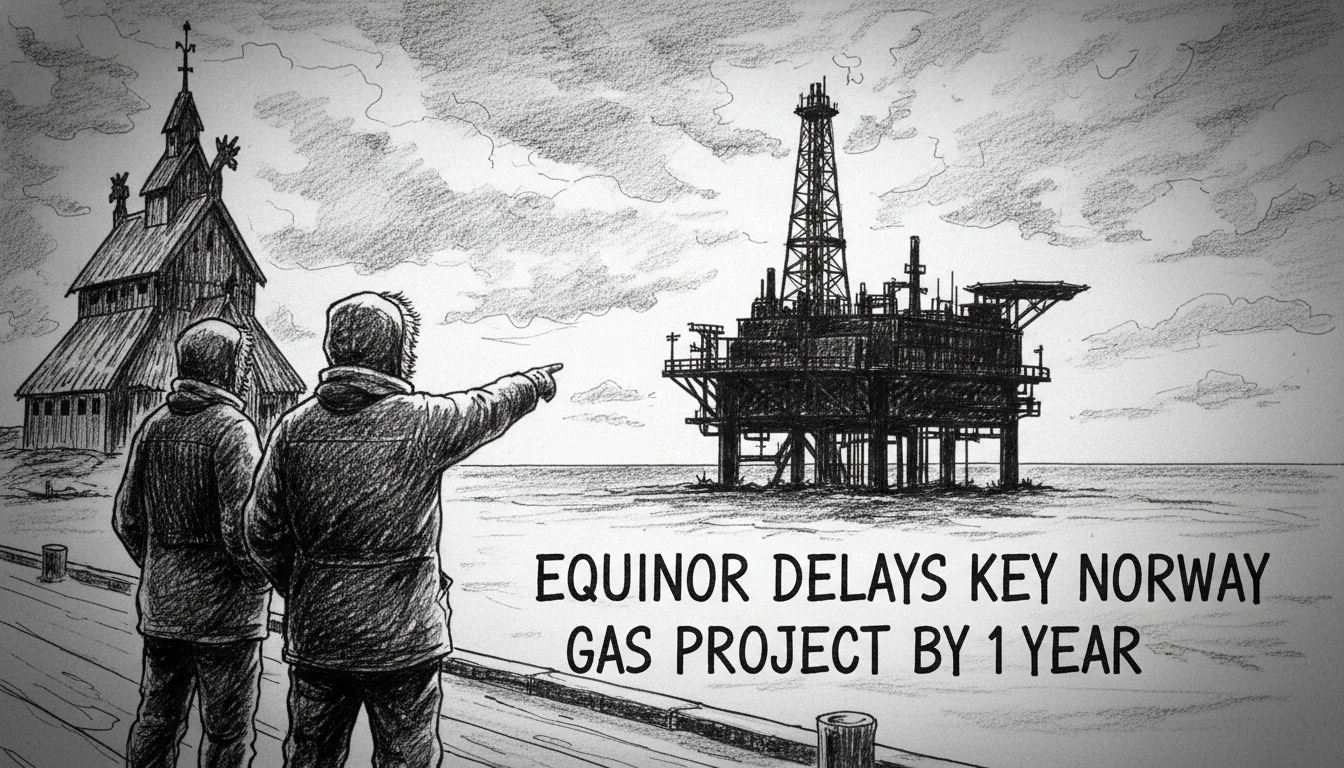
Norway's flagship industrial decarbonization project has been delayed by 12 months. State-owned energy giant Equinor announced that its Snøhvit Future development, essential for the future of gas exports from the Barents Sea, will now start in 2029. The company also revealed costs have risen by approximately four billion Norwegian kroner since last year, a significant overrun that underscores the growing financial and logistical pressures facing Europe's energy transition.
The project at the Hammerfest LNG plant on Melkøya island is designed to secure long-term gas production while drastically cutting emissions. Its postponement deals a dual blow to Norway's industrial strategy and its climate ambitions in the Arctic region.
A Critical Project for Norway's North
Snøhvit Future is not a minor upgrade. It represents the largest industrial project in Northern Norway and is pivotal for both the country's energy exports and its emission targets. The plan has two core components: electrifying the Hammerfest LNG processing plant and installing onshore compression facilities.
Electrification, powered by electricity from the mainland grid, is projected to cut the plant's annual CO2 emissions by 850,000 tonnes. That figure is equivalent to two percent of Norway's total annual emissions. The land-based compression is required to maintain stable gas flow from the Snøhvit field as natural reservoir pressure declines over time. Without it, production would fall.
“This delay creates ripples beyond a simple timeline,” said Lars Jacob Hiim, an energy analyst based in Oslo. “It postpones substantial emission reductions, impacts long-term gas supply contracts, and tests the economic viability of major green investments in the oil and gas sector. The cost increase suggests the challenges of retrofitting complex legacy infrastructure are greater than anticipated.”
Mounting Costs and Complex Logistics
The four-billion-kroner cost escalation highlights the volatile environment for major capital projects. Industry experts point to persistent global supply chain issues, rising prices for specialized equipment, and the inherent complexity of working on a live gas export facility in a remote Arctic location.
Hammerfest LNG, Europe's first large-scale LNG export terminal, has faced operational challenges before. A fire in 2020 shut the plant for nearly two years, underscoring its critical yet vulnerable role in Europe's energy infrastructure. The Snøhvit Future project is meant to future-proof the facility for the next decades.
“Integrating new, low-carbon technology into an existing plant while maintaining operations is a high-wire act,” explained Maria Fernanda, a project management consultant for the energy sector. “You are dealing with extreme precision, immense safety protocols, and a very limited window for certain construction work. Delays and cost overruns, while unfortunate, are common in this scenario.”
The delay pushes the project's start-up beyond the original 2028 target. For the local economy in Finnmark county, this means a later timeline for the significant local contracts and jobs associated with the construction phase.
Balancing Climate Goals and Energy Security
The setback arrives at a politically sensitive time. Norway's government, led by Prime Minister Jonas Gahr Støre, champions its role as a stable, clean energy supplier to Europe while committing to steep domestic emission cuts. Projects like Snøhvit Future are central to this dual narrative—they aim to extend the life of fossil fuel infrastructure by making it greener.
“This project is a cornerstone of our policy for the north: reducing emissions from our largest industries while maintaining value creation and jobs,” said Terje Aasland, Norway’s Minister of Petroleum and Energy, in a recent parliamentary committee hearing. “We are following the development closely with Equinor.”
The one-year delay means 850,000 tonnes of CO2 emissions that would have been eliminated will now be released into the atmosphere for longer. This complicates Norway's path to its 2030 climate targets. Furthermore, as Europe seeks to diversify away from Russian gas, Norwegian supplies have become even more strategic. Any uncertainty around the long-term capacity of key installations like Hammerfest LNG is noted in European capitals.
The Road Ahead for Equinor and Snøhvit
Equinor stated the revised schedule follows a comprehensive review to ensure quality, safety, and prudent project execution. The company must now manage supplier contracts, regulatory approvals, and stakeholder expectations against this new timeline.
The Snøhvit field itself is a foundational asset in the Barents Sea. Its gas travels through a 143-kilometer pipeline to Melkøya, where it is cooled into liquid form for export by ship. Ensuring its efficient and less carbon-intensive operation is a technical necessity for Equinor's portfolio.
Analysts will watch closely to see if this delay is an isolated issue or a symptom of broader inflationary and technical pressures affecting other major energy transition projects on the Norwegian continental shelf. Several other large-scale electrification schemes, including for the Troll and Oseberg fields, are in the planning stages.
Can Norway's model of greening its fossil fuel industry withstand the pressures of cost, complexity, and time? The journey of the Snøhvit Future project, now stretching into 2029, will provide a critical answer. Its success or failure will resonate from the remote shores of Melkøya to the halls of the Storting in Oslo, setting a precedent for the future of Arctic energy.