
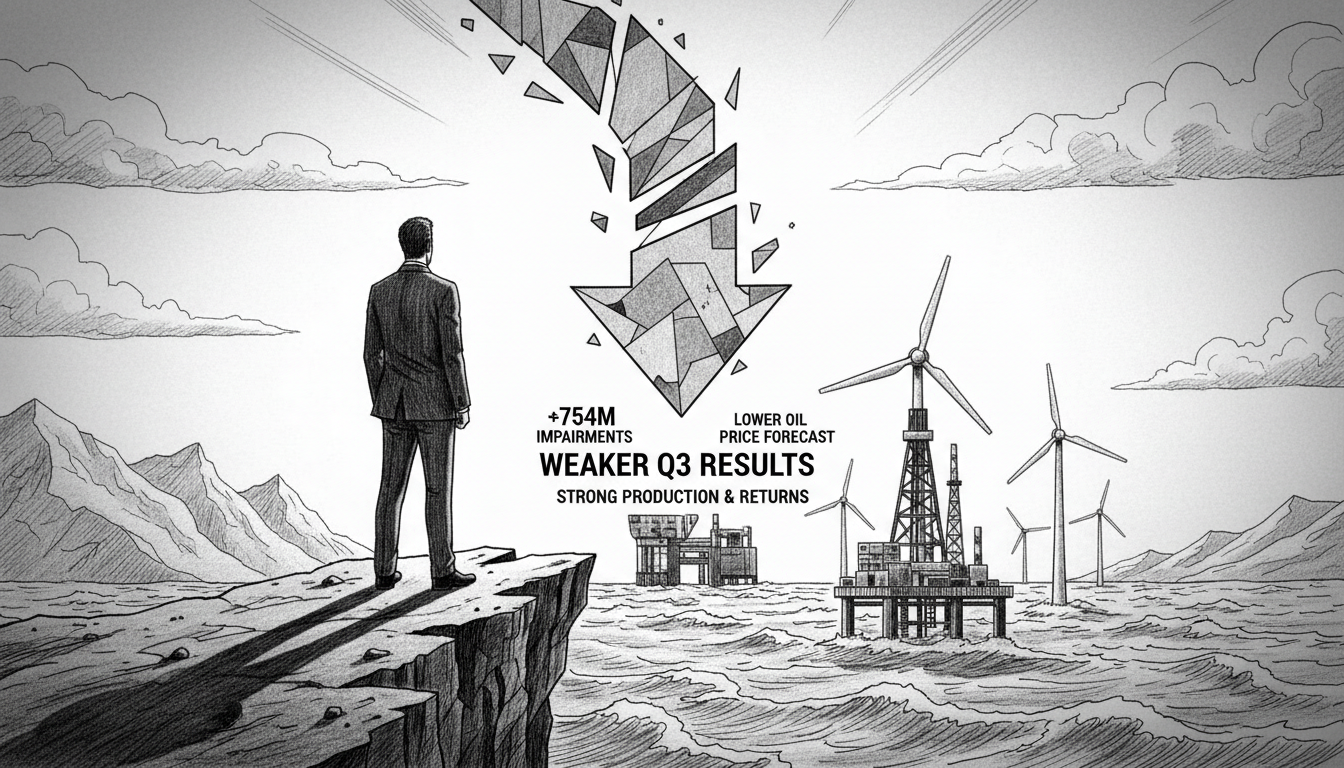
Norwegian energy company Equinor delivered somewhat weaker financial results compared to the same period last year. Lower price expectations contributed to impairments totaling 7.5 billion Norwegian kroner.
The company's quarterly results have moderated since the 2022 energy crisis, though numbers remain substantially stronger than pre-crisis levels in 2021.
Reduced energy prices have dampened the oil and gas giant's stock performance this year. Before today's quarterly figures, the stock had declined 8.8 percent year-to-date.
Equinor reported net impairments of $754 million in the third quarter. This relates partly to updated long-term price assumptions.
The company now expects Brent crude oil to average $75 per barrel between 2030 and 2040. Earlier this year, the company valued its assets based on $80 per barrel in 2030, $75 in 2040, and $70 in 2050.
Equinor also revised downward earnings expectations for its Midstream, Marketing and Processing segment, which handles energy trading. This segment will now deliver average adjusted quarterly operating results around $400 million moving forward, down from previous expectations of $400-800 million per quarter.
The company's board proposed an ordinary dividend of $0.37 per share for the third quarter. Equinor continues with the fourth part of its 2025 share buyback program, totaling up to $5 billion.
These measures will contribute to total shareholder payments of approximately $9 billion this year, fulfilling the company's February capital markets day promise.
Equinor achieved several operational milestones despite financial headwinds. The company produced 2.13 million barrels of oil equivalent in the third quarter, up from 1.984 million barrels in the same quarter last year.
Analysts had anticipated total production of 2.095 million barrels of oil equivalent per day.
CEO Anders Opedal stated the company delivered good operational performance this quarter. He highlighted the October production start at Bacalhau, Equinor's largest international offshore field.
Opedal noted the company has worked systematically on cost control over time. He said costs have remained stable this year despite production growth and inflation pressures.
Equinor reduced costs within its renewable energy division by 50 percent.
The company faces the classic energy sector challenge of balancing shareholder returns with long-term investment needs. While current production remains strong, the downward price revisions suggest Equinor anticipates a more moderate energy price environment ahead.