
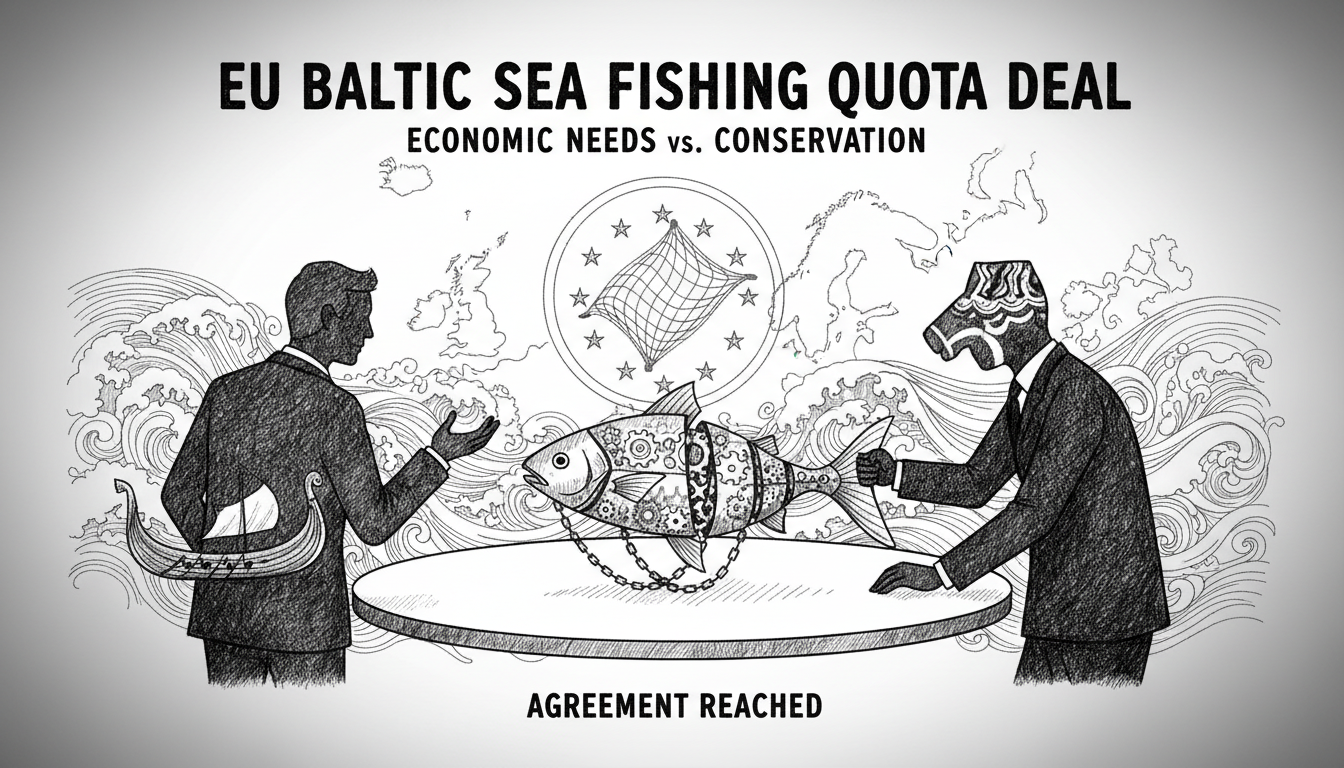
EU fisheries ministers agreed on next year's Baltic Sea fishing quotas after difficult negotiations. The talks stretched from Monday into Tuesday in Luxembourg.
Finland focused particularly on the Gulf of Bothnia herring quota. This fish stock is crucial for Finland's fishing industry. The European Commission proposed cutting the quota by over 60 percent for next year. They cited the low population levels as the reason.
The final agreement reduced the cut compared to the Commission's original proposal. Only Sweden supported the Commission's position among member states. Finland and several other countries opposed the deep cuts.
Sweden also rejected the compromise solution. Swedish officials wanted the full 60 percent reduction to proceed as planned.
The Gulf of Bothnia herring quota was set at approximately 39,100 tons until October next year. This quota could potentially increase to nearly 55,870 tons next autumn. The increase depends on scientific advice from the International Council for the Exploration of the Sea (ICES). ICES will provide its scientific assessment in late May.
Finland's Minister of Agriculture and Forestry Sari Essayah described the outcome as the best possible given the negotiation circumstances. She said in a statement that Finland achieved its main objectives in very difficult talks. The overall solution maintains viable fishing value chains and ensures sustainable fishing practices.
The main basin Baltic Sea herring quota will increase by 15 percent. The sprat quota rises by 45 percent. Finland's fishing opportunities for herring and sprat will grow by 10 percent combined.
Targeted commercial salmon fishing can continue in all Finnish sea areas. However, the main basin Baltic Sea and Gulf of Bothnia salmon quotas will decrease by 27 percent. Officials called this reduction record-breaking.
The compromise reflects the ongoing tension between economic interests and conservation needs. While environmental groups wanted deeper cuts, coastal communities successfully argued for more moderate reductions to protect livelihoods.
Why did Sweden push for deeper cuts than other Baltic nations? Sweden has consistently taken stronger environmental positions in EU fisheries negotiations, often prioritizing stock recovery over immediate economic concerns.