
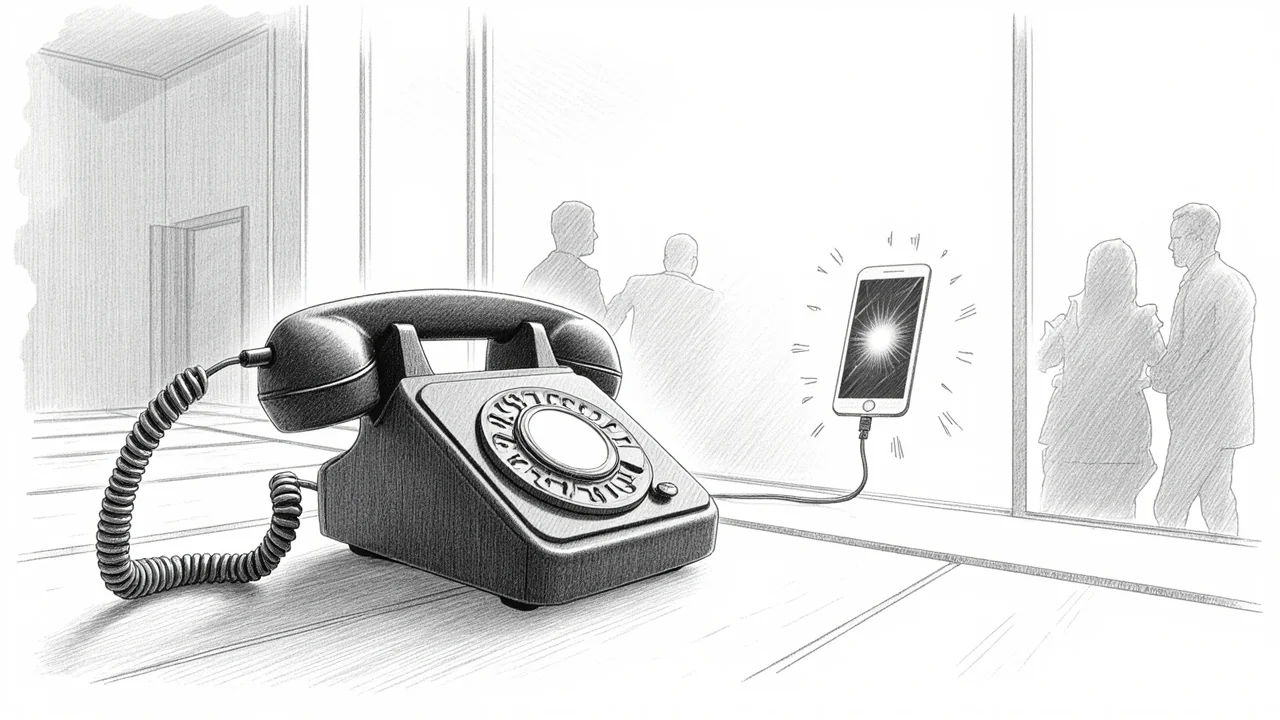
Finland's long technological evolution sees one of its most enduring symbols retire this summer as telecom operator Elisa announces it will disconnect all remaining landline connections by June 30th. The move concludes a service spanning over two centuries and marks a final, official shift to a fully mobile and digital communications infrastructure for the nation.
Elisa states that the change will impact both consumer and business customers, with the few thousand remaining landline links primarily used for traditional telephones, fax machines, switchboard solutions, and elevator emergency phones. The company confirms it has not sold new landline subscriptions for years, with the number of active connections continuously declining.
The Final Countdown for Copper Lines
All affected consumer customers will be contacted by letter at the end of April, where Elisa will present them with replacement alternatives. For business clients, the company is mapping out tailored replacement solutions. Ilkka Pohtola, Elisa's business manager responsible for consumer subscriptions, outlined the scope in a statement. 'At the moment, Elisa's customers still have a few thousand landline connections in use, and the number is decreasing all the time,' Pohtola said.
The process allows for the preservation of a familiar phone number. Customers can transfer their existing landline number directly to mobile network-based solutions. This means the number can continue to be used at home, at work, or at a summer cottage with a standard mobile handset or a GSM-based desk phone that mimics the traditional landline experience.
From Dominance to Nostalgia: The Arc of a Technology
The decline of the landline was cemented in the early 2000s with the mass adoption of mobile phones. Despite this, the landline number often remained a household's primary contact point for years, embedded in memory and on official documents. For many Finns, the landline evokes a specific era of communication—a shared family phone, a fixed location for calls, and numbers memorized for a lifetime.
Elisa's decision follows the path of its competitor, Telia, which phased out its own landline network back in 2019. This staggered shutdown reflects the gradual but inevitable fading of copper wire infrastructure, which once represented the pinnacle of connectivity and now stands as a relic in a nation defined by wireless innovation.
The transition underscores a broader technological pivot. Fixed-line networks, expensive to maintain for a dwindling user base, are being phased out in favor of more flexible, efficient, and modern digital and mobile networks. This shift also aligns with EU-level digital infrastructure goals that prioritize next-generation broadband and mobile connectivity over legacy systems.
Practical Steps for Consumers and Businesses
For the final users, the change requires a simple but symbolic adjustment. The key offer from Elisa is the number portability service, ensuring continuity. Consumers will need to decide whether to simply use their mobile phone for all calls or opt for a fixed wireless solution, like a GSM desk phone, if they prefer a hands-free home handset. Businesses with integrated systems, such as fax lines or alarm systems tied to landlines, will require more specific consultations with Elisa to find secure digital alternatives.
The phase-out is a logistical exercise in managing technological obsolescence with minimal disruption. Elisa's targeted communication strategy, starting with letters in April, provides a three-month window for customers to make the switch, suggesting the number of affected users is now small enough to manage through direct contact.
A Nation's Identity Wired Through Communication
Finland's relationship with telecommunications is profound. As the home of Nokia, the country lived through the mobile revolution that made the landline obsolete. Ending the landline service is not just a corporate decision but a cultural milestone. It closes a chapter that began with the first telegraph lines and evolved through party lines and rotary dial phones to the touch-tone era.
The disappearance of the landline network also has subtle implications for infrastructure and security. While mobile networks are highly robust, the old copper network represented a physically separate system. Its complete retirement consolidates dependence on wireless and fiber-optic grids, raising continuous questions about network resilience and universal service obligations in a fully digital age.
Yet, the consensus within the industry and among policymakers is clear. Maintaining two parallel nationwide fixed-line networks—one digital and one analog—is economically and technically unjustifiable. The resources freed up by sunsetting the old network can be redirected to enhancing the capacity and coverage of modern alternatives.
What Remains When the Line Goes Dead?
As the June 30th deadline approaches, the change will be quiet for most Finns, who abandoned their landlines years ago. For the final holdouts, it will be a small, personal endpoint to a familiar domestic object. The landline number, however, can live on, a digital ghost of its former self, transferred to a mobile SIM card.
Finland, often a leader in digital adoption, thus formally severs its last direct copper connection to the telecommunications past. The story of the Finnish landline ends not with a bang, but with a dial tone that quietly ceases, and a network that finally earns its retirement after serving generations. The question now is what physical artifact of our current digital age will seem equally quaint and obsolete two centuries from now?