
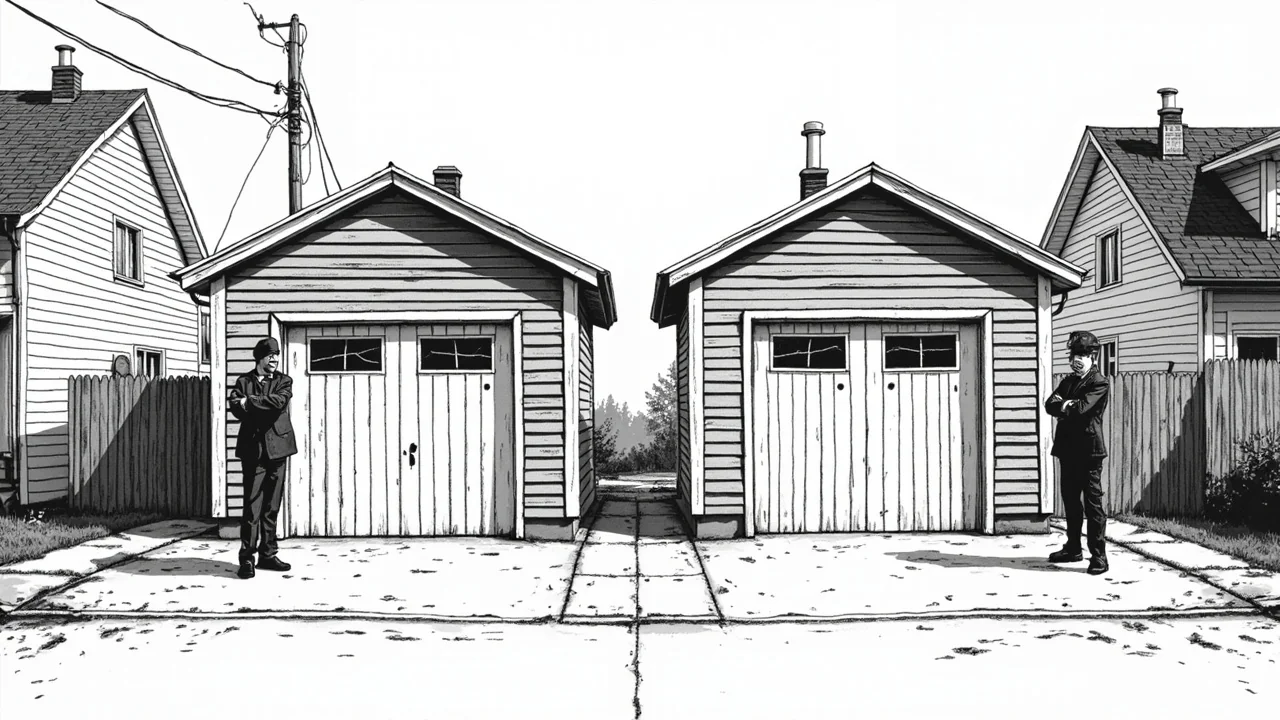
Finland's revised construction law has allowed a garage to be built just three meters from a family's home in Espoo, igniting a bitter neighbor conflict and exposing gaps in local oversight. Reetta Viitanen now measures the scant distance between her property line and the new structure, a tangible result of legislation intended to simplify small-scale building. Her family's complaint to the Espoo building authority was rejected, with officials citing the 2025 law that permits outbuildings under 30 square meters without a permit. This case in the Saunalahti district has become a flashpoint for debates on property rights, fire safety, and the limits of municipal intervention in Finland.
A Garage Rises in Saunalahti
Reetta Viitanen and her family watched as their neighbors constructed a garage on an adjacent plot owned jointly through a partition agreement. The building was erected approximately 40 centimeters from the formal partition boundary, placing it about three meters from the Viitanen's canopy structures and five meters from the main wall of their house. According to Viitanen, the construction proceeded without their consent, and they immediately raised concerns with Espoo's building control department. The neighbors involved have denied any wrongdoing, stating they acted within their rights. The spatial closeness has transformed the Viitanen's backyard, with the garage now dominating the view from several windows and raising immediate practical worries.
The 2025 Construction Law Explained
The legal cornerstone of this dispute is Finland's new construction law, which took effect at the start of 2025. This legislation allows property owners to erect auxiliary buildings, such as garages or sheds, with a footprint of less than 30 square meters without needing to apply for a building permit from local authorities. The intent, as discussed in parliamentary proceedings, was to reduce bureaucracy for homeowners and stimulate minor construction projects. However, the law does not explicitly override all other regulations, including those pertaining to fire safety or municipal zoning plans. In Espoo, Building Control Head Jari Saajo directly invoked this law in his decision to reject the Viitasen's complaint. He stated that nothing in the case gave the building authority grounds to intervene, as the garage falls under the permitted size threshold. This interpretation has left families like the Viitanens feeling powerless against constructions that feel invasively close.
Fire Safety Risks and Conflicting Interpretations
Central to Reetta Viitanen's formal complaint are pressing fire safety concerns. She referenced a decree from the Ministry of the Environment on building fire safety, which stipulates that a distance of less than eight meters between structures requires fire spread to be limited through construction methods. The garage's proximity, she argues, violates this principle and creates a tangible risk. A municipal fire safety inspector reportedly viewed the site and identified potential risks, requesting cooperation from the building control department on the matter. However, Jari Saajo contested this assessment, stating the fire inspector had misinterpreted the situation. This conflict between official evaluations leaves the safety issue unresolved and places the burden on residents to navigate complex technical arguments. Viitanen called it unreasonable that the new law's interpretation could lead to a scenario where building control 'throws its hands up' and leaves safety risks for residents to manage.
The Path of Legal Appeals
Frustrated by the local authority's stance, Reetta Viitanen has taken a two-pronged legal approach. She has appealed the building control's decision to the Administrative Court, seeking a judicial review of whether the garage should have required a permit under the circumstances. Simultaneously, she has filed a complaint with the Office of the Chancellor of Justice, the parliamentary ombudsman, arguing that the authority's refusal to investigate constitutes maladministration. These proceedings are ongoing and could set a precedent for how the 2025 construction law is applied in similar neighbor disputes across Finland. The case highlights the tension between legislative simplification and the protection of individual property rights, a balance that courts may now need to define. The Viitanen family must now wait, living with a structure they see as a daily reminder of regulatory failure.
Broader Implications for Finnish Homeowners
This incident in Espoo is not an isolated one, as the new law removes a layer of pre-emptive oversight for small constructions. Other municipalities in Finland may face similar conflicts, where the absence of a permit process eliminates a forum for neighbors to raise objections before building begins. The law assumes good faith and adherence to other codes, but as the Saunalahti case shows, disputes over placement, safety, and aesthetics can arise post-construction with few clear resolution paths. The Viitanen's experience raises a fundamental question for Finnish housing policy: how can the state balance the desire for deregulation with the need to protect citizens from potentially harmful or intrusive building projects? The outcome of their legal challenges will be closely watched by homeowners, local officials, and lawmakers alike, potentially prompting calls for legislative clarifications or amendments to prevent future conflicts of this nature.