
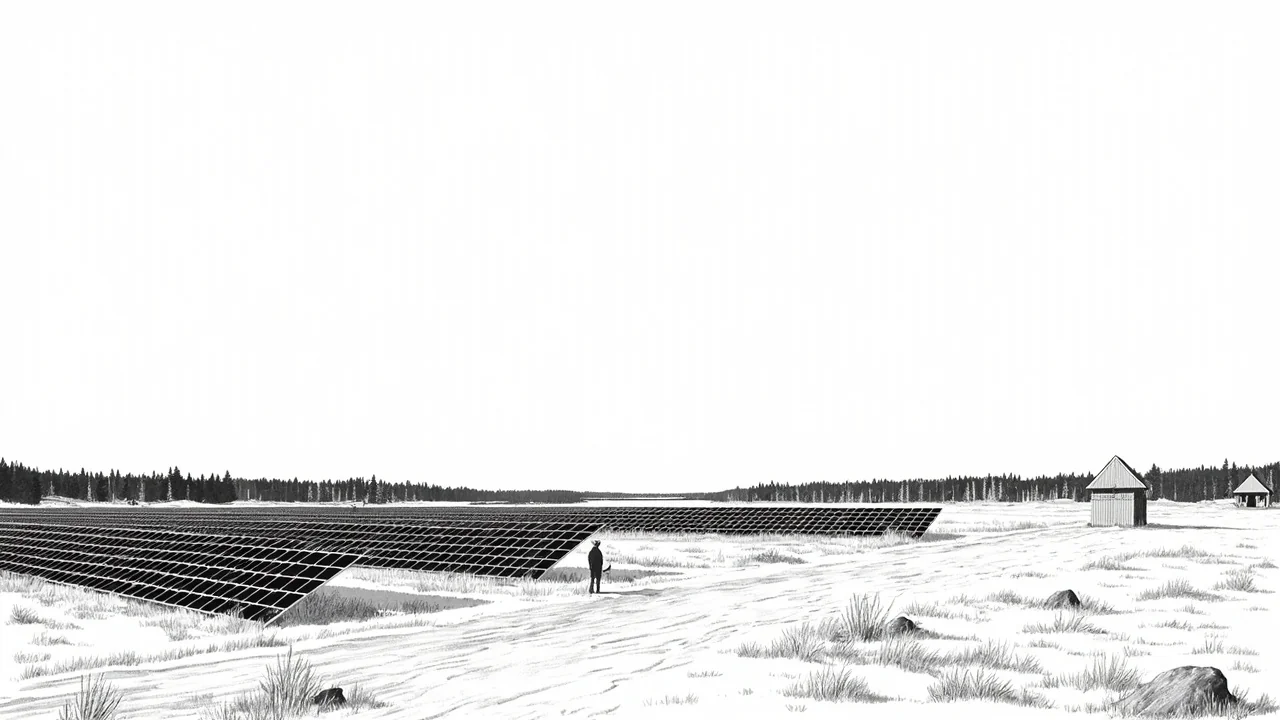
Finland's municipal energy landscape could gain a major new player with plans for a significant solar park in Kangasniemi. A project under development targets the construction of a solar power plant spanning approximately 116 hectares, a substantial investment for the region that promises to boost local property tax revenues alongside its green energy output.
A Major Investment for a Small Municipality
The scale of the proposed solar park represents a notable infrastructure project for the municipality of Kangasniemi. Covering an area equivalent to roughly 160 football pitches, the development would transform a significant parcel of land into a source of renewable electricity. While the exact megawatt capacity and projected energy yield are not yet specified in the available plans, projects of this physical scale typically represent a capital investment running into tens of millions of euros. For a smaller Finnish municipality, such an investment carries considerable economic weight, bringing construction activity and, upon completion, a new stream of municipal income.
Fiscal Benefits for Local Government
A key incentive for the municipality lies in the project's potential to increase local tax income. Under Finnish law, power generation plants are subject to property tax. The completed solar park would become a new and sizable asset on the municipal tax roll, providing Kangasniemi with annual property tax revenue that can be directed towards local services, infrastructure maintenance, or other community projects. This fiscal benefit is a critical factor in the municipal planning and approval process, offering a tangible local upside to a national energy transition project. The additional revenue could help offset costs elsewhere in the municipal budget or fund new initiatives, directly linking the green energy project to community welfare.
Context Within Finland's Energy Strategy
This planned development in Kangasniemi aligns with broader national and European Union objectives. Finland has set ambitious targets for carbon neutrality and increasing the share of renewable energy in its overall consumption. Solar power, while historically less dominant than wind, hydro, and biomass in the Nordic energy mix, has seen rapid growth in installed capacity in recent years. The Finnish government's energy and climate strategy encourages diversified renewable production to enhance energy security and meet binding EU climate commitments under the Green Deal and Fit for 55 package. Large-scale solar parks, often developed on previously unused or low-productivity land, are becoming an increasingly visible part of this strategy, complementing distributed rooftop solar installations.
The Planning and Approval Pathway Ahead
For the Kangasniemi solar park to move from plan to reality, it must navigate Finland's detailed land use planning and environmental permitting processes. The developer will need to submit a specific plan amendment, likely going through the municipal board and requiring a statement from the local council. Environmental impact assessments will scrutinise the project's effects on local biodiversity, hydrology, and landscape. Public hearings will allow residents and stakeholders to voice concerns or support. This regulatory pathway, while rigorous, is designed to balance development needs with environmental protection and community interests. The promise of increased tax revenue will be a significant point in the project's favour during these municipal deliberations.
Comparative Scale in the Nordic Context
A 116-hectare installation places the Kangasniemi project among the larger solar parks currently in operation or development in Finland and the wider Nordic region. While several solar farms exceeding 100 hectares are now in planning phases across the country, each represents a major step in scaling up solar capacity. The project underscores a shift in perception, demonstrating that solar energy can be a viable large-scale power source even at northern latitudes, thanks to technological improvements in panel efficiency and favourable summer sunlight conditions. Its success could serve as a reference point for similar developments in other municipalities with available land resources.
Looking to the Future Energy Grid
The integration of this potential new power source also touches on questions of energy infrastructure. The output from the solar park would need connection to the national grid, managed by Fingrid. This involves considerations of grid capacity and stability, particularly as the intermittent nature of solar power requires balancing with other energy sources. The project contributes to a more distributed and resilient energy generation model, reducing reliance on single, large power plants. Its development is part of the ongoing evolution of Finland's smart grid, which must accommodate a growing share of variable renewable production while maintaining the high reliability of supply that households and industry depend on.
A Decision with Lasting Local Impact
The final decision on the Kangasniemi solar park rests with local democratic processes, weighing the long-term benefits of clean energy and stable tax income against any localised impacts on land use. If approved and constructed, the solar park would become a permanent feature of the local landscape and economy for decades. It represents a concrete example of how global climate goals translate into local development, offering a model where environmental investment also strengthens municipal finances. The coming months of planning debates will determine whether this sizable tract of land in Kangasniemi will soon begin converting sunlight into electricity and revenue for the community.