
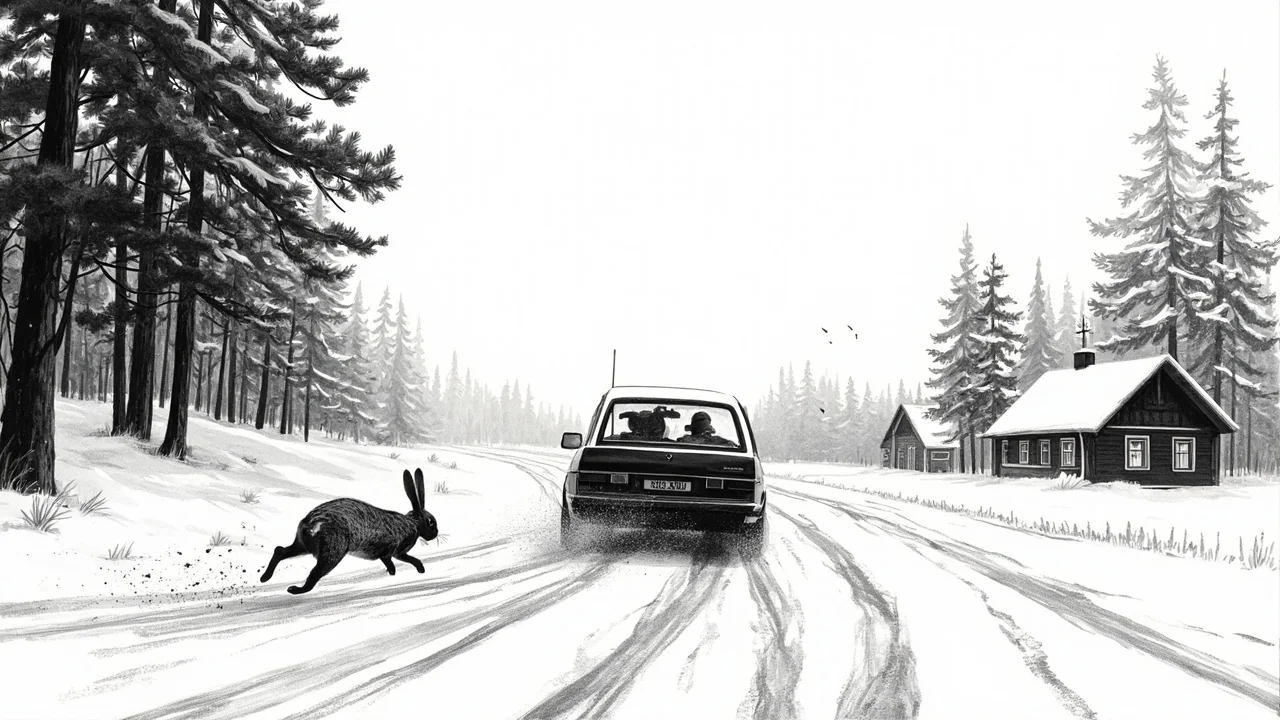
Finland's roads see over 8,000 reported collisions with wild animals annually, a statistic that gained new relevance Tuesday evening when a driver in Toivakka swerved to avoid a rabbit and left the road. The incident, which caused no injuries to the driver or a dog that was also in the car, highlights a persistent seasonal hazard on rural Finnish routes. The personal car ended up in a ditch on Kangasniementie, a few kilometers from the Uusitie intersection heading towards Kangasniemi. Emergency services logged the traffic accident report at 7:38 PM.
The Toivakka Incident Details
According to the available report, the sole action leading to the accident was the driver's attempt to avoid hitting a rabbit. The vehicle left the roadway and came to rest on the roadside embankment. A tow truck was called to the scene before rescue services arrived, indicating the situation was not an emergency requiring extraction or medical aid. No personal injuries or animal injuries were reported from the incident. The dog in the car was unharmed. The location on Kangasniementie places it within the typical setting for such events—a rural road bordered by forest or field, where wildlife crossings are common.
A Widespread Seasonal Hazard
While this event ended without consequence, it represents a frequent type of single-vehicle accident in Finland, particularly during dawn, dusk, and nighttime hours when animal activity is high. The Finnish Wildlife Agency and the Finnish Transport Infrastructure Agency maintain statistics on animal collisions. The most common large animal involved in serious accidents is the moose, with approximately 1,500 collisions reported each year, often resulting in significant vehicle damage and human injury. However, smaller animals like rabbits, badgers, and foxes are involved in thousands more incidents, many of which go unreported unless they cause an accident like the one in Toivakka. The reflex to swerve, while understandable, is often cited by driving safety instructors as a major risk factor for losing control of the vehicle.
| Animal Type | Estimated Annual Collisions in Finland | Typical Risk Period |
|---|---|---|
| Moose (Hirvi) | ~1,500 | Year-round, peaks autumn & spring |
| White-tailed Deer (Valkohäntäpeura) | ~3,500 | Year-round |
| Roe Deer (Metsäkauris) | ~2,000+ | Year-round |
| Smaller Mammals (e.g., rabbit, badger) | Several thousand | Spring, Summer, Autumn |
Official Advice for Drivers
Traffic safety authorities and organizations like the Finnish Central Organisation for Traffic Safety (Liikenneturva) provide clear guidance for these situations. The primary rule is counterintuitive for many drivers: if a collision with a small animal like a rabbit or bird is unavoidable, you should not swerve violently. A sudden steering maneuver at high speed can lead to a far more dangerous outcome, such as veering into oncoming traffic, hitting a tree or ditch, or causing the vehicle to roll over. The official recommendation is to brake firmly while holding the steering wheel steady. For larger animals like moose or deer, the advice is more complex due to the high center of mass of a moose, which can crash through the windshield. In those cases, controlled braking is still the first action, with evasive steering considered only if it can be done safely without endangering other road users.
Infrastructure and Preventative Measures
The risk is not borne by drivers alone. The Finnish Transport Infrastructure Agency installs and maintains wildlife warning signs, reflector systems, and fencing along known high-risk corridors, especially on newer or upgraded highways. These fences are designed to guide animals to specific crossing points, such as wildlife bridges or underpasses. However, on the vast network of smaller regional and local roads like Kangasniementie, such infrastructure is less common due to cost. Local municipalities are responsible for safety measures on these roads, and initiatives vary. Some areas trial acoustic or optical warning devices to deter animals from crossing when vehicles approach.
The Broader Context of Rural Road Safety
This minor accident touches on the broader challenge of maintaining safety on Finland's extensive rural road network. These roads, vital for connectivity in sparsely populated regions, often have higher speed limits despite having fewer safety features than main highways. They also traverse the habitats of Finland's abundant wildlife. The combination presents a unique risk profile. While the number of fatalities in animal collisions has decreased over the long term thanks to better car safety technology (like reinforced A-pillars for moose collisions) and targeted infrastructure, property damage and personal risk remain high. Annually, animal collisions cause tens of millions of euros in vehicle damage and insurance claims.