
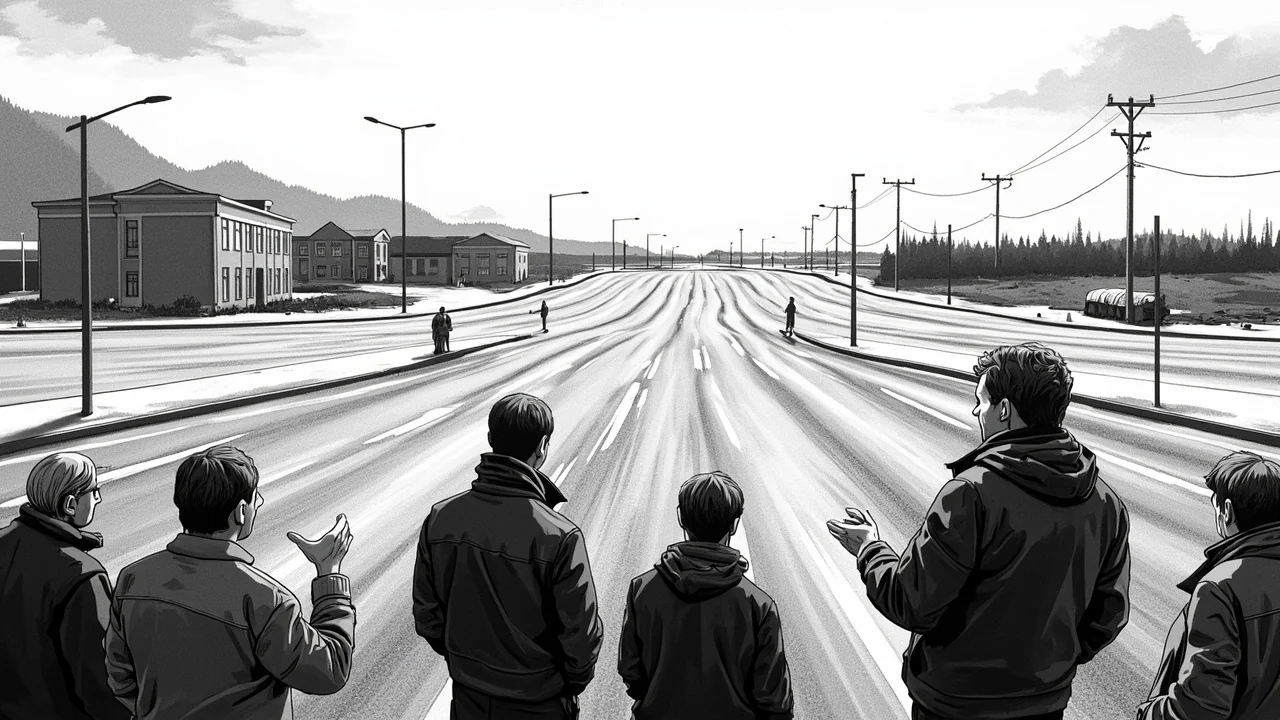
Finnish road planners faced pointed questions from Lievestuore residents this week over a major upgrade to Highway 9, the Ysite, that will bypass two dangerous intersections but leave a third one untouched. The public meeting at Tervamäki School in Laukaa drew a crowd of about 80 people, who directed detailed questions at Finnish Transport Infrastructure Agency project manager Jarmo Niska.
The project focuses on improving traffic flow and safety on the busy route between Jyväskylä and the Lievestuore urban area. Plans confirm the construction of two new grade-separated interchanges at the Lievestuore and Hojo intersections, effectively eliminating the current at-grade crossings. This significant investment aims to streamline the major artery and prevent cross-traffic accidents.
A Community's Persistent Safety Concern
The most pressing issue raised by residents was not about the planned improvements, but about the omission of a third problematic crossing. Multiple attendees questioned why the project scope does not simultaneously address the at-grade railway crossing and junction at Kelkkamäentie and Ruuhimäentie. One resident framed the driving experience with clear frustration, stating that traffic coming from the Jyväskylä direction first travels at 100 km/h, only to then brake hard for the Kelkkamäki intersection. They asked project lead Niska directly how the traffic flow could be slowed down to the planned speed limit of 60 km/h in that section.
The tension in the room crystallized with a stark, shouted interjection from the audience: "There's a cemetery there." This comment underlined the community's deep-seated fear that the existing dangerous conditions at the unimproved intersection could lead to fatal consequences, making the perceived oversight feel particularly grave.
The Explainer: Phasing, Priorities, and Procedure
In response to the consistent line of questioning, project manager Jarmo Niska provided the agency's rationale for the current project's boundaries. While not detailed in the source material, his explanation would typically involve standard Finnish infrastructure planning protocols. Such protocols often require separate feasibility studies, environmental impact assessments, and funding approvals for distinct project phases. Combining all three intersections into a single contract could complicate procurement, extend environmental review timelines, and exceed the current budget allocation authorized by the Finnish government and the Eduskunta.
The two interchanges currently slated for construction likely scored higher on the agency's priority matrix, which evaluates traffic volume, accident history, and regional development goals. The Kelkkamäentie intersection, while a local concern, may handle a lower daily vehicle count or have a marginally different accident profile in the agency's statistical models. Furthermore, intersections involving railway crossings, like the one at Ruuhimäentie, fall under a stricter regulatory framework involving national rail operator VR and the Finnish Transport Safety Agency, adding layers of complexity to any redesign.
The Anatomy of a Finnish Road Project
Understanding the community's frustration requires a look at how major road projects progress in Finland. The Finnish Transport Infrastructure Agency operates under mandates from the Ministry of Transport and Communications, with long-term plans like the National Transport System Plan guiding investments. Funding is typically allocated in parliamentary budget cycles, with projects advancing in stages from planning and environmental permits to construction. Public meetings, like the one held in Lievestuore, are a statutory part of the process, allowing for local feedback which must be formally recorded and addressed.
The Ysite improvement project itself is part of broader efforts to enhance connectivity in the Central Finland region, supporting both local mobility and broader EU transport network goals. The decision to proceed with two interchanges now, rather than three, reflects a calculated trade-off between immediate safety gains, fiscal responsibility, and administrative capacity. It is a standard, if sometimes unpopular, approach to managing a large national infrastructure portfolio.
What Comes Next for Lievestuore's Third Crossing
The public meeting served its core democratic function: surfacing a gap between official planning priorities and lived local experience. The concerns voiced about the Kelkkamäentie and Ruuhimäentie intersection are now formally part of the project record. While a change to the current construction contract is highly improbable, the strong community push ensures the issue will not be forgotten. Local municipal leaders from Laukaa are now likely to apply renewed pressure on the agency and regional MPs to fast-track a separate study for the third intersection, aiming to secure its place in the next funding round.
For the residents of Lievestuore, the promise of two safer interchanges is tempered by the continued daily risk at a third spot they explicitly identified as a danger zone. The project highlights a recurring tension in infrastructure development: the need for systematic, phased planning versus communities' holistic view of their own safety. The final outcome for the third crossing will depend on continued local advocacy, its standing in future technical evaluations, and the political will to find additional funds. The cemetery by the road, mentioned in that stark outburst, remains a silent testament to the stakes involved.