
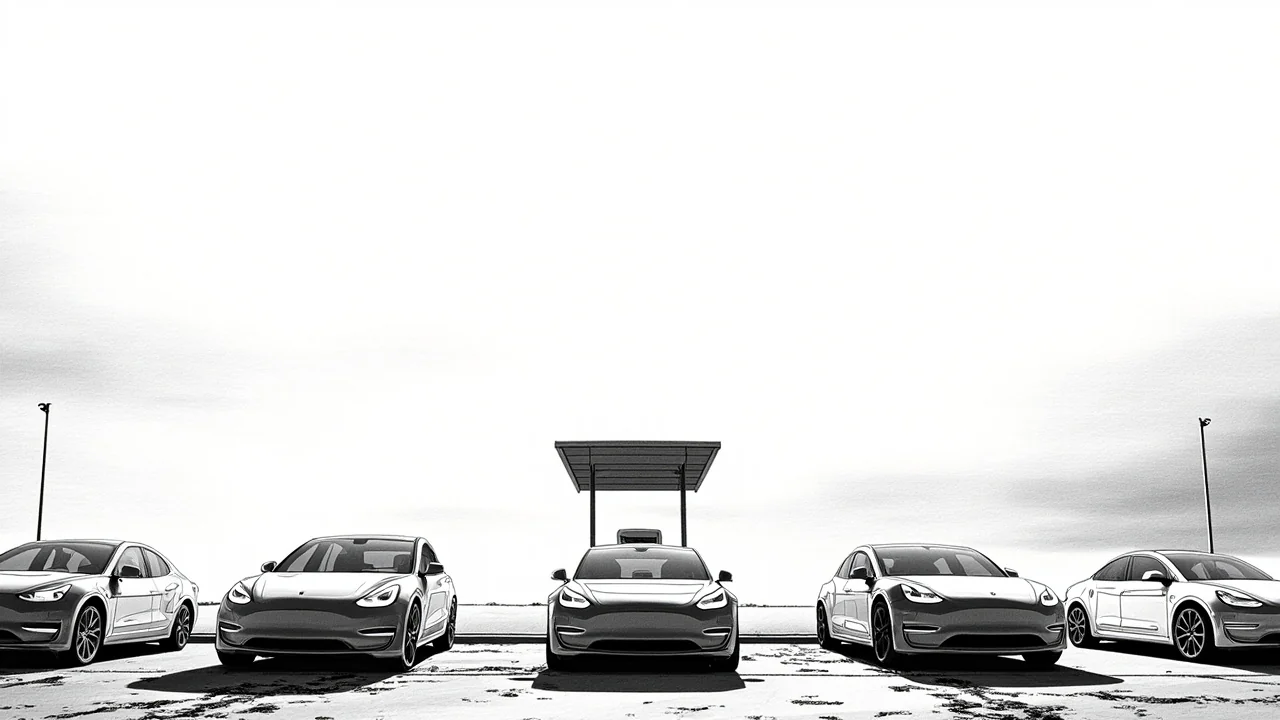
Finland's transition to electric vehicles is revealing a stark municipal paradox, where slow adoption fails to spark demand for the very infrastructure meant to enable it. In the Central Finnish municipality of Hankasalmi, the number of fully electric passenger cars has grown by 22 since spring 2024, bringing the total to 52 out of 2,697 registered vehicles. Despite this incremental growth, the town's three existing public charging stations see surprisingly little use, leading local officials to question further investment.
Infrastructure Outpaces Demand
Hankasalmi currently operates three 22 kWh charging points, located at the municipal office building, the Kotiranta service house and dental clinic, and the Kuuhankavesi school. Each station can charge two vehicles simultaneously. Two more stations are scheduled for installation this spring at the Asema school and a multi-purpose hall. This planned expansion continues despite current low utilization rates. Municipal Property Manager Hannu Lampinen states the situation clearly, noting the town is prepared to add more stations if needed, but the current data suggests otherwise. "Latauspisteiden käyttö on ollut yllättävän vähäistä," Lampinen said. "If there was demand, we would add more charging points, but now it seems pointless to invest more."
National Goals Meet Local Reality
The situation in Hankasalmi presents a tangible challenge to Finland's national and EU-aligned climate ambitions. The Finnish government's transport decarbonization strategy relies on a rapid increase in EV adoption, supported by a dense network of charging infrastructure. This local case study, however, highlights a potential chicken-and-egg problem at the municipal level. Infrastructure built in anticipation of demand can sit underused, making it difficult to justify the capital expenditure for further expansion. This creates a potential bottleneck, where the lack of visible, busy charging points might itself deter residents from making the switch to electric, fearing inconvenience on longer journeys or lacking home-charging options.
A Calculated Wait-and-See Approach
Hankasalmi's decision reflects a pragmatic, data-driven approach to public spending. Municipalities across Finland are balancing mandatory services with strategic investments for the future. With limited budgets, investing in infrastructure that sees minimal immediate use is a hard sell for local councils. The current strategy appears to be one of incremental expansion—adding a few stations with each construction or renovation project—while closely monitoring usage statistics. This spreads the cost over time and aligns infrastructure growth directly with observable need, rather than speculative forecasts. It is a conservative model that minimizes financial risk but may not accelerate the transition at the pace envisioned by national policymakers.
The Broader Finnish Context
Hankasalmi's experience is not isolated. Similar discussions are occurring in many small and medium-sized Finnish municipalities outside major urban centers. The adoption curve for new technology is rarely uniform across a country. In Greater Helsinki, demand for public charging is robust, driven by higher population density, a larger share of residents living in apartments without dedicated parking, and generally faster EV uptake. In rural areas, where daily distances are longer and single-family homes with private garages are more common, the initial EV wave often consists of owners who can charge overnight at home. Their need for public chargers is primarily for longer trips, which doesn't generate the consistent local usage required to make a municipal network seem busy or cost-effective.
The Road Ahead for Hankasalmi
For now, Hankasalmi will proceed with its two new stations and watch the numbers. The growth from 30 to 52 EVs in less than a year is positive, but the base remains small. The real test will come when local EV ownership reaches a critical mass, perhaps around 150-200 vehicles, where the occasional need for public charging becomes more frequent. Municipal officials will likely continue their cautious, reactive strategy until the data compels a change. This story underscores a fundamental truth of the energy transition: national targets are implemented one municipality at a time, each with its own budget realities, demographic profile, and practical calculus. The journey to a fully electric fleet is a marathon, and some towns are still finding their pace.