
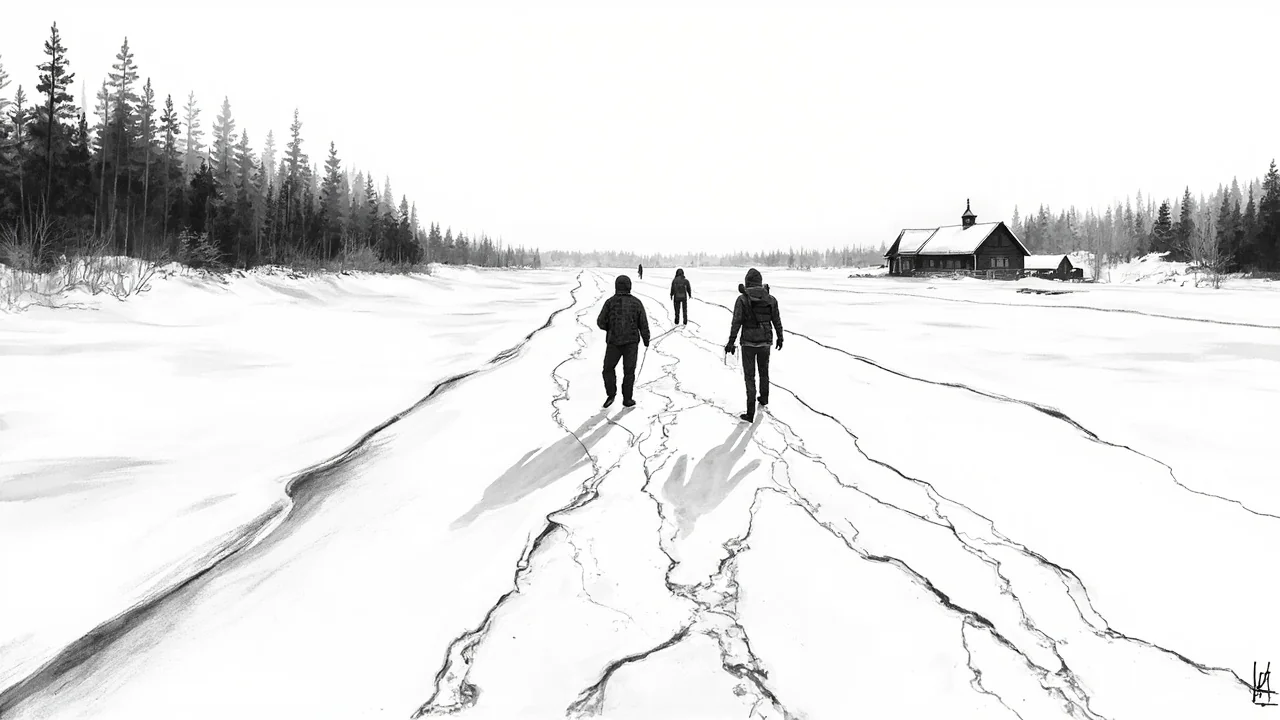
Finland's Hamari ice road has officially opened for the winter season, marking a quintessential Nordic tradition where frozen waterways transform into official public highways. The initial three-kilometer loop currently connects key points including Hamari Seo, the Haiko Manor pier, Kråkön Island, Sikosaari point, and the Gammelbacka swimming beach. This network will expand cautiously as ice thickness increases, governed by strict safety protocols from local authorities who monitor the frozen Baltic Sea inlet daily. For residents of the Southern Finland region, this annual event is not a novelty but a vital seasonal transport link, deeply embedded in the cultural and practical fabric of life above the 60th parallel.
This opening signals more than just a change in travel routes; it represents a complex, state-sanctioned interaction with nature that few countries institutionalize. The ice road operates under the jurisdiction of local road authorities, who assume liability once they declare it open, creating a unique publicly managed infrastructure built entirely upon a natural element. Drivers no longer need to rely on folklore or guesswork about ice safety, as official measurements and regular maintenance provide a framework for secure passage. The system exemplifies the Finnish principle of 'jääkaappi'—literally 'ice cupboard' but metaphorically a cool, pragmatic approach to problem-solving in extreme conditions.
A Symphony of Measurement and Patience
The opening of an ice road is never a sudden event but the culmination of weeks of patient observation and precise data collection. Authorities do not simply wait for cold weather; they track the formation of different ice types. Initial 'siku' or new ice forms a fragile layer, followed by 'nuori jää' (young ice) which gains strength. The critical threshold for pedestrian traffic is typically 10 centimeters, while the Hamari route requires a minimum of 25-30 centimeters of strong, blue-white 'vanha jää' (old ice) to support vehicle weight. This process cannot be rushed, and the opening date can vary by weeks from year to year, directly linking civic infrastructure to the immediate whims of the climate.
Local experts, often from the municipal environmental or public works department, conduct daily core samples using specialized augers. They examine not just thickness but ice quality, looking for dangerous vertical cracks, air pockets, or areas weakened by underwater currents or freshwater springs. "The ice is a living structure," explained a veteran inspector from the region, who preferred not to be named. "It talks to you if you know how to listen. The sound it makes under a test drill, the way it bends under weight—these are all signals. Our job is to translate those signals into a safe public directive."
The Infrastructure of a Frozen Highway
Once declared safe, the ice road is meticulously prepared. This is not a matter of simply removing snow. Road crews use plows to clear a defined path, but they leave a thin, textured layer of snow to provide crucial traction for vehicle tires. Reflective markers, often simple evergreen branches or official plastic poles, are implanted into the ice to delineate the lane, guiding drivers away from potentially thinner areas near natural inflows or currents. Speed limits are enforced rigorously, typically between 30-50 km/h, as the wave effect from a moving vehicle can destabilize the ice sheet far ahead and behind it.
The economic and social utility is significant. For island residents or those with properties across the inlet, the ice road can reduce winter travel times by over an hour compared to summer ferry routes or long drives around the coastline. It enables the transport of goods, access to schools and services, and maintains community cohesion during the darkest months. The opening is often announced in local newspapers and on municipal websites, treated with the same administrative formality as the repair of a conventional asphalt road, yet it carries a unique sense of communal achievement and seasonal rhythm.
Cultural Significance and National Identity
The existence of official ice roads speaks volumes about the Finnish relationship with nature. It is a relationship based not on domination, but on astute adaptation and respectful cooperation. The practice, while practical, is woven into national identity. It represents 'sisu'—the Finnish concept of stoic perseverance—applied collectively. It also reflects a deep-seated trust in public institutions; drivers trust that the authorities have done their due diligence, and authorities trust citizens to follow the established rules, such as keeping minimum distances between vehicles and not stopping on the ice.
This tradition stands in stark contrast to the growing concerns of climate change. While this winter has been cold enough to open the Hamari route, the long-term data held by the Finnish Meteorological Institute shows a trend toward later freezing dates and earlier thawing periods across the southern coastal regions. Each successful ice road season is now quietly celebrated, but also studied as a data point in a changing environmental context. The knowledge held by the older generation of ice inspectors becomes increasingly valuable, a form of localized, tactile science that complements satellite data and climate models.
The Delicate Balance of Risk and Regulation
Operating an ice road is an exercise in managing inherent risk. The Finnish government and local municipalities walk a fine line between enabling this useful seasonal infrastructure and ensuring public safety. Liability is a key concern. Once the road is officially open, the maintaining authority is responsible for its condition. This necessitates constant vigilance. A sudden warm spell, rain, or strong winds can degrade ice quality rapidly, requiring prompt closure. The decision to close is as critical as the decision to open, demanding a willingness to act against public convenience for collective safety.
Insurance and legal frameworks are adapted to this reality. Vehicle insurance policies in Finland typically cover travel on officially opened ice roads, treating them as any other public highway. This legal normalization is crucial. It removes ambiguity and reinforces the official status of the route, discouraging individuals from attempting to pioneer their own, unsafe paths across the ice. The system creates a clear, binary state: the road is either open and governed by official rules, or it is closed and travel on that ice is undertaken at one's own peril.
A Window into Nordic Governance
From a political and administrative perspective, the Hamari ice road is a fascinating case study in Nordic governance. It demonstrates how Finnish public services extend their mandate to harness natural phenomena for the common good. The planning involves the municipal board, environmental officials, and public works departments in a coordinated effort. Funding for markers, signage, and monitoring is allocated in local budgets, debated in council meetings alongside funding for schools and snow removal on paved streets.
This pragmatic approach reflects a broader Scandinavian model where public trust is high and civic responsibility is taken seriously. There is no need for dramatic rhetoric about 'conquering the ice'; instead, there is a quiet, systematic process of collaboration with the winter environment. The ice road is a testament to a society that plans for extremes, invests in localized expertise, and maintains a flexible, responsive administrative structure capable of managing an infrastructure that literally melts away each spring. As climate patterns shift, this model of adaptive, nature-based infrastructure may hold lessons for regions worldwide facing new environmental realities. Will the deep knowledge required to maintain these frozen highways remain relevant, or will it become a fading art in a warming world?