
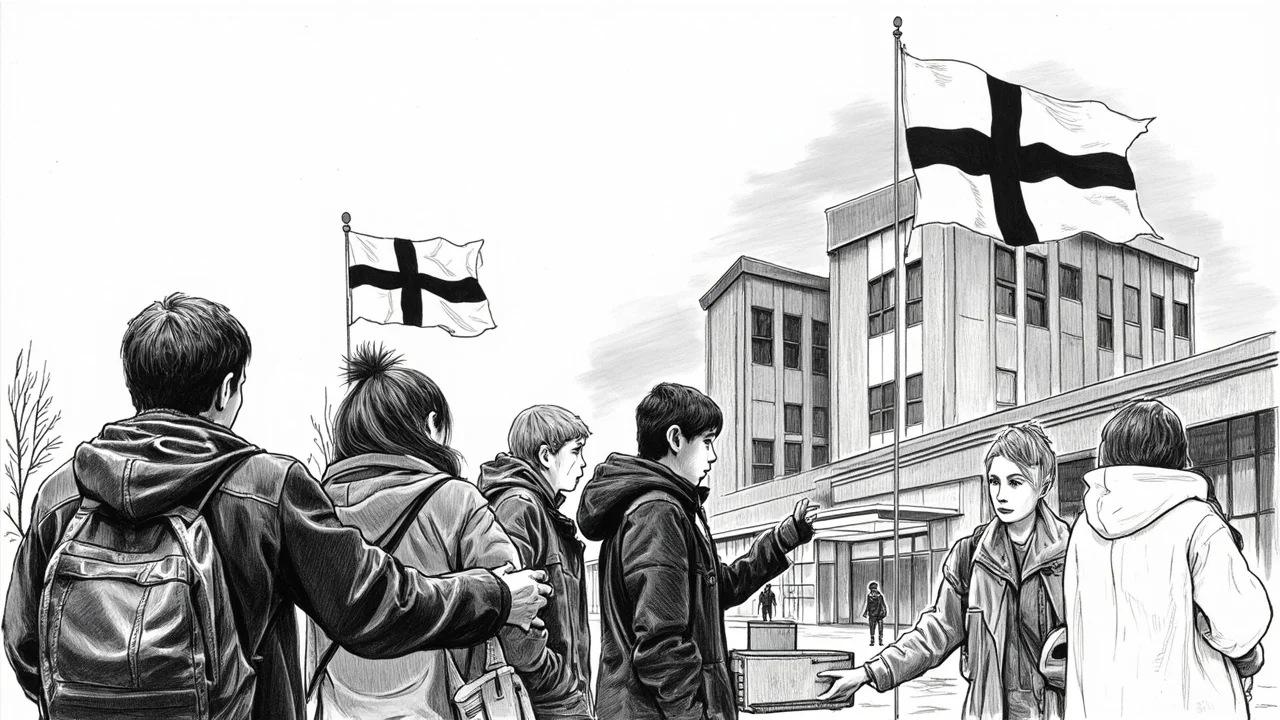
Finland's international students are increasingly turning to breadlines and food banks as economic pressures mount. In the university city of Jyväskylä, social workers report a sharp rise in foreign degree students requiring emergency food assistance, challenging the nation's image as a seamless Nordic welfare state.
Kirsi Lepoaho, a diaconal expert with the Jyväskylä Parish, confirms the troubling trend. Her team now issues food vouchers and directs students to low-cost or free meals regularly. "The number of international students needing different kinds of financial support has grown in recent years from our perspective in Central Finland," Lepoaho stated. She identifies a harsh collision between expectation and reality for many. "A picture may have been created for many international students that it's easy to get work in Finland. The reality can be a disappointment."
A Perfect Storm of Economic Pressures
This situation stems from multiple concurrent challenges. Finland's employment landscape is difficult for all job seekers currently, placing those without fluent Finnish or Swedish at a distinct disadvantage. International students from outside the EU/EEA face particularly stringent rules, permitted to work only an average of 30 hours per week during term time. Many arrive with savings requirements but find living costs, especially in cities with student populations like Jyväskylä, Helsinki, and Tampere, are higher than anticipated. The scarcity of part-time jobs that do not require local language proficiency creates a significant barrier, leaving students who exhaust their funds with few legal avenues for income.
Unlike Finnish citizens and permanent residents, most international students have very limited access to Finland's comprehensive social safety net. They are generally ineligible for housing allowance, unemployment benefits, or general social assistance from Kela, the Social Insurance Institution of Finland. This leaves charitable organizations and municipal crisis services as the primary, and often only, source of aid during financial emergencies. The Finnish Immigration Service (Migri) requires non-EU students to prove they have sufficient funds for their entire stay, but unexpected expenses, inflation, and the inability to secure predicted work can quickly derail those calculations.
Systemic Gaps and Policy Shortfalls
Experts point to a structural gap in Finland's otherwise well-regarded immigration and education framework. The nation actively recruits international students to boost university revenues, enhance cultural diversity, and address long-term skill shortages in sectors like technology and healthcare. However, the support systems for these students during their studies appear inadequate. "The situation is due to a challenging employment situation, lack of language skills, and the scarcity of available support," Lepoaho summarized, describing the core of the problem.
This issue has direct implications for Finland's strategic goals. The current government, led by Prime Minister Petteri Orpo, has stated aims to increase work-based immigration and streamline pathways for educated professionals to stay after graduation. Yet, students struggling with basic subsistence are less likely to view Finland as a future home. Negative experiences with poverty and food insecurity can tarnish the country's reputation abroad, potentially impacting future recruitment. The Finnish National Agency for Education (EDUFI) promotes study in Finland globally, but student testimonials about needing food aid could undermine these marketing efforts.
The Human Cost and Institutional Response
The human impact extends beyond empty cupboards. The stress of financial precarity severely affects academic performance and mental health. Students facing food insecurity report higher levels of anxiety, depression, and an inability to focus on studies—the very reason they are in the country. The Jyväskylä Parish's experience indicates the problem is not isolated but spreading across student cities. While student unions at universities provide some support, such as food aid cooperatives and advice services, their resources are also stretched.
Some universities have begun to address the issue internally. Initiatives include expanding the availability of subsidized meals in campus cafeterias, creating emergency loan funds, and offering more Finnish language courses to improve employability. However, these are often piecemeal solutions. A broader policy discussion is needed, potentially involving the Ministry of Education and Culture and the Ministry of Economic Affairs and Employment. Proposals from student advocacy groups include revisiting work-hour restrictions for non-EU students, creating more state-funded grants accessible to international learners, and establishing a clearer protocol for municipalities to offer crisis support to this temporary resident population.
EU Context and the Bigger Picture
Finland is not alone in facing this challenge within the European Union. Countries like Ireland and the Netherlands have also reported rising reliance on food banks among their international student populations. The EU's push for greater student mobility through programs like Erasmus+ often focuses on academic and cultural exchange, with less emphasis on the economic sustainability of longer-degree mobility. For non-EU students, the situation is even more precarious across the continent, as their right to work and access public funds is typically heavily restricted by national laws.
Finland's case is particularly striking given its powerful brand as a model of equality and social welfare. The sight of international students in breadlines contradicts the nation's self-image and international reputation. It exposes a vulnerability in a system designed primarily for citizens and permanent residents, struggling to adapt to a more globalized education sector. As competition for global talent intensifies, the student experience—encompassing basic needs like food security—becomes a critical factor in a country's attractiveness.
Ultimately, the growing lines at food banks in Jyväskylä are a signal. They indicate a mismatch between Finland's ambition to be a top destination for international education and the on-the-ground realities of student life. Addressing this will require more than charitable responses; it demands a serious re-evaluation of how Finland supports the temporary residents it invites to contribute to its academic and future economic life. The alternative is a steady stream of disillusioned graduates who leave with stories of hardship, not opportunity.