
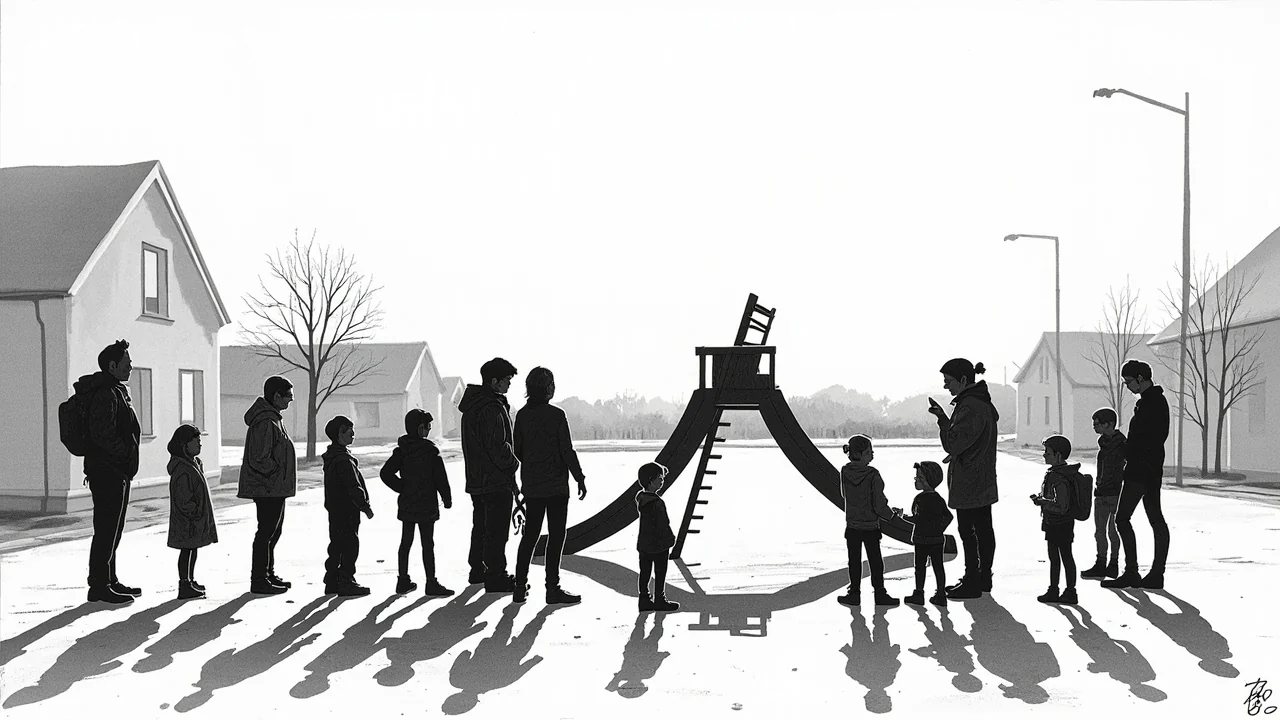
Finland's housing companies removed at least dozens of communal playgrounds last year following the enactment of a new consumer service safety law, driven by widespread confusion over its requirements. Property managers have dismantled swings and sandboxes, interpreting the legislation as mandating costly renewals, despite authorities clarifying the law demands only standard maintenance.
Widespread Misinterpretation Leads to Removals
"A completely senseless regulation that surely is only followed in Finland," said Matti Hirvenkivi, a resident whose housing association removed a swing and a sandbox from its yard. His sentiment echoes across Finnish suburbs where housing company boards, responsible for shared properties, have opted for demolition over perceived legal complexity. The law, which entered force last year, governs the safety of consumer services, a category that includes communal playgrounds in housing company properties. Fear of liability and varied interpretations of phrases like "adequate safety" have prompted drastic actions, with some boards deciding it is simpler to remove equipment than navigate the new rules.
The Law's Actual Text Versus Perceived Demands
Central to the confusion are questions like whether sand in a sandbox must be replaced annually or if a climbing frame built in the 1980s must now be torn down. The Finnish Real Estate Federation, known as Kiinteistöliitto, states the law introduced no significant new obligations for properly maintained sites. "If a playground has been previously maintained appropriately, the new law does not create much additional hassle for the housing company," a federation representative explained. The core requirement remains a duty of care: conducting regular inspections, performing necessary repairs, and ensuring the equipment is safe for use. The law did not impose retrospective standards that would outlaw older, well-maintained play structures.
Bureaucratic Caution Overrides Common Sense
Experts point to a characteristic Finnish tendency toward strict legal compliance, where housing company boards, comprised of resident volunteers, err on the side of caution to avoid any potential liability. The ambiguity in the law's application to existing, older playgrounds has created a legal grey area. Without explicit, granular guidelines for every piece of existing equipment, boards are making independent and often inconsistent decisions. This has led to a patchwork of outcomes, where identical equipment in neighboring districts faces different fates based on the board's risk tolerance and interpretation. The phenomenon highlights the gap between legislative intent and practical implementation at the local level.
Proper Maintenance as the Intended Solution
Contrasting with the removal trend are housing companies that have correctly interpreted the statute. For them, the process involves formalizing existing good practices. This includes documenting annual safety checks, keeping records of repairs, and establishing a clear maintenance schedule. Jenni Räikkönen and her daughter Aura Näkki use their housing company playground in Viikki every day, a site unaffected by the confusion because its management understood the continuity of the rules. The visual of daily play underscores the law's goal: to ensure such spaces remain safely available, not to eliminate them through overzealous compliance.
The Cost of Misunderstanding Community Space
The removal of playgrounds represents a tangible loss of communal space and value for residents, particularly families with young children. It reduces opportunities for spontaneous social interaction among neighbors and degrades the living environment. The financial cost is also dual-faceted: housing companies incur expenses for demolition and removal, while also diminishing the attractiveness and family-friendliness of their property. This outcome is at odds with broader Finnish societal goals promoting child-friendly urban environments and healthy outdoor activity. The situation reveals how well-intentioned regulation can have unintended negative consequences when its communication and guidance are insufficient.
Seeking Clarity from Authorities
In response to the growing confusion, industry bodies like Kiinteistöliitto have issued guidance to their members, stressing that the law is not a mandate for wholesale replacement. They emphasize that a sensible, documented maintenance regime is the primary requirement. The federation encourages housing companies to seek professional assessments if unsure, rather than taking the irreversible step of removal. However, the dissemination of this clarification to thousands of individual housing company boards, often run by non-experts, remains a significant challenge. The case may prompt authorities to provide more detailed, practical examples of compliance for common scenarios.
A Finnish Paradox of Rule-Following
The widespread removal of playgrounds speaks to a deeper cultural relationship with rules and liability. The Finnish preference for clear, unambiguous directives, when met with a law requiring contextual judgment, has produced an extreme reaction. It is often easier and feels legally safer for a volunteer board to remove a potential liability entirely than to assume responsibility for interpreting "adequate safety" on a case-by-case basis. This incident serves as a real-world case study in regulatory impact, demonstrating that a law's effectiveness depends not just on its text, but on the support system around it to ensure correct understanding and application.
Looking Beyond the Sandbox
The implications of this misinterpretation may extend beyond playgrounds. The same Consumer Safety Act applies to other common property facilities like saunas, shared laundry rooms, and gyms. Housing companies must now assess all such services under the new framework. The confusion witnessed with playgrounds could repeat itself in other areas if clearer communication is not achieved. The goal of enhancing consumer safety is universal, but the path to achieving it must be paved with practical guidance to prevent the loss of valuable community amenities. The future of Finnish housing company living may depend on finding a balance between legal safety and common-sense preservation of shared spaces.