
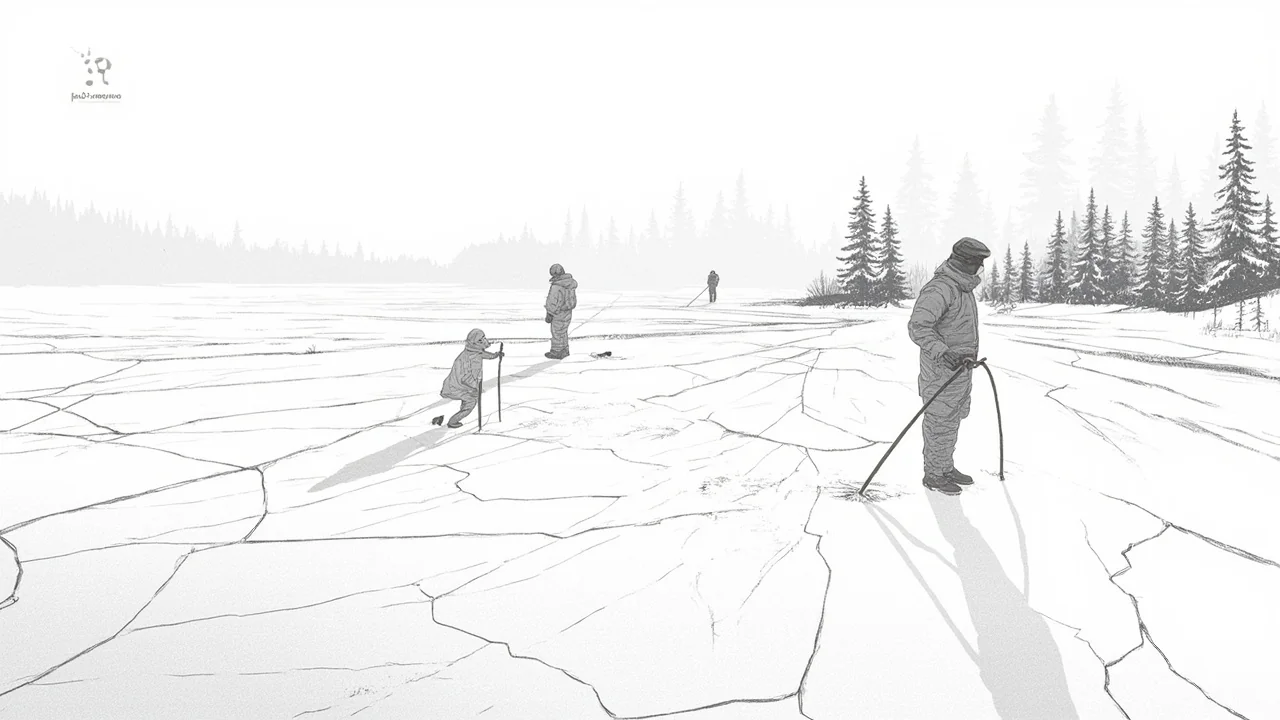
Finland's Saimaa lake ice is just 14 centimetres thick at a key measurement point near Lappeenranta, only half its typical thickness for this time of year. The ice cover at the Kanavansuu location in Lauritsala formed on January 1st, significantly later than the long-term average formation date of November 27th. Despite its thinness, scientists from the Finnish Environment Institute (SYKE) describe the ice as uniformly solid 'steel ice.' A second measurement point at Simpelejärvi lake in Parikkala also shows ice that is clearly thinner than usual, confirming a regional pattern following an unusually mild December.
Unprecedented Measurements Recorded
The measurement, taken on Monday, January 19th, provides a concrete data point for a winter that has felt conspicuously soft to many residents. The Finnish Environment Institute maintains two official ice measurement stations in the South Karelia region: one on Lake Saimaa at Lauritsala, Lappeenranta, and the other on Simpelejärvi at Särkisalmi, Parikkala. These stations provide standardized, comparable data that is crucial for understanding long-term climate trends. The 14-centimetre reading is a stark numerical deviation from the historical norm, offering less than the typical margin of safety for winter activities. The ice finally became thick enough to measure only after the frosts around the New Year, highlighting the delayed start to the stable winter season.
The Science of 'Steel Ice' Formation
The term 'steel ice' refers to a specific, strong type of ice formation. It develops when ice forms steadily in calm, cold conditions without snow cover initially weighing it down or subsequent thaw-freeze cycles creating weaker, layered snow-ice. This results in a clear, solid, and homogeneous sheet of ice that possesses greater structural integrity per centimetre of thickness than bubbly or layered ice. This characteristic explains why, despite the alarming lack of depth, the existing ice sheet is considered robust. Its formation is directly linked to the weather patterns of the past month. The exceptionally mild December across much of Finland prevented early ice formation, but the subsequent cold snap in early January allowed for a period of consistent, undisturbed freezing over open water, creating this strong but thin layer.
A Broader Regional Climate Picture
The conditions observed in South Karelia are not an isolated phenomenon. They reflect broader climatic trends affecting the entire Baltic Sea region. The Finnish Meteorological Institute has consistently reported warming winters, with reduced ice cover days on lakes and the Baltic Sea being a key indicator. The late ice-in date recorded at Kanavansuu aligns with decades of data showing a trend toward shorter ice seasons across Finnish inland waters. This shift has tangible impacts beyond scientific interest. It affects local ecosystems, winter transportation routes across lake ice, traditional cultural practices, and recreational activities like ice fishing and skating, which are integral to the Finnish winter experience. The measurement serves as a localized snapshot of these larger, ongoing environmental changes.
Historical Context and Future Implications
Comparing current measurements to historical averages provides critical context. The long-term data set maintained by SYKE allows researchers to distinguish between natural annual variability and significant climatic shifts. When a single season's measurement shows a 50% reduction from the norm, it raises immediate practical safety concerns for authorities and the public. Looking ahead, the continued thinness of the ice will depend entirely on sustained cold weather. Any further mild periods or significant snowfall, which insulates the ice and slows further growth, could make the ice season exceptionally short and unstable this year. The data from Lauritsala and Simpelejärvi will be closely monitored in the coming weeks to see if the ice can catch up to typical thicknesses or if this winter will be recorded as another significant data point in the trend of warming winters.
Practical Impacts and Official Guidance
For residents and visitors in the South Karelia region, the SYKE measurements translate into a need for heightened caution. While the ice is described as strong for its type, its minimal thickness significantly reduces its load-bearing capacity. Local rescue services and authorities routinely warn against venturing onto ice based solely on calendar dates, instead emphasizing the need to check official local conditions and measure thickness personally. The 'steel ice' phenomenon, while structurally sound, can be dangerously deceptive, as its clear appearance and solid feel may inspire a false sense of security when the underlying metric of centimetres remains insufficient for many activities. The official data underscores the message that this winter requires more vigilance than most.
The Role of Systematic Monitoring
This report was made possible by Finland's systematic, long-term environmental monitoring infrastructure. The consistent methodology used at SYKE's fixed stations ensures data reliability over time, turning anecdotal observations about a 'mild winter' into quantifiable facts. These ongoing measurements are vital for climate research, environmental protection, and public safety planning. They inform models that predict future conditions and help society adapt to changing winters. The reading from January 19th is more than a news item, it is an entry in a continuous record that documents how Finland's iconic winter landscape is evolving, providing an unambiguous signal that the natural world is responding to a changing climate, one centimetre of ice at a time.