
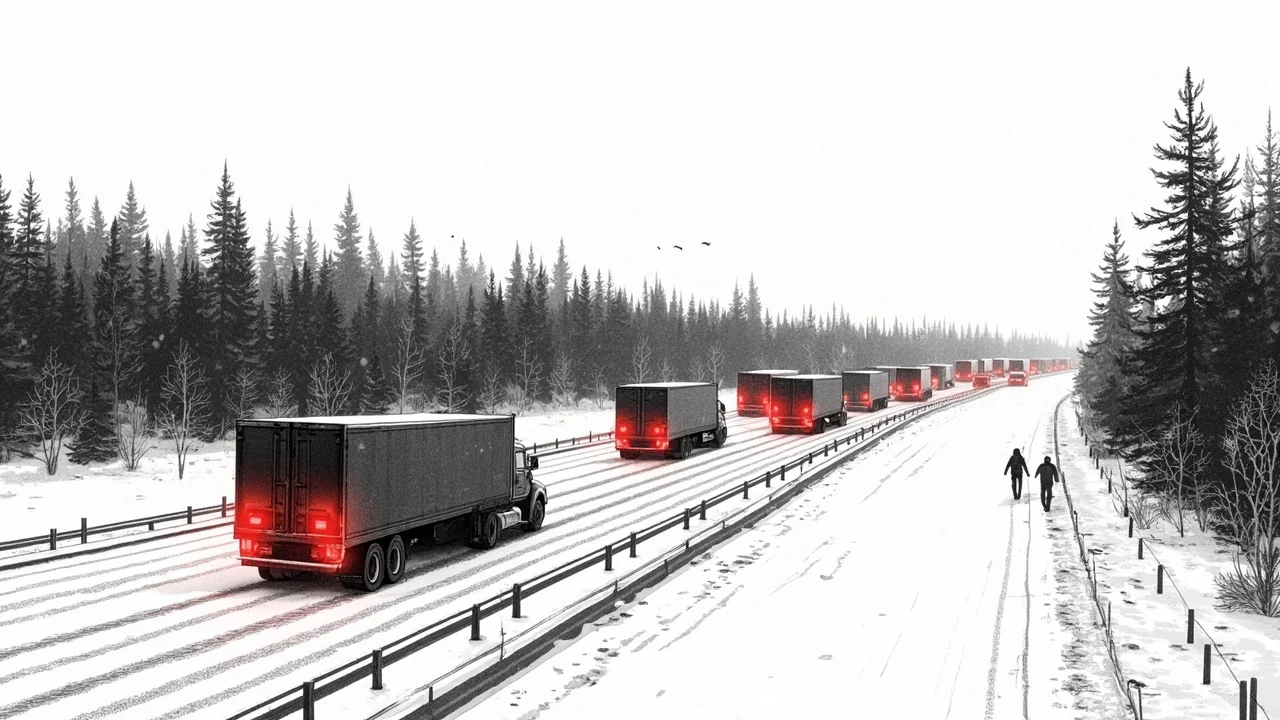
Finland's National Road 12, a vital artery for eastern Finland's industry and tourism, became a 100-kilometer parking lot on Tuesday afternoon. A single heavy goods vehicle, its mechanical failure sudden and complete, stalled directly across the Matkakeidas intersection in Iitti, effectively sealing the crossroads. The immobilized truck created an immediate and cascading traffic blockade, with the local rescue service forced to deploy crews not for extraction, but for traffic control. This isolated incident on a key highway underscores a persistent vulnerability in Finland's transport infrastructure, where a single point of failure can disrupt regional logistics for hours.
The Anatomy of a Gridlock
The incident occurred just before 3:00 PM at the Matkakeidas junction, a critical node where local traffic from Iitti merges with the nationally significant Highway 12. The truck did not collide with another vehicle; it simply stopped functioning in the worst possible place. With its bulk blocking all through lanes, the flow of goods from the ports of Hamina and Kotka toward the inland regions of Savonia and North Karelia was instantly severed. Passenger vehicles, including tourist traffic heading toward the Kymi River Valley and beyond, were similarly trapped. The Iitti rescue department's primary role shifted from emergency response to managing a growing queue of frustrated motorists, a task that consumed resources for the duration of the blockage.
This scenario is not unique to Iitti. Finland's transport network, while modern, is characterized by long distances and a limited number of major trunk roads. Highways like the 12, the 4, and the 5 function as singular lifelines for vast geographic areas. There are often few, if any, equivalent alternative routes for heavy freight. A closure on the E75 in Lapland or the Ring I around Helsinki creates similar disproportionate impacts. The Iitti blockage is a microcosm of this systemic risk, where redundancy is limited and the economic cost of downtime escalates rapidly.
Economic Ripple Effects Beyond the Road
The immediate inconvenience for drivers is only the surface layer of the problem. For Finland's export-dependent economy, reliable logistics are non-negotiable. The Finnish Transport and Communications Agency, Traficom, consistently highlights transport reliability as a key competitiveness factor. "Unplanned stoppages on our main corridors have a direct cost on national productivity," a Traficom analyst noted in a recent infrastructure review. While the duration of the Iitti stoppage may have been limited to several hours, the disruption occurs within a just-in-time supply chain framework where delays compound.
Local businesses in Iitti and surrounding municipalities felt the pinch immediately. Delivery vans were delayed, shift workers were late, and customers could not reach their destinations. On a broader scale, trucks carrying components for manufacturing or fresh produce for markets sat idling, burning fuel and missing delivery windows. The Confederation of Finnish Industries has repeatedly called for increased investment in road maintenance and alternative route development, arguing that the cost of these disruptions far outweighs the investment needed for resilience. This single truck breakdown provides a tangible, if small-scale, case study supporting their argument.
A Policy Challenge for Helsinki and Brussels
The incident arrives amid ongoing debates in the Eduskunta, Finland's parliament, concerning national infrastructure spending and the implementation of the EU's Trans-European Transport Network (TEN-T) policy. Finland's TEN-T corridors, including the Nordic–Baltic corridor which connects to the wider network, rely on these domestic highways being passable. Minister of Transport and Communications Lulu Ranne has emphasized the need to "future-proof" Finland's roads against both climate extremes and increasing traffic volume. "Our geography demands smart solutions. We must ensure that a technical fault in one vehicle does not paralyze a region," Minister Ranne stated during a parliamentary committee session last month.
From an EU perspective, the bloc's connectivity goals are hindered by such choke points. The European Commission's focus on seamless mobility within the single market is tested by national infrastructure vulnerabilities. For Finland, this translates into a need to align national upgrade projects—such as improving key intersections or building bypasses—with EU funding mechanisms like the Connecting Europe Facility. The Matkakeidas intersection, while a local issue, is part of this larger continental puzzle. Securing EU co-funding for improvements often requires demonstrating existing vulnerabilities and their broader economic impact, making documentation of disruptions like Tuesday's crucial.
The Human Element in Systemic Failure
Beyond the policy papers and economic models, the gridlock had a direct human impact. Families returning from day trips, commercial drivers facing missed deadlines, and local residents unable to navigate their own town experienced shared frustration. Social media channels from the area filled with images of the stationary queue and complaints about lost time. This public reaction is a powerful political driver. It transforms abstract infrastructure budgets into a tangible quality-of-life issue for voters.
Finnish political parties are sensitive to this. The Centre Party, with its strong base in rural and small-town Finland, frequently highlights road connectivity as a matter of regional equality. The National Coalition Party frames it as an economic imperative. The Green League, while advocating for rail, acknowledges the current critical role of roads. An incident in Iitti, therefore, is not just a traffic report; it becomes a data point in ongoing political negotiations over the state budget's allocation for transport. MPs from the Kymenlaakso region are likely to reference this event when arguing for specific local infrastructure upgrades in the next budgetary cycle.
Looking Beyond the Next Breakdown
The solution set is complex and expensive. It involves not only civil engineering—redesigning intersections, constructing additional lanes or bypasses—but also embracing intelligent transport systems. Real-time traffic management, better dynamic signage to redirect traffic before queues form, and improved emergency response coordination can all mitigate the impact of inevitable incidents. Finland has been a pioneer in winter mobility technology; applying similar innovation to incident management is the next logical step.
Furthermore, promoting a modal shift for freight, a long-term goal of Finnish and EU transport policy, would reduce pressure on these critical roads. Increasing the volume of goods transported by rail along the Helsinki–Kouvola–Joensuu axis would make the highway network less critical for heavy logistics. However, this requires significant investment in rail capacity and terminal networks, a project measured in decades, not years.
For now, the citizens and businesses of eastern Finland remain dependent on the unimpeded flow of Highway 12. The truck in Iitti was eventually moved, the traffic dissipated, and the road returned to normal. But the question lingers: in a nation built on efficient logistics and geographic challenge, can we afford to have our economic vitality held hostage by a single mechanical failure at a random crossroads? The answer, forged in policy debates in Helsinki and funding decisions in Brussels, will determine whether Tuesday's gridlock remains a frequent anecdote or becomes a historical footnote.