
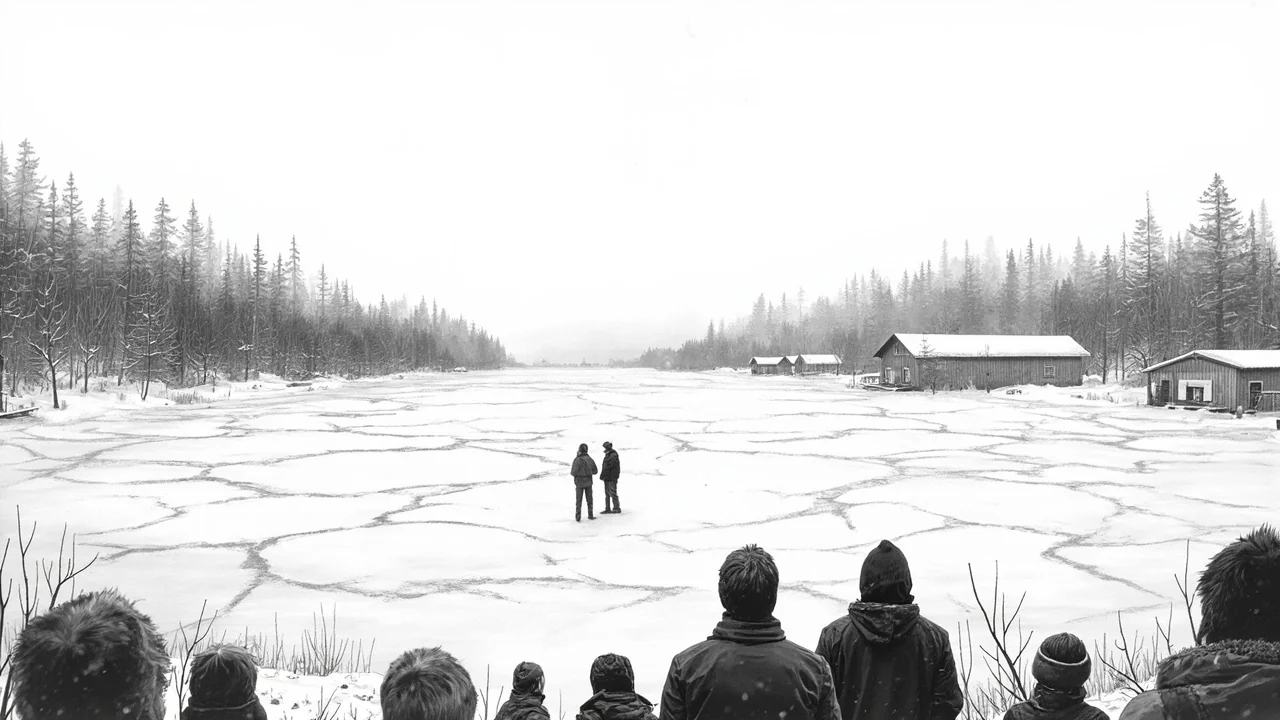
Finland's cherished winter tradition of natural ice skating rinks faces a critical test this week, with the opening of the popular Jyväsjärvi track in central Finland hanging on a mere 20 centimetres of ice. The annual ritual, a symbol of Finnish resilience and connection to nature, is delayed by unusually mild winter conditions, forcing local contractors and communities into a tense waiting game. "We'll bring the pontoons to the shore on Tuesday ready. I'm not making promises, but we're keeping our hopes alive," said Marcus Häkkinen, a second-generation contractor whose family business has maintained the rink for decades. His cautious optimism underscores a broader national concern as climate patterns shift and threaten seasonal customs.
Häkkinen's company, Country Häkkinen, drilled five test holes across Jyväsjärvi lake last week and again on Monday to measure the ice's thickness. The first hole, near the Sataman Viilu area, revealed exactly 20 centimetres—the absolute minimum required to support the 1,500-kilogram small tractor and its pontoons needed to clear and maintain the skating track. This precise measurement is the threshold between a community enjoying a winter playground and another season of disappointment. The situation in Jyväskylä is not isolated; similar reports are emerging from Southern and Central Finland where lake ice remains dangerously thin for recreational use well into January.
The Precarious Science of Safe Ice
The 20-centimetre standard is a well-established safety guideline in Finland, rooted in both practical experience and hydrological science. This thickness is calculated to distribute the weight of light machinery and, subsequently, hundreds of skaters. However, it represents a bare minimum, leaving no margin for error if temperatures fluctuate. The ice's strength is not uniform; it depends on factors like snow cover, which insulates and slows freezing, underwater currents, and the purity of the water itself. For contractors like Häkkinen, the decision to deploy equipment is a heavy responsibility, balancing public demand with absolute safety.
"You can have 20 centimetres in one spot and 15 just a few metres away. That's why we drill multiple test holes," explained a veteran ice safety instructor from the Finnish Swimming Teaching and Lifesaving Federation (SUH). "The public often sees a solid white surface and assumes it's safe, but we see a complex, living structure that can fail catastrophically." This professional caution is vital, as breaking through weak ice with heavy machinery is not only a financial loss but poses severe risks to operators. The community's anticipation must therefore be tempered by the contractor's rigorous, data-driven assessment.
A Tradition Under Threat from Warming Winters
The delayed opening of the Jyväsjärvi rink is a microcosm of a significant environmental trend. The Finnish Meteorological Institute has documented a clear trend towards later ice formation and earlier spring melts across Finnish lakes over the past 50 years. The period of safe, continuous ice cover has shortened, particularly in the southern and central parts of the country. This shift directly impacts cultural touchstones like ice skating, ice fishing, and traditional lake crossings, which are woven into the national identity.
From a policy perspective, this presents municipalities with new challenges. Investing in the infrastructure for natural ice rinks—contracting ploughing services, installing lighting—becomes a financial gamble if the season is unreliable. Some cities have turned to artificial outdoor rinks, but these lack the vast, natural expanse and scenic beauty that make tracks like Jyväsjärvi so special. The dilemma pits cultural preservation against adapting to a changing climate, a quiet but profound policy discussion happening in town halls across the nation.
The Community's Role in the Winter Wait
While contractors measure and officials ponder, the community's role is one of patience and shared hope. Social media groups in Jyväskylä are filled with daily updates and photos of the lake, with residents eagerly interpreting weather forecasts. The opening of the rink is a social event that boosts local wellbeing during the darkest months, providing free, accessible exercise and a space for communal gathering. Its delay is felt not just as an inconvenience, but as a loss of a seasonal rhythm.
Local businesses, especially cafes near the lakefront and sports shops hiring skates, also feel the impact. A late start can mean a significant reduction in seasonal revenue. This economic ripple effect shows how deeply embedded these winter traditions are in local economies. The community's collective deep breath, waiting for the signal that the ice is ready, highlights a shared vulnerability to the weather and a unified hope for a return to normalcy.
Looking Beyond This Season
The scene at Jyväsjärvi this week is a stark, real-time lesson in climate adaptation. It forces a conversation about how Finland preserves its winter culture. Solutions may involve more sophisticated ice-thickness monitoring technology, revised municipal budgets that account for shorter seasons, or even community-led ice farming techniques where water is flooded onto fields to create more controllable rinks. The knowledge held by families like the Häkkinens, passed down through generations, may need to be combined with new technologies and strategies.
For now, all eyes are on the thermometer and the courageous contractor who will make the final call. The pontoon tractor sits ready, a symbol of human preparation poised against natural uncertainty. The story of the Jyväsjärvi ice rink is no longer just a local news item about a recreational delay; it is a narrative about resilience, risk management, and the tangible effects of a warming climate on a nation defined by its winters. The 20-centimetre threshold is more than a safety rule—it is the line between a tradition thriving and a tradition merely surviving. As Finland navigates this new reality, the patience and preparedness shown at this one lake will need to be replicated nationwide, ensuring that the sound of blades on natural ice remains a part of the Finnish winter soundtrack for generations to come.