
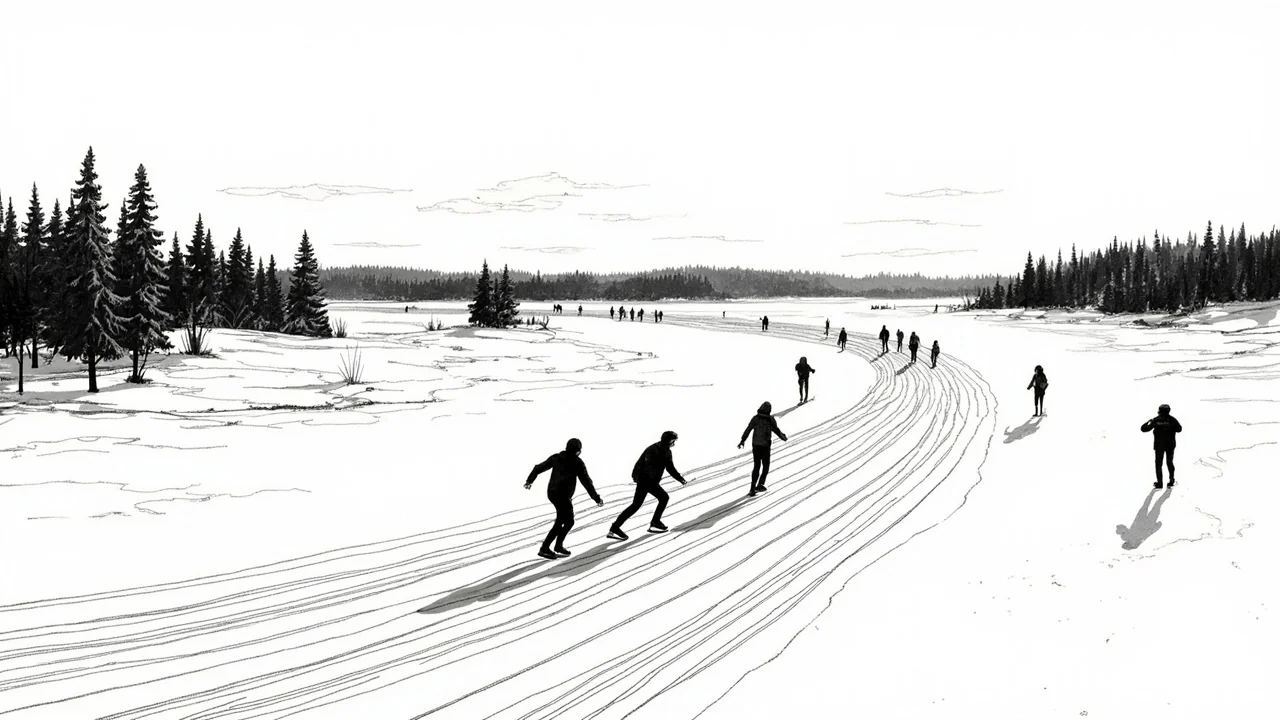
Finland's Saimaa Canal now features a one-kilometre ice track for skating and kick-sledding, maintained entirely by a crew of dedicated volunteers. In Nuijamaa, these locals are battling against an uncooperative winter to carve out a rare, safe corridor for public recreation on the historic waterway's thick ice. Their work has created a dual-purpose route that serves both ice skaters and users of potkukelkat, or kick-sleds, providing a vital outdoor resource during a season that has otherwise offered poor conditions for traditional ice activities.
Volunteer Effour Keeps Tradition Afloat
The operation is a classic example of Finnish talkoot, or communal work action. A group of friends, including Petri Kuokka, take it upon themselves to plow and maintain the track along the canal. They use their own snowmobiles and equipment to clear the path, ensuring it remains usable for anyone who wishes to visit. The same group also grooms a several-kilometre-long cross-country ski trail adjacent to the canal, effectively creating a small, informal winter sports centre. Visitors like Jukka Liirija and Tero Hämäläinen, who arrived on their snowmobiles near the Suikkia bicycle lift lock, are a testament to the spot's growing popularity, drawn by the knowledge that a reliable, maintained space exists.
Challenging Conditions Demand Adaptation
This winter's specific weather patterns have created a clear divide in usability on the canal ice. Petri Kuokka, who enjoys kick-sledding on the track, notes the distinct challenge for skaters. 'The kick-sled works really well. But for skates, this winter has been more difficult,' Kuokka described. The issue likely stems from snow cover and ice texture, a perfect skating rink requires repeated clearing and sometimes flooding to create a smooth, glassy surface, which is more labour-intensive than simply plowing a path for sleds. The volunteers' efforts are therefore specifically tailored to overcome the season's particular shortcomings, prioritizing a packed surface that supports a wider variety of activities even when ideal skating ice is hard to produce.
The Canal's Winter Transformation
The Saimaa Canal, a crucial maritime link between Lake Saimaa and the Gulf of Finland, undergoes a dramatic functional shift each winter. Its 23 locks freeze solid, and commercial shipping ceases, transforming the engineered waterway into a vast, frozen landscape. This annual freeze-over opens it up for public use, though safety and accessibility are never guaranteed. The volunteer-driven maintenance in Nuijamaa represents a localized, organized response to this opportunity, converting a transport corridor into a recreational one. It highlights a community's initiative to maximise the utility of public space, ensuring the winter canal serves people directly during its months of dormancy from maritime traffic.
A Community Hub on Ice
The resulting kilometre-long track is more than just a path, it functions as a social hub. The volunteers know their work attracts people, and users are aware they are benefiting from shared, voluntary labour. This dynamic fosters a sense of communal ownership and responsibility. There are no fees or formal organisers, just an understood agreement that those who create the resource do so for everyone's benefit, and users respect the space. This model is deeply ingrained in Finnish culture, where communal management of natural resources like forests, lakes, and now icy canals, is a common practice. The track's existence is a direct manifestation of this principle, providing a free, accessible venue for winter exercise and socialisation.
The Reliance on Volunteer Spirit
The sustainability of the Saimaa Canal ice track is entirely dependent on the continued goodwill and effort of its volunteer crew. There is no municipal authority or sports association officially managing the area, its survival year-to-year hinges on the same group choosing to undertake the arduous task of plowing and grooming. This informality is both its strength and its vulnerability. It allows for quick adaptation to conditions and fosters a genuine community project, but it offers no guarantee of permanence. The effort required is significant, involving hours of work in cold temperatures using private fuel and machinery, a contribution made purely for the love of the activity and the desire to share it with others.