
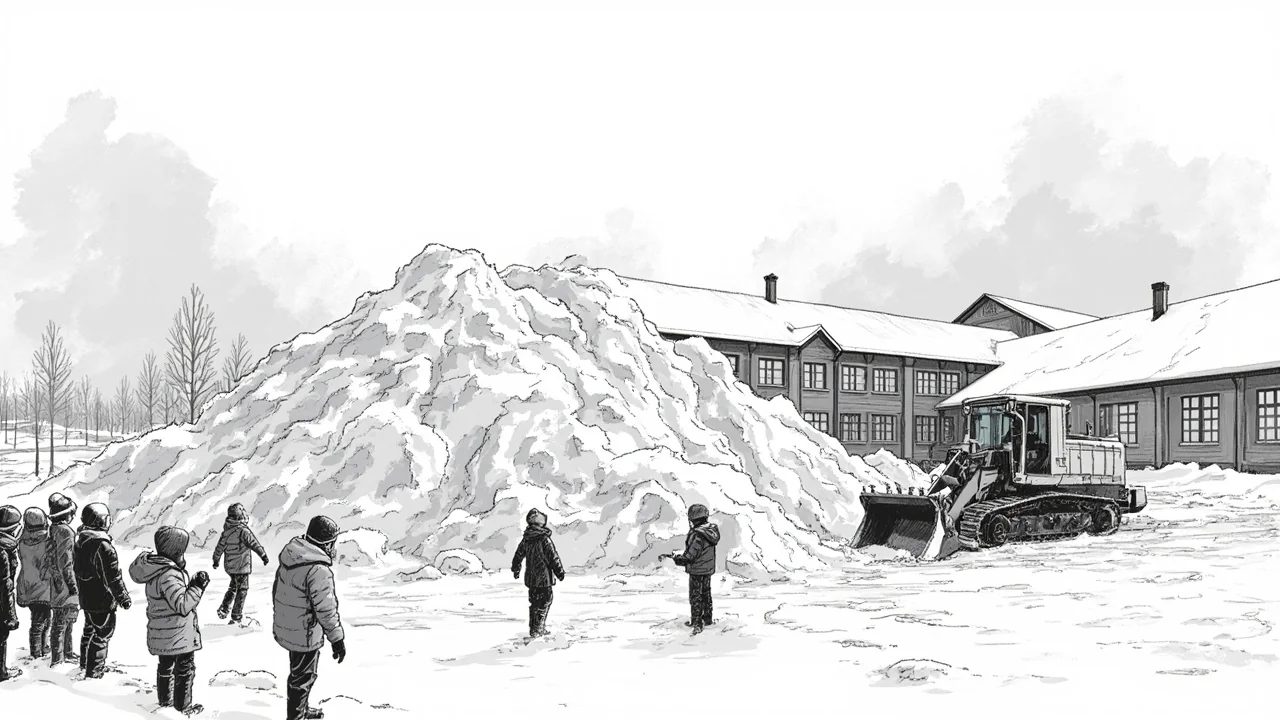
Finland's school safety protocols enacted a common but locally significant decision this week as authorities in Toivakka dismantled a large student-built snow pile. The Toivakka school center's leadership team ordered the removal of the snow mound located between the school and the Toivakkatalo building, citing clear safety hazards. Acting Deputy Principal Simo Marttinen from the Municipality of Toivakka confirmed that pupils had been building forts and caves into the pile, which sat just outside the school's official boundaries. The activity was deemed dangerous because the structure could collapse on children, and the snow might contain hazardous debris like broken glass.
The Calculus of Play and Risk
This single action in a Central Finnish municipality opens a window into the everyday application of Finland's overarching child safety and educational philosophies. While not a matter of parliamentary debate or ministerial decree, the decision operates within a framework established at the national level. The Finnish National Agency for Education's curriculum guidelines emphasize a safe learning environment, granting local school leadership the autonomy to make practical assessments. The Toivakka decision reflects this decentralized model, where a virka-apulaisrehtori (acting deputy principal) and a local school board evaluate a tangible risk against the recognized developmental value of unstructured, creative play. The move underscores a constant, quiet negotiation happening in schoolyards across the country: balancing the inherent benefits of independent outdoor activity, a cornerstone of Finnish childhood, with the professional duty of care.
Autonomy and Accountability in the Municipal System
Finland's education system delegates substantial operational authority to its 309 municipalities. The decision in Toivakka was not mandated by a directive from Helsinki but emerged from the local johtoryhmä (leadership team). This structure is typical. Municipalities and individual school administrators are empowered and expected to conduct their own risk assessments concerning school premises and adjacent areas used by children. The reasoning provided by Simo Marttinen—featuring specific, plausible dangers like structural collapse and hidden sharp objects—demonstrates the practical criteria used in these assessments. It is a routine administrative act, yet one that carries the weight of legal and ethical responsibility for student welfare. The procedure follows established channels of local governance, where such safety decisions are made efficiently without needing higher-level intervention, showcasing the functionality of Finland's decentralized public administration.
The Cultural Context of Snow and Safety
The snow pile, or lumikasa, is a ubiquitous feature of the Finnish winter landscape, traditionally serving as a natural playground. Its dismantling for safety reasons touches on a broader cultural conversation about risk aversion and childhood independence. Finland generally fosters a culture of trust and encourages children to engage with their environment, often in all weather conditions. However, this is not an unqualified freedom, it exists within professionally defined boundaries. The key factor in Toivakka appears to have been the scale and nature of the constructions—'linnoja ja luolia' (forts and caves)—which increased the risk of entrapment or a cave-in. This action does not signal a ban on snow play but illustrates a targeted intervention where play morphs into a scenario with predictable and significant danger. It highlights how Finnish educators apply principles of reasonable precaution, differentiating between acceptable risk and unacceptable hazard based on observable factors.
A Microcosm of Finnish Governance
Ultimately, the dismantling of the snow pile in Toivakka is a microcosm of Finnish societal function. It reflects a high-trust model where local authorities are empowered, a consensus-driven approach to child welfare that values both autonomy and safety, and a pragmatic response to environmental realities. There is no political conflict or scandal here, but rather a demonstration of routine administrative competence. The story's significance lies not in drama but in its ordinariness—it is a small, well-reasoned action that reveals the quiet machinery of a society built on responsibility, localized decision-making, and a profound, practical commitment to keeping its children safe. It prompts a consideration of how societies navigate the timeless conflict between childhood freedom and adult oversight, with Finland offering a model rooted in trust, professional judgment, and community-specific solutions.