
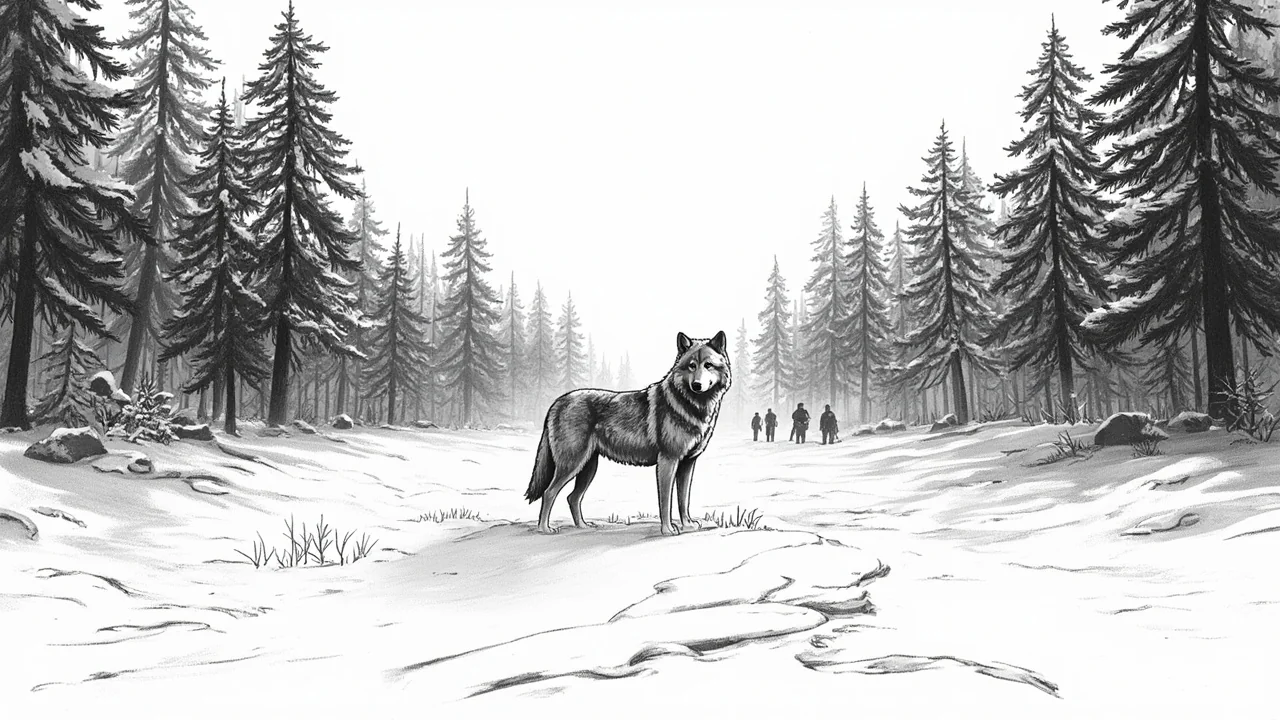
Finland's controversial wolf hunting season has reached a critical juncture, with over 80 of the 100-wolf annual quota already shot. The Finnish Wildlife Agency reports that hunting has concluded in ten designated areas, leaving wolves legally targetable in just six regions nationwide. This rapid pace of culling, driven by a government-sanctioned quota system, places Finland's wolf population management strategy under intense scrutiny from conservationists, rural communities, and European Union officials.
The hunting permits, issued by the Finnish government earlier this year, authorized the culling of 100 wolves across 16 specific management areas. The quota was established to address persistent conflicts between predators and livestock owners, particularly in rural regions where sheep and reindeer herding are common. The Ministry of Agriculture and Forestry argues the cull is necessary to prevent damage and alleviate local fears, framing it as a tool for social acceptability of large carnivores. However, the speed at which the quota is being filled—exceeding 80% by mid-season—suggests a high level of participation and, critics argue, an unsustainable pressure on a species still classified as endangered within the country.
A Policy Born from Political Pressure
The current hunting framework is a direct result of political negotiations within Finland's coalition government, led by Prime Minister Petteri Orpo. The center-right coalition, which includes the agrarian Centre Party, made explicit promises to rural constituencies to address predator conflicts. This led to the Ministry of Agriculture and Forestry, under Minister Sari Essayah of the Christian Democrats, pushing for more flexible hunting regulations. The policy represents a compromise between the strict protections demanded by the EU's Habitats Directive and the calls for population control from hunting and farming lobbies. The Eduskunta, Finland's parliament, has seen heated debates on the issue, with the Green League and the Left Alliance consistently opposing expanded hunting quotas, while the Centre Party and Finns Party advocate for even more aggressive management.
Finland's approach tests the boundaries of the EU's legal framework. The wolf is strictly protected under Annex IV of the Habitats Directive, requiring member states to ensure its conservation. Derogations for controlled hunting are permitted under specific conditions, such as preventing serious damage to livestock or in the interest of public safety. Helsinki justifies its quota under these clauses, but the European Commission maintains a watchful eye. Any perceived systematic failure to maintain a favorable conservation status could trigger infringement proceedings, a scenario Finnish ministers are keen to avoid. The Ministry of the Environment, led by Minister Kai Mykkänen of the National Coalition Party, must constantly balance domestic political demands with international legal obligations.
The Geographic Frontlines of the Hunt
The closure of hunting in ten areas, including the recent closure in the Lauhanvuori region, concentrates remaining hunting pressure on a shrinking map. The six areas where hunting remains open are now focal points for the final phase of the season. These regions typically feature a mix of dense boreal forest and scattered farmland, where encounters between wolves and domestic animals are most frequently reported. Local hunting associations coordinate the culls, operating under strict permits that specify the number, sex, and sometimes the age of wolves that can be taken. The Finnish Wildlife Agency monitors the reported kills in real-time, announcing closures as each area's sub-quota is met.
This geographic targeting is central to the government's strategy. By permitting hunting only in specific conflict zones, policymakers aim to surgically remove problem individuals or packs believed to be responsible for attacks on livestock. Proponents argue this method is more precise and socially acceptable than blanket protection. Yet, wildlife biologists caution that wolf pack structures are complex. Removing key individuals can disrupt pack stability, potentially leading to increased livestock predation by dispersing, inexperienced wolves, or causing unexpected shifts in territorial boundaries that create new conflict areas. The long-term ecological impact of this selective removal in Finland remains a subject of ongoing study and debate.
Conservation Backlash and Legal Challenges
Environmental organizations, including the Finnish Nature League and the Finnish Association for Nature Conservation, have condemned the scale of the hunt. They cite the fragile state of Finland's wolf population, which numbers only around 300 individuals, fragmented into small, genetically vulnerable packs mostly in the eastern and central parts of the country. Conservationists argue that an annual cull of 100 wolves represents a disproportionate removal, risking the genetic health and long-term viability of the population. They question the reliability of the population estimates used to set the quota and challenge the government's assertion that every killed wolf is a proven "problem animal."
Legal challenges have become a constant feature of Finland's wolf policy. NGOs have previously taken the state to court over hunting permits, arguing they violate both Finnish nature conservation law and EU directives. While not always successful in stopping hunts entirely, these lawsuits have forced authorities to meticulously justify their decisions and have occasionally led to reduced quotas. The threat of litigation also influences the timing and transparency of the permit process. This adversarial dynamic ensures that every hunting decision is made with the knowledge that it may be scrutinized by a judge, adding a layer of judicial oversight to the politically charged issue.
The Rural Perspective: Fear, Livelihood, and Tradition
In the communities where hunting is ongoing, the perspective is starkly different. For many livestock owners, the wolf is not a symbol of wilderness but a direct threat to their economic survival. A single wolf attack can wipe out dozens of sheep in one night, causing significant financial and emotional distress. Electric fences and guard dogs, while helpful, are not foolproof solutions in Finland's vast forest landscapes. This tangible threat fuels a deep-seated frustration with what is perceived as urban-centric conservation policy imposed by Brussels and Helsinki. The regulated hunt is seen as a necessary tool for self-defense and a recognition of their plight.
Hunting culture also runs deep in these regions. The regulated wolf cull is integrated into a broader tradition of game management. Local hunters often view their role as one of stewardship, arguing that controlled predation management benefits all wildlife by preventing overpopulation and disease. They emphasize that they follow the law meticulously and that the hunt is not a sport but a management action. This cultural chasm—between the rural view of the wolf as a manageable game animal and the urban/ecological view of it as a protected apex predator—lies at the heart of Finland's enduring conflict. The government's quota system is, in essence, an attempt to bridge this unyielding divide with a numerical compromise.
The EU's Watchful Eye and Finland's Balancing Act
As the hunt progresses, officials in Helsinki remain acutely aware of the European Commission's stance. Finland has previously been criticized for its carnivore management. The country walks a tightrope, using the derogation clauses of the Habitats Directive to authorize hunting while simultaneously investing in non-lethal prevention measures like fence subsidies and compensation schemes for lost livestock. The Ministry of Agriculture and Forestry frequently highlights these coexistence investments to demonstrate a balanced approach. The underlying question for EU authorities is whether Finland's actions are a genuine exception for specific problems or a disguised form of population control, which the Directive does not permit.
The final tally of this year's hunt, likely to hit or come very close to the full 100-wolf quota, will provide fresh data for this debate. Population monitoring in the coming year will be crucial. If wolf-related damage decreases without a corresponding drop in overall pack health and distribution, the government will claim vindication. If livestock attacks continue unabated or if genetic studies show increased inbreeding, critics will say the cull was ecologically reckless. The results will directly inform next year's quota proposal, setting the stage for another round of political negotiation, legal review, and social conflict. Can Finland find a sustainable path that truly reconciles the survival of its wolves with the legitimate concerns of its rural citizens, or is this an annual cycle of conflict with no resolution in sight?