
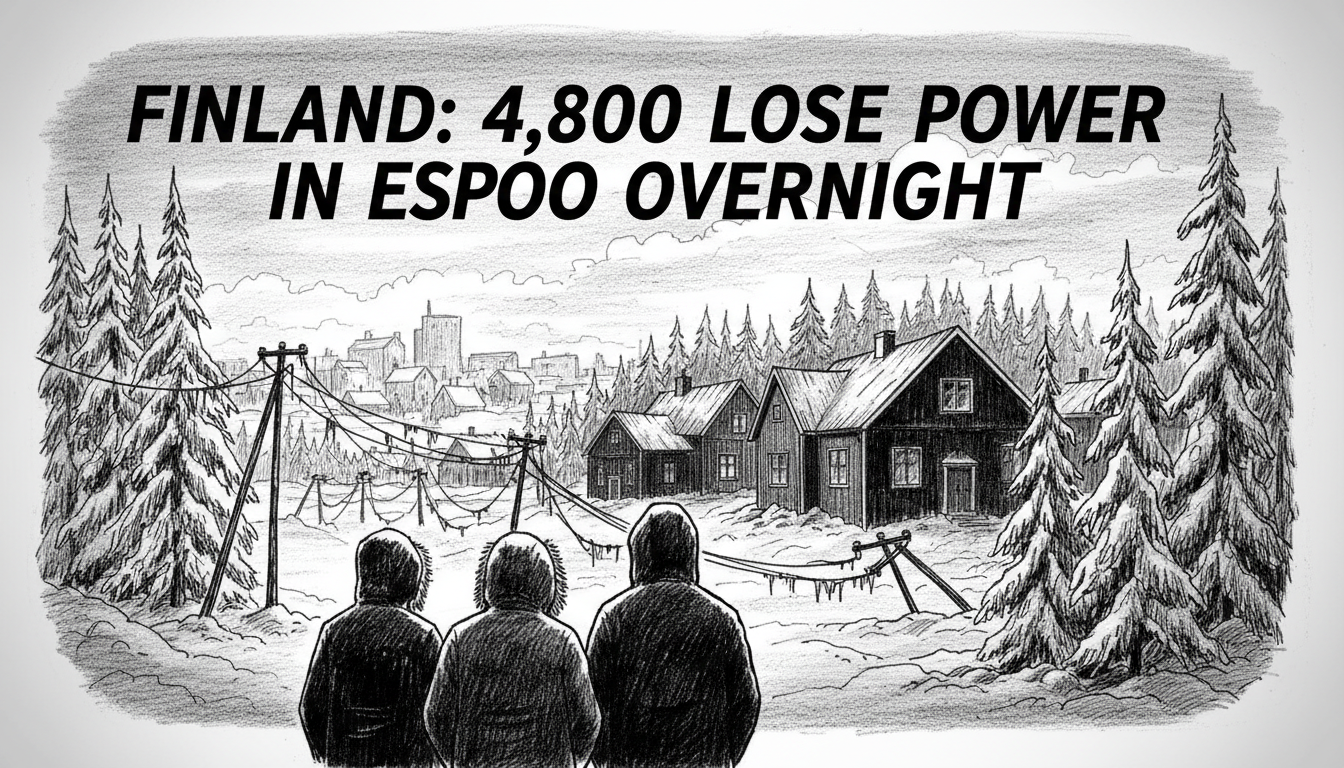
Finland's electricity grid faced a significant disruption early Friday morning as a widespread power outage hit the city of Espoo. Up to 4,800 customers of the distribution network operator Caruna were plunged into darkness, with the blackout beginning shortly after midnight and restoration efforts continuing for hours. The incident has reignited a long-running national debate about the resilience of Finland's power infrastructure and the significant costs of improving it.
Waking Up in the Dark
Residents in the districts of Pohjois-Tapiola and Tapiola woke up to a cold, silent morning as the outage severed power to homes and businesses. Caruna's live outage map showed a concentrated cluster of affected properties in these central Espoo neighborhoods. The company confirmed the fault began at approximately 00:10 local time. Their initial repair crews worked through the night, aiming to restore service for all customers by 04:30 Friday morning. By the time repairs were underway, the number of affected customers had been reduced to around 1,900, though the disruption to sleep and morning routines for thousands was complete.
Such outages, while disruptive, are not uncommon in Finland. The country's extensive forest cover and reliance on overhead power lines in many areas make the network vulnerable, especially during autumn storms and heavy winter snowfall. Falling trees and branches frequently damage lines. Caruna, as the dominant electricity network operator in southern and western Finland, manages over 44,000 kilometers of power lines. Their response time and communication during such events are often scrutinized by both customers and regulators.
The Cost of Keeping the Lights On
Finland generally boasts a highly reliable electricity supply by European standards. The average duration of interruptions per customer each year is low compared to many EU nations. This statistic, however, offers little comfort to those facing a freezing home or a business with spoiled goods. The Espoo outage, occurring on a calm night, points to causes beyond severe weather. Technical failures in substations, cable faults, or accidental damage from construction work can trigger these events.
This incident immediately brings the perennial issue of underground cabling back to the fore. The political question in Helsinki is straightforward but costly: should Finland accelerate the burial of its power lines? The Social Democratic Party and the Green League have consistently pushed for more investment in underground networks. They argue that the societal and economic costs of outages—from lost productivity to food spoilage and safety risks—justify the enormous upfront investment.
Opponents, including many fiscal conservatives, point to the staggering expense. Burying cables can cost up to ten times more than maintaining overhead lines. These costs would ultimately be passed to consumers through higher network charges. The Centre Party, with its strong rural base, also notes that while burial might make sense in dense urban areas like Espoo, it is economically unfeasible for vast, sparsely populated regions of the country.
A Private Operator in the Public Eye
Caruna's role adds another layer to the debate. It is a privately owned, profit-driven company, purchased by a consortium of international investors including the Canadian pension fund OMERS. Since its acquisition, there have been repeated public and political concerns about whether the profit motive aligns with the imperative for resilient national infrastructure. The Finnish Energy Authority regulates the maximum prices Caruna can charge, but investments and maintenance schedules are largely company-driven.
Following the outage, Caruna's communication strategy was typical for such events: updates via its online outage map and social media channels. For affected residents, this digital-first approach is effective only if they have mobile data and charged devices. Some local politicians have previously called for more proactive, direct communication with municipalities during large-scale disruptions, especially those affecting critical services or lasting through the night.
An expert from Aalto University's Department of Electrical Engineering and Automation, speaking on background, noted that no grid is immune to faults. "The focus is always on minimizing frequency and duration," the expert said. "Finland's grid is modern, but it is also vast and exposed to nature. Every major outage fuels the underground cable discussion, but the economic analysis is complex. It's a trade-off between higher monthly bills for everyone versus occasional disruptions for some."
Looking Beyond the Immediate Fix
The response to Friday's event will extend beyond Caruna's repair crews. Local officials in Espoo will likely request a detailed fault report from the company. Members of Parliament (Eduskunta) from the affected areas may raise questions about network reliability, especially with winter approaching. The Ministry of Economic Affairs and Employment monitors these events as part of its broader oversight of national energy security.
The incident also touches on Finland's broader climate and energy transition goals. A more electrified society, with electric vehicles and heat pumps, depends fundamentally on a reliable grid. This dependency increases the potential impact of each outage. Consequently, grid resilience is no longer just a matter of convenience but a core component of national strategy.
As power was restored in Tapiola, the immediate crisis ended. The political and economic conversation it reignites, however, is ongoing. The Finnish model balances cost, reliability, and fairness. Events like the Espoo outage test that balance, forcing policymakers, companies, and citizens to question whether the current equilibrium is right for the future. With climate change promising more extreme weather, the pressure on Finland's infrastructure will only grow. The nation must decide if the price of near-perfect reliability is one it is willing to pay.