
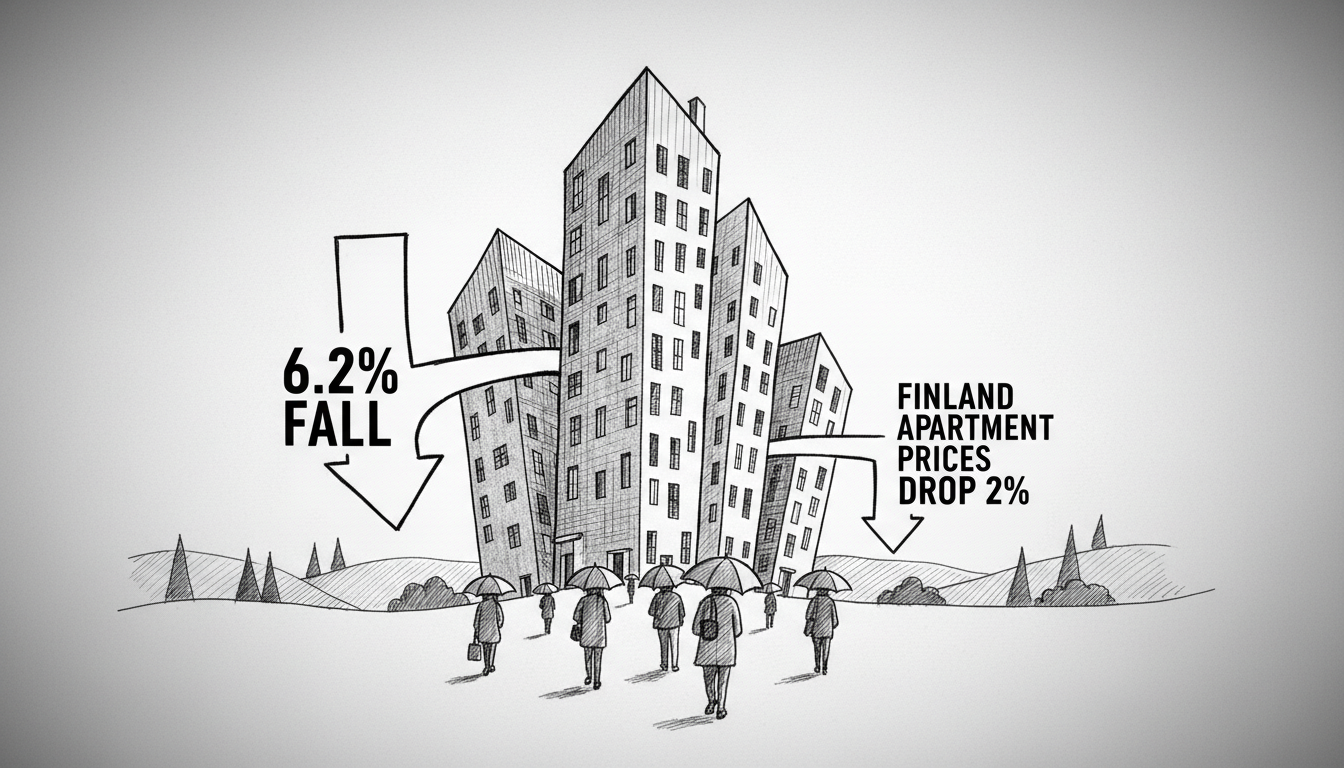
Finland's housing market shows a continued cooling trend with prices for old apartment shares decreasing by 2.0% nationwide over the past year. The latest data from Statistics Finland reveals that this decline is not uniform, with Vantaa experiencing the most significant drop at 6.2% and Turku following closely with a 5.7% decrease. This marks a persistent correction in a market that saw substantial growth in previous years, raising concerns among homeowners and investors alike.
A Market in Correction
The 2.0% nationwide dip confirms a broader shift in the Finnish real estate landscape. All major urban centers recorded falling prices, signaling that local economic factors are interacting with national trends. This decline follows a period of rapid appreciation, particularly during and after the COVID-19 pandemic, when low interest rates and shifting work patterns fueled demand. Analysts now point to a necessary market adjustment. "We are witnessing a normalization after an unsustainable climb," said economist Laura Saarela from the Helsinki Graduate School of Economics. "The key drivers now are rising borrowing costs and a cautious consumer sentiment, which are outweighing the fundamental demand for housing in growth areas."
Geographic Disparities in Decline
Vantaa's sharp 6.2% decline places it at the epicenter of the downturn. As part of the broader Helsinki metropolitan area, Vantaa's market is often seen as a bellwether for suburban housing trends. The drop suggests that affordability pressures are hitting satellite cities harder, possibly due to their higher proportion of first-time buyers who are more sensitive to interest rate hikes. Turku's 5.7% decrease similarly highlights how regional capitals are not immune to the slump. In contrast, while Helsinki proper also saw prices fall, the rate was less severe, indicating that prime locations may retain value better despite overall market weakness. This disparity underscores the fragmented nature of the current correction.
Economic Headwinds and Policy Context
The primary forces behind the price drops are well-documented by financial institutions. The European Central Bank's interest rate increases have directly translated into higher mortgage costs for Finnish households. This has cooled buyer enthusiasm and reduced purchasing power. Simultaneously, economic uncertainty linked to global inflation and weak export prospects has made potential buyers more hesitant. From a policy perspective, the Finnish government has been monitoring the situation closely. The Ministry of the Environment has acknowledged the trend in recent briefings, emphasizing a focus on long-term housing affordability rather than short-term market interventions. Within the EU framework, Finland's market adjustments are being compared to similar cooling in other Nordic and Baltic states, though the Finnish decline remains relatively moderate.
Implications for Homeowners and Buyers
For existing homeowners, especially those in Vantaa and Turku, the decline represents a tangible loss in asset value. This could affect household wealth and confidence, potentially limiting consumer spending. For prospective buyers, the falling prices present a double-edged sword. Lower entry points are beneficial, but tighter lending standards and higher loan costs offset some advantages. Real estate agents report a longer average time on market for properties, particularly for older apartment buildings in suburban zones. "Sellers need to adjust their expectations to the new reality," noted broker Mikko Järvinen from a major Helsinki-based agency. "The days of multiple bids above asking price are gone in many neighborhoods. It's now a buyer's market in several segments."
The Supply and Demand Equation
Another critical factor is the housing supply pipeline. Construction of new apartments has remained robust in some areas, adding to the available inventory and giving buyers more options. This increased supply, meeting softened demand, naturally pressures prices downward. In cities like Vantaa, new development projects completed in the last two years are now competing with older units, exacerbating the price competition. Demographic shifts also play a role; internal migration patterns have slowed, with less movement from rural areas to cities than in previous decades. Population growth in key urban regions has moderated, reducing the constant pressure on housing demand that previously drove prices upward.
Expert Outlook and Future Trajectory
Most market observers believe the correction has further to run. Banks forecast that interest rates will remain at their current elevated levels for most of the coming year, sustaining pressure on the market. However, a drastic crash is considered unlikely due to Finland's stable employment situation and the underlying housing shortage in growth centers. "We expect a gradual bottoming out over the next 12 to 18 months," predicted Saarela. "Prices may decline another few percentage points before stabilizing. The market is finding a new equilibrium based on genuine affordability, not speculative demand." The government's role will be crucial in managing the social impact, particularly for over-leveraged households, but large-scale bailouts are not currently on the political agenda in Helsinki.
A Test for Stability
The ongoing price decline serves as a stress test for Finland's financial stability and housing policy framework. While painful for some, it may lead to a healthier, more accessible market in the long term. The significant drops in Vantaa and Turku will likely trigger localized discussions on municipal planning and development incentives. As Finland navigates this period of adjustment, all eyes will be on the next quarterly data set to gauge whether the descent is accelerating or beginning to moderate. For now, the message from the numbers is clear: the era of easy gains in the Finnish housing market is over, and a new chapter of cautious realism has begun.