
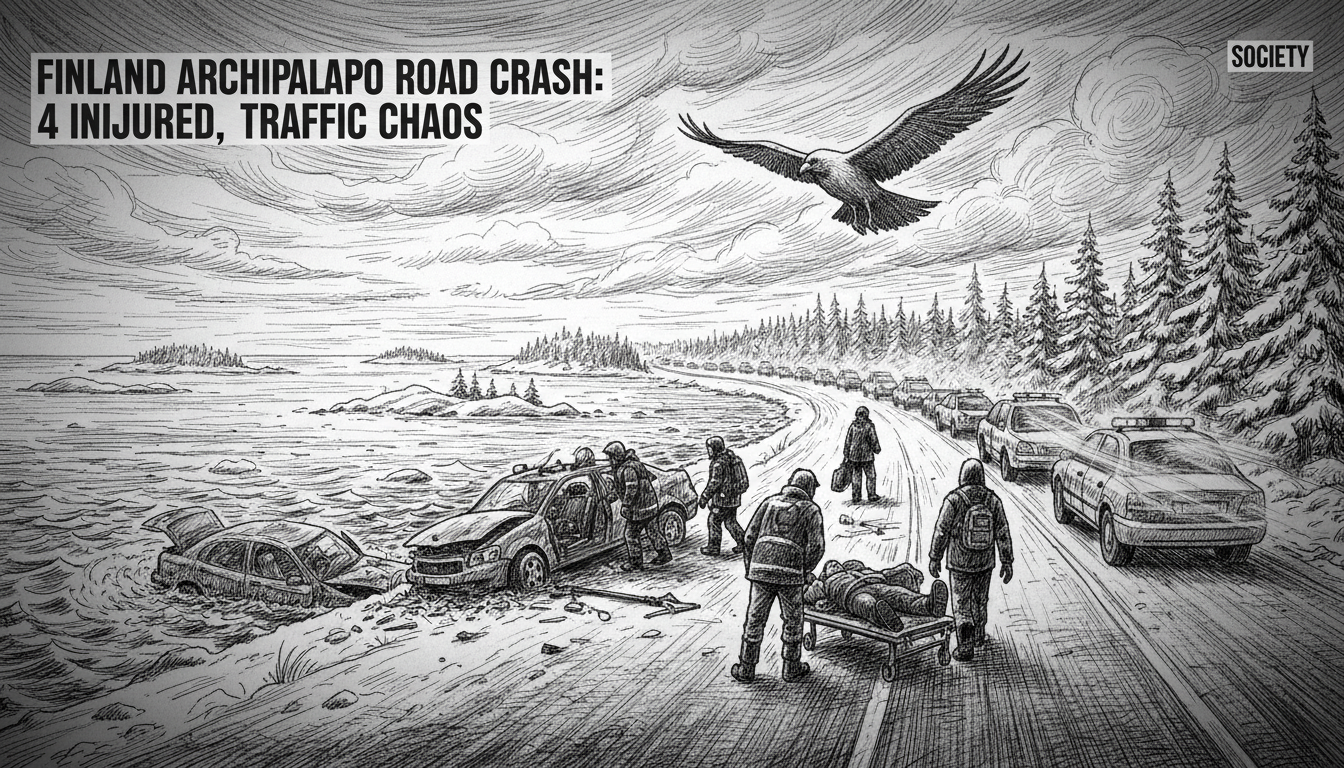
Finland's scenic Archipelago Road became a scene of disruption and injury on Thursday afternoon after a serious head-on collision near the town of Pargas. The crash, involving two passenger cars, sent four people to the hospital and triggered kilometers-long traffic jams on the vital tourist and commuter route connecting Korppoo and Kaarina. Emergency services reported significant congestion on Saaristotie, with the limited alternative routes in the island-dotted region exacerbating the gridlock.
A Scenic Route Transformed into a Traffic Standstill
The accident occurred on a key stretch of Road 180, known as the Archipelago Road or Saaristotie. This network of bridges, causeways, and ferry connections weaves through the stunning Turku archipelago, a major summer destination for both domestic and international tourists. The South-West Finland Police Department confirmed the head-on collision and the four injuries. All injured individuals required further hospital treatment, though the precise nature and severity of their injuries were not immediately disclosed. The Lounais-Suomen pelastuslaitos (South-West Finland Rescue Department) highlighted the immediate consequence: severe traffic congestion stretching for kilometers along the already busy corridor.
This incident underscores a persistent vulnerability in Finland's transport infrastructure. The Archipelago Road, while picturesque, often lacks parallel alternative routes. When a crash or closure occurs, vehicles have few options for detours, especially larger trucks or caravans. The reliance on scheduled ferry connections at certain points further complicates traffic management during incidents. Thursday's crash effectively created a bottleneck, stranding motorists during the afternoon travel period.
Recurring Safety Challenges on a Vital Artery
Road safety experts point to the Archipelago Road's unique characteristics as factors in its accident risks. The route features a mix of long, straight sections encouraging higher speeds and sudden, winding passages through rocky landscapes. During summer, traffic volume increases dramatically with tourist vehicles, cyclists, and pedestrians, creating a complex mix of road users. Weather conditions, including sudden sea winds, rain, or winter ice, can also pose significant hazards on the exposed roadways and bridges.
"Accidents on routes like the Archipelago Road have a disproportionate impact compared to similar incidents on mainland highway networks," explains a Finnish transport planning consultant familiar with the region. "The geographical constraints mean there is no simple way to redirect the traffic flow. A single collision can paralyze movement for an entire peninsula, affecting commuters, commercial deliveries, and emergency services access. It places immense pressure on response units to clear the scene rapidly."
Data from the Finnish Transport Infrastructure Agency (Väylävirasto) consistently shows that rural two-lane roads, which describe much of the Archipelago Road, see a higher rate of serious accidents per kilometer than motorways. Head-on collisions, often resulting from overtaking errors or lapses in concentration, are a particularly severe risk on these undivided carriageways. The government's national road safety strategy has targeted a reduction in such accidents, but implementing widespread physical separation on scenic routes remains a costly and complex challenge.
Emergency Response and Traffic Management in a Constrained Environment
The response to Thursday's crash involved coordinated efforts from police, rescue services, and likely the Finnish Border Guard, which often assists with maritime-related incidents in the archipelago. The priority in such remote yet busy locations is a multi-pronged effort: providing urgent medical care, conducting a thorough crash investigation, and restoring traffic flow as safely and quickly as possible. Towing damaged vehicles from a narrow road with limited access points is a logistical challenge that contributes to prolonged clearance times.
For stranded motorists, information is critical. Authorities typically use variable message signs and traffic news broadcasts to alert drivers approaching the area. However, for those already in the queue, options are limited. The incident serves as a stark reminder for travelers to be prepared for delays when navigating the archipelago, especially during peak seasons. Carrying water, snacks, and patience is standard advice from local motoring organizations.
The economic ripple effects of such disruptions are felt locally. Businesses reliant on timely deliveries or tourist arrivals can suffer from these unexpected road closures. The reputation of the region as an accessible and smooth tourist destination can also be subtly impacted by recurring news of major traffic incidents, though the natural beauty continues to be the primary draw.
Policy Implications and the Search for Solutions
This accident will likely reignite discussions in regional council meetings in Varsinais-Suomi (Southwest Finland) and at the national transport ministry. While major infrastructure projects like new bridges or tunnel links are discussed in long-term plans, they involve billion-euro investments and lengthy environmental assessments. More immediate measures include enhanced road safety campaigns targeting summer drivers, increased police patrols during high-traffic periods, and potential spot improvements to the most dangerous sections of road, such as adding crash barriers or improving sightlines.
From an EU perspective, Finland's road safety performance is generally strong, but its unique geography presents specific challenges. EU cohesion funds and transport network funding can sometimes be directed towards improving safety on TEN-T (Trans-European Transport Network) corridors, though secondary scenic routes like the Archipelago Road often compete for limited national resources. The balance between preserving a region's scenic character and implementing modern safety standards is a continuous debate in many European tourist regions, from the Amalfi Coast to the Scottish Highlands.
In the Eduskunta, the Finnish Parliament, questions about regional road maintenance and safety investments are perennial topics for MPs from coastal constituencies. The governing coalition, led by Prime Minister Petteri Orpo's National Coalition Party, must balance strict fiscal policy with tangible investments in infrastructure across the country. Incidents like the Pargas crash provide concrete examples for opposition and regional politicians to argue for increased funding.
Looking Ahead: Safety Versus Scenery in the Archipelago
The four individuals injured in the collision face personal recoveries, while the thousands caught in the traffic face a reminder of the fragility of connectivity in archipelago regions. The crash near Pargas is not an isolated event but part of a pattern that tests the resilience of Finland's coastal infrastructure each year. As summer approaches and traffic volumes swell, pressure will mount on authorities to demonstrate that safety on the iconic Archipelago Road is being proactively managed.
Will this incident catalyze faster action on known risk points, or will it be absorbed as an unfortunate but expected cost of accessing one of Finland's most beautiful landscapes? The answer depends on political will, budgetary priorities, and the continued advocacy of local communities who rely on Saaristotie not just for tourism, but for their daily lives. The road's future must navigate the difficult path between preserving its tranquil charm and ensuring it does not become a recurring headline for the wrong reasons.