
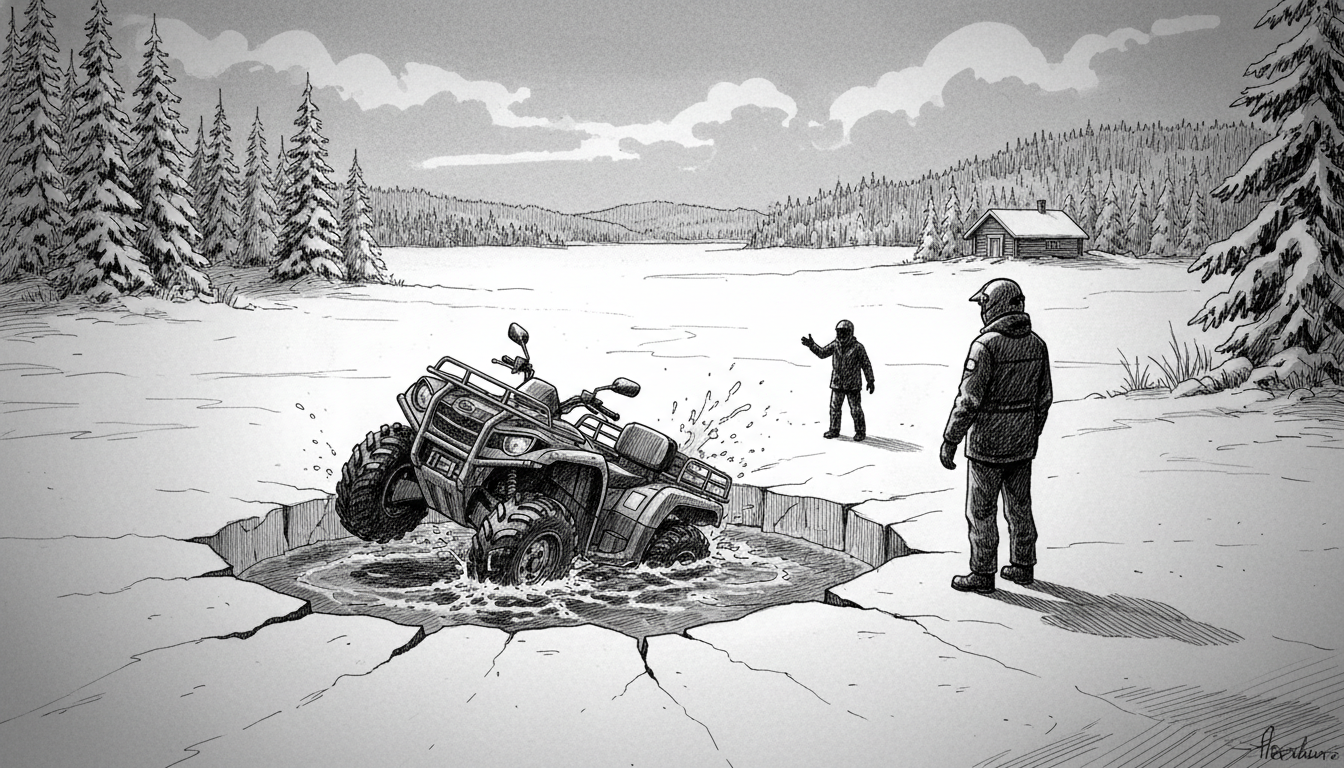
Finland ATV safety faces scrutiny after a recreational vehicle, known locally as a mönkijä, sank into a body of water in Jämsä on Tuesday morning. The Central Finland Rescue Department confirmed the vehicle came to rest at a depth of approximately 1.5 meters on Vehkaojantie road. Emergency services were dispatched to the scene after 11:17 AM to assess recovery options for the submerged all-terrain vehicle. Officials reported the driver emerged physically unharmed from the incident, which highlights the unpredictable risks of off-road travel during Finland's spring thaw period.
This single-vehicle accident in the Central Finland region represents a common but often underreported category of incident involving popular recreational equipment. ATVs are integral to rural Finnish life, used for forestry work, agriculture, and accessing remote summer cottages. Their widespread use across the country's vast and varied terrain, however, brings a consistent pattern of accidents each year. The Jämsä incident occurred as melting snow and ice create deceptive and unstable ground conditions, a seasonal hazard rescue services know well.
A Routine Call with Deeper Implications
The response by the Central Finland Rescue Department was standard procedure for a vehicle recovery operation. Their primary task was to evaluate the feasibility of retrieving the ATV from the water, a process that involves assessing environmental damage risks, water depth, and equipment needs. While the driver escaped injury, the sunken machine represents a potential pollutant. Fuel, oil, and battery acids from a submerged vehicle can leak into waterways, posing an environmental threat that often necessitates recovery even when the vehicle is considered a write-off.
Rescue professionals emphasize that accidents like the one in Jämsä are frequently preventable. "The transition seasons, spring and autumn, are particularly challenging for off-road driving," says a veteran rescue commander with over twenty years of experience in Central Finland. "What looks like solid ground or thin ice can give way instantly. Operators must actively assess their route, not just follow familiar paths, as conditions change daily with temperature and precipitation." This expert perspective underscores a critical gap between the ATV's design for rugged terrain and the operator's assessment of its limits.
The Cultural Role of the Mönkijä in Finland
Understanding this incident requires a look at the vehicle's role in Finnish society. The word 'mönkijä' is a colloquial Finnish term for ATV, a workhorse of the countryside. Finland's geography, with its 187,888 lakes and extensive forests, makes conventional road access impossible for many properties and woodlots. These vehicles are not merely recreational toys but essential tools for loggers, farmers, and homeowners. Their popularity is reflected in sales figures, with thousands of new and used ATVs sold annually across the country.
This deep integration into daily life can, paradoxically, contribute to complacency. Familiarity with local terrain may lead drivers to underestimate new hazards, especially those presented by rapidly changing seasonal conditions. The accident on Vehkaojantie, a local road likely well-known to the driver, is a classic example. Safety campaigns repeatedly stress that no trail or ice crossing is ever the same twice, a message that struggles against the confidence born of routine.
Regulatory Framework and Safety Debates
Finland's regulatory approach to ATVs sits at a crossroads between personal freedom and public safety. Operating a mönkijä on public roads requires a standard driver's license (class B), and the vehicle must be registered and insured. However, on private land and designated off-road trails, regulations loosen significantly. There is no national mandate for helmet use off-road, though it is universally recommended by safety authorities and insurance companies. This mixed model places a heavy burden on individual responsibility and risk assessment.
Parliamentary discussions (Eduskunta) on ATV safety have surfaced periodically, often following tragic accidents resulting in fatalities. Proposals have ranged from mandatory safety courses for purchasers to stricter rules on youth operation. However, these talks often confront a strong cultural preference for minimal interference in rural lifestyles. The Centre Party (Keskusta), with its strong rural base, has historically emphasized education and voluntary guidelines over stringent legislation. The balance between preventing accidents and preserving practical access to the Finnish wilderness remains a delicate political issue.
Seasonal Thaw: The Hidden Hazard
The timing of the Jämsä accident is not coincidental. Late winter and early spring present a specific set of dangers known as 'kelirikko' (bad road conditions) and unstable ice. During the thaw, groundwater levels rise, and previously frozen ground turns to mud. Streams and ditches swell beyond their normal banks. Ice on lakes and ponds weakens from below and becomes honeycombed, losing strength even if it appears thick from the surface. An ATV, which distributes its weight differently than a snowmobile, can easily break through a weakened ice sheet or sink into saturated, boggy ground.
Rescue services across Finland see a predictable spike in calls during this period. These incidents range from vehicles stuck in deep mud to catastrophic breakthroughs into icy water. The Jämsä driver's escape without injury is fortunate; cold water immersion poses severe risks of hypothermia and drowning, especially if the driver is pinned by the vehicle or tangled in gear. The incident serves as an annual reminder of the powerful and dynamic natural forces that define the Finnish landscape, forces that do not accommodate human schedules or assumptions.
Analysis: Beyond the Single Incident
While this event ended without physical harm, it functions as a microcosm of broader safety challenges. It highlights the intersection of human judgment, machine capability, and environmental volatility. The Finnish Rescue Services (SPEK) and organizations like the Finnish Safety and Chemicals Agency (Tukes) collect data on such accidents, which informs public safety announcements. Their data consistently shows that a significant proportion of serious ATV incidents involve water, either through breaking ice or misjudging the depth of a crossing.
The economic costs are also notable. Recovering a sunken ATV is a resource-intensive operation requiring specialized winches and personnel. If the vehicle is not recovered, it becomes both an environmental contaminant and a financial loss for the owner, as comprehensive insurance may not cover accidents deemed to result from negligent operation. For municipalities and rescue departments, these operations divert resources from other potential emergencies, creating a public cost for a private incident.
A Look Forward: Education and Technology
The path to reducing such accidents likely lies in a combination of education and technological adaptation. Safety organizations advocate for pre-season refreshers on risk assessment, emphasizing the unique dangers of thaw periods. Some ATV manufacturers are incorporating more sophisticated stability control and flotation devices into new models, though these features are far from standard. In the Finnish context, where the vehicle is a tool first, practical training for rural operators—similar to that for forestry machinery—could prove more effective than blanket regulations.
The story from Vehkaojantie road is a small news item with a quiet conclusion. The ATV was likely retrieved, the driver returned home, and the rescue crew moved on to the next call. Yet, it encapsulates a recurring seasonal narrative in Finland. As the snow recedes and the land reawakens, the freedom to traverse it comes with a renewed responsibility to respect its hidden dangers. The mönkijä is a symbol of Finnish self-reliance and connection to nature, but this incident reminds us that nature always has the final say. Will the annual cycle of thaw-related accidents lead to a cultural shift towards more cautious off-road practices, or will the convenience and tradition of ATV use continue to override the persistent warnings of rescue professionals?