
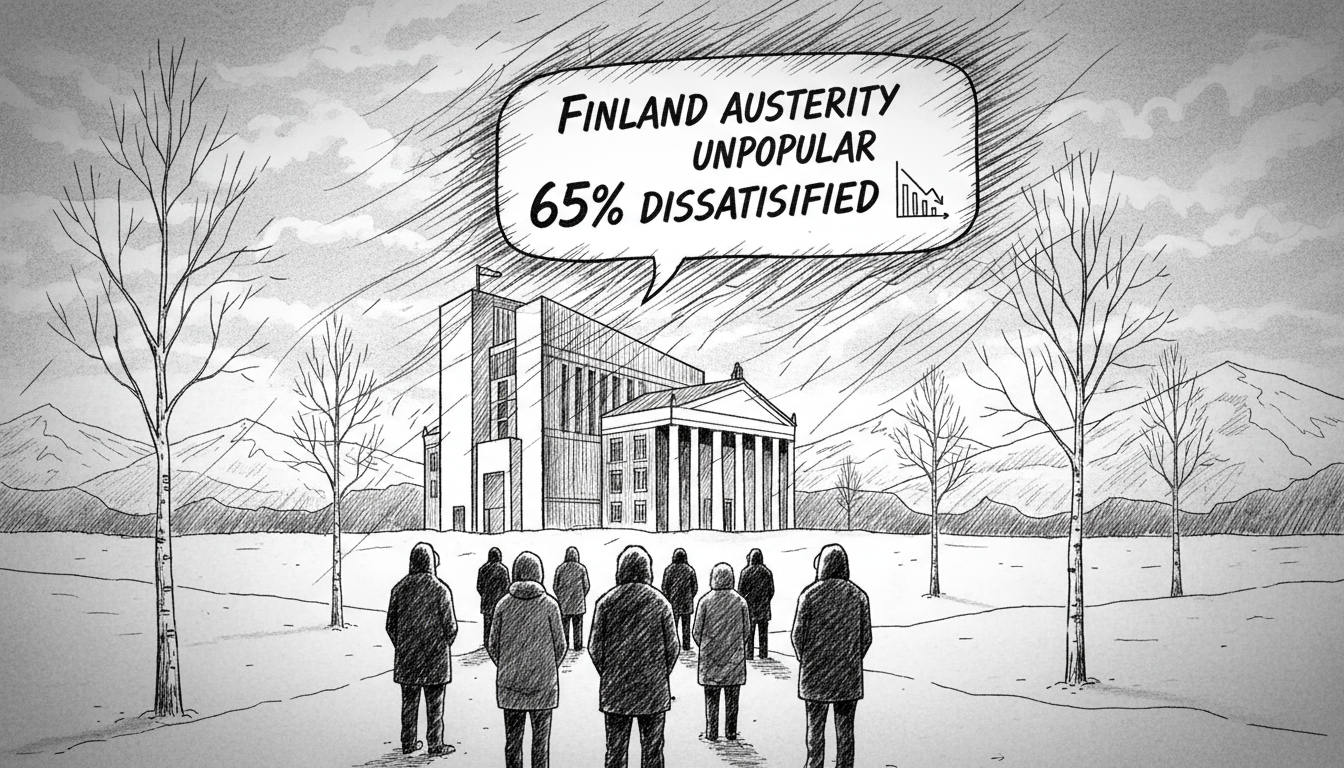
Finland's government faces a stark public opinion crisis as a new poll reveals nearly two-thirds of citizens are dissatisfied with its austerity measures. According to the latest USU-gallup, 65% of Finns are unhappy with the actions taken by Prime Minister Petteri Orpo's coalition to repair the nation's public finances, presenting a major political challenge as the government approaches the mid-point of its term.
The survey, conducted in late 2025, shows profound discontent cutting across most demographics. A significant 39% of respondents declared themselves 'very dissatisfied' with the government's fiscal consolidation program, while another 26% were 'somewhat dissatisfied'. Only one in five Finns expressed satisfaction, with just 20% reporting they were either 'very' or 'somewhat satisfied' with the policies. The remaining 15% adopted a neutral stance.
A Coalition of the Content?
The poll reveals a clear socioeconomic divide in attitudes towards the government's agenda. Satisfaction is concentrated among groups that have been relatively shielded from the harshest effects of spending cuts or have benefited from certain policy choices. Those with high incomes, entrepreneurs, and pensioners emerged as the demographics most content with the government's direction.
This alignment reflects key elements of the governing program drafted in the historic Helsinki government district negotiations in 2023. The coalition, led by Orpo's center-right National Coalition Party (Kokoomus) and including the nationalist Finns Party, the Swedish People's Party, and the Christian Democrats, promised to halt the growth of public debt through substantial savings. For entrepreneurs and high earners, policies like planned labor market reforms and certain tax adjustments hold potential long-term benefits, explaining their greater tolerance for short-term pain.
The Economic Reality Behind the Discontent
Public frustration is rooted in a tangible economic paradox. Despite eighteen months of contentious cuts and reforms, many Finns do not perceive a corresponding improvement in the state's financial health. Professor Niku Määttänen, an economics expert at the University of Helsinki, provided a blunt assessment that resonates with the poll findings. “The indebtedness continues, and the public sector deficit is still quite large,” Määttänen noted, analyzing the sentiment. “People are probably skeptical about the extent to the government has succeeded in strengthening public finances.”
This skepticism presents a fundamental communication and credibility problem for the cabinet. The government's program, titled “A Strong and Committed Finland,” argued that drastic action was necessary to correct a unsustainable trajectory of rising debt-to-GDP ratio. Ministers have repeatedly stated that the results of their painful decisions will materialize over years, not months. However, the immediate experience for many citizens has been reduced services, tighter social security eligibility, and increased costs in areas like healthcare and education, without a visible national payoff.
Navigating a Fraught Political Landscape
The overwhelming dissatisfaction places immense pressure on the four-party coalition's unity and strategic direction. With municipal elections on the horizon and a European Parliament election cycle having passed, maintaining discipline becomes harder when policies are so unpopular. The Finns Party, in particular, faces a delicate balancing act. As a party that often draws support from lower-income and welfare-dependent voters who are feeling the pinch of austerity, its continued commitment to deep cuts could alienate its base.
Meanwhile, the opposition is capitalizing on the grim poll numbers. The Social Democratic Party (SDP), the Centre Party, and the Left Alliance have consistently criticized the government's approach as socially unfair and economically misguided. They argue for alternative measures focusing more on economic growth and less on spending reduction. This poll provides them with powerful evidence that their message is connecting with a majority of the electorate.
Inside the cabinet's meeting rooms in the stately Government Palace, the debate likely centers on whether to stay the course or adjust tactics. Political analysts suggest that while a major shift in policy is unlikely, the government may seek to amplify messaging around any positive economic indicators and potentially slow the pace of some future cuts to soften the political blow.
A Historical Pattern of Painful Adjustments
Finland is no stranger to periods of severe fiscal consolidation. The country underwent significant austerity following the 1990s recession and again after the 2008 financial crisis. Historically, governments implementing such measures have faced steep declines in popularity, which have sometimes led to electoral losses in subsequent votes. The current situation echoes these past cycles, where the long-term necessity of balancing books clashes with the short-term hardship experienced by households.
What makes the Orpo government's position particularly challenging is the current global economic climate of slow growth and high geopolitical uncertainty. These external factors limit the government's ability to generate a rapid economic boost that might offset the negativity surrounding cuts. Furthermore, Finland's aging population creates persistent pressure on public expenditures for pensions and healthcare, a structural problem that no single government can solve quickly.
The Road Ahead for the Orpo Cabinet
The USU-gallup serves as a critical mid-term report card, and the grade is poor. With approximately half of its governing term remaining, the Orpo coalition has time to change the narrative, but the path is narrow. The government must demonstrate tangible progress in reducing the deficit and stabilizing debt, while somehow mitigating the daily impact of its policies on dissatisfied citizens.
The coming months will test the government's resilience. Key pieces of legislation, including controversial labor market reforms and additional social security adjustments, are still pending in the Eduskunta. Each debate and vote will be held under the specter of this overwhelming public disapproval. The government's ability to pass these measures without fracturing, and to eventually show data that proves their effectiveness, will determine whether this poll is a temporary setback or a prophecy of political decline.
Ultimately, the story told by this poll is one of a democratic contract under strain. A government elected on a platform of fiscal responsibility is enacting that platform, only to find the public's appetite for the prescribed medicine is vanishingly small. The fundamental question for Finnish politics is now whether trust in the long-term diagnosis can be restored before the political patience runs out completely.