
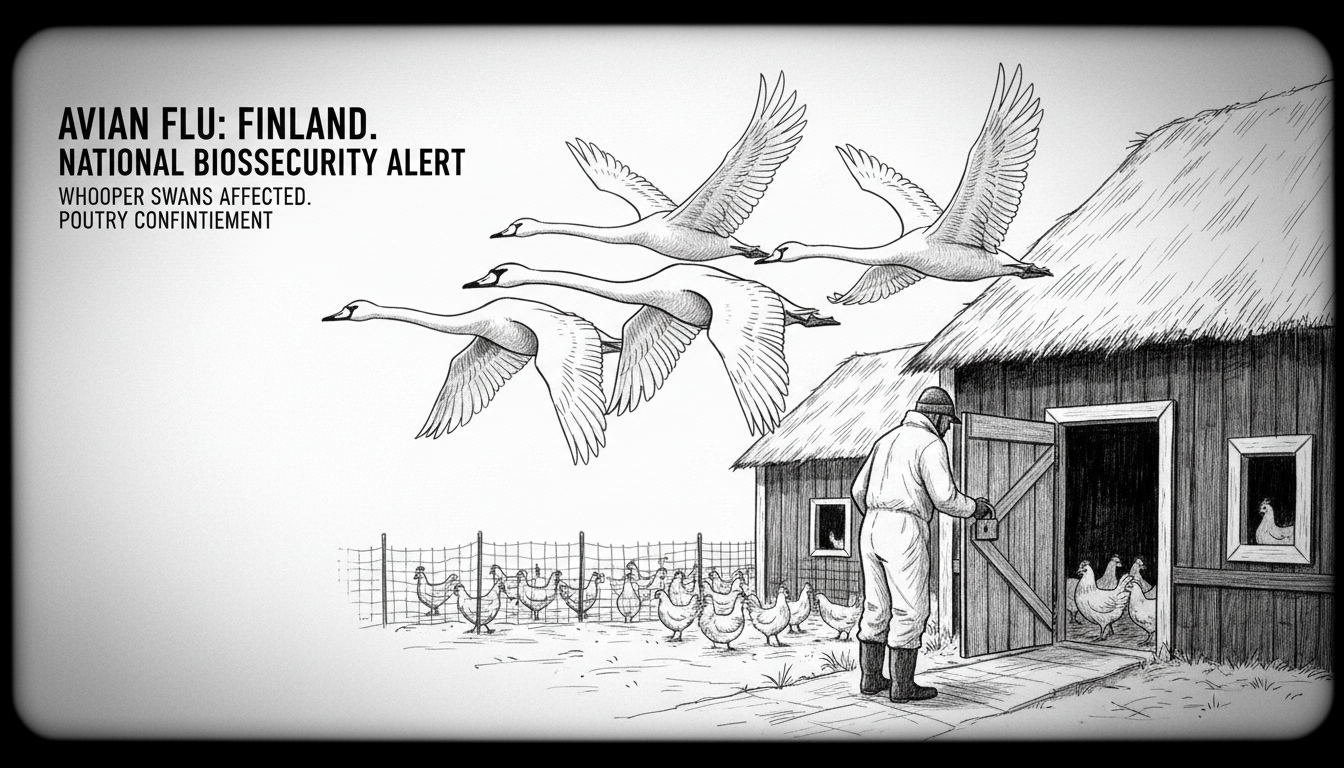
Finnish authorities have issued a nationwide advisory for poultry farmers and the public after confirming a highly pathogenic avian influenza outbreak in wild swans. The Finnish Food Authority now recommends keeping all poultry indoors in affected regions. This directive follows the detection of the H5N1 virus in two whooper swans found in Janakkala municipality during November. The discovery triggered an immediate response from local officials in Riihimäki, who coordinated with national veterinary agencies.
The detection in Janakkala, a municipality in the Tavastia Proper region, represents the first major avian flu case of the season in Southern Finland. The H5N1 strain poses a severe threat to both wild bird populations and commercial poultry operations. Finnish agriculture officials emphasize that the virus can spread rapidly through migratory bird routes. They have established monitoring zones around the detection site. Farmers across Uusimaa and Tavastia are now implementing strict biosecurity measures.
This outbreak carries significant economic implications for Finland's agricultural sector. The country maintains a robust export market for poultry products, particularly within the European Union. Any widespread outbreak could trigger immediate trade restrictions from partner nations. The Finnish Ministry of Agriculture and Forestry has contingency plans for such scenarios, but officials hope to contain the virus before it reaches commercial flocks. The situation requires careful balancing of wildlife conservation and food security interests.
From a public health perspective, the risk to humans remains classified as low by the Finnish Institute for Health and Welfare. Direct transmission to people is rare and typically requires close contact with infected birds or their environments. However, the agency advises citizens to avoid handling sick or dead wild birds. They recommend reporting any findings to municipal environmental services. This precautionary approach aligns with guidelines from the European Centre for Disease Prevention and Control.
The timing of this outbreak is particularly concerning for wildlife experts. November marks a period of active migration for many bird species moving south from Arctic breeding grounds. Whooper swans, Finland's national bird, are among these migrants. Their congregations at coastal and inland water bodies can accelerate viral transmission. Ornithologists note that climate change may be altering migration patterns and disease dynamics. Warmer autumns can delay migrations, potentially increasing contact between wild and domestic bird populations.
For international readers and residents in Finland, the practical advice is clear. The Finnish Food Authority states that poultry must be kept indoors or under netting in areas where wild bird flu is present. This prevents contact with migratory waterfowl. Bird feeders in gardens should be cleaned regularly with disinfectant. Anyone finding multiple dead wild birds should contact local authorities rather than touching the carcasses. These measures are standard protocol but require public cooperation to be effective.
Looking ahead, Finnish veterinary teams will conduct enhanced surveillance in wetland areas throughout the country. The success of containment efforts will depend on early detection and rapid response. Previous European outbreaks have demonstrated how quickly H5N1 can move through bird populations. Finland's extensive coastline and numerous lakes create both challenges and opportunities for monitoring. The coming weeks will be critical for determining whether this remains an isolated event or develops into a broader epizootic. The government's response will be closely watched by neighboring Nordic countries and EU agricultural officials.