
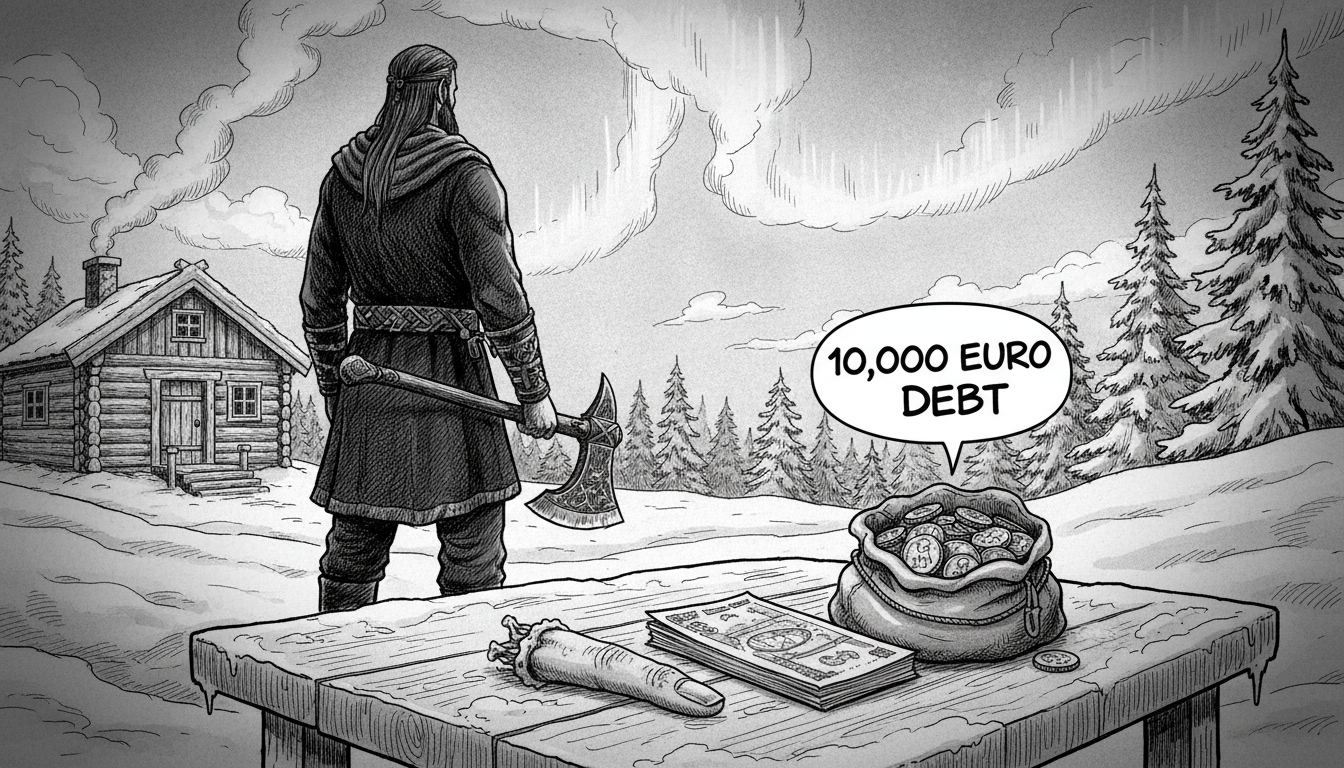
Finland violent crime has taken a particularly brutal turn in a case now before the Helsinki Court of Appeal. The case centers on an alleged debt of 10,000 euros, which prosecutors say led three men to abduct a victim from Porvoo, drive him to a remote forest in Orimattila, and systematically assault him with a baseball bat before severing his right index finger with an axe. This shocking act of premeditated violence, occurring in autumn 2020, challenges perceptions of safety in a nation known for its low crime rates and raises difficult questions about debt enforcement and extreme violence.
A Calculated Act of Brutality in the Finnish Forest
The facts of the case, as presented in court, read like a grim script. The male victim was taken from Perämiehentie in the historic coastal city of Porvoo. His assailants then transported him approximately 50 kilometers to a secluded forest road near Orimattila, a location chosen for its isolation. There, the violence escalated in stages. The initial beating was carried out with a baseball bat, a weapon indicating preparation. The assault then reached its horrific climax when the attackers used an axe. It took two deliberate blows with the blade to completely amputate the victim's right index finger. The injured man was subsequently left bleeding at the remote site, where he was later found. This sequence of events—abduction, transportation, staged violence, and abandonment—points to a calculated intent to inflict maximum terror and permanent physical punishment.
Finland's Crime Paradox: Low Rates and High-Profile Violence
This case exists in stark contrast to Finland's overall crime statistics. The country consistently records one of the lowest homicide rates in Europe, with approximately 5.7 homicides per million inhabitants in 2022. Aggravated assaults, while treated with utmost seriousness by the Finnish police and judiciary, form a small fraction of total reported crime. The nation's legal philosophy strongly emphasizes rehabilitation over pure punishment, a model often studied internationally. Yet, cases of extreme debt-related violence periodically surface, revealing a darker undercurrent. These incidents are often linked to informal lending, disputes within criminal networks, or severe personal conflicts exacerbated by financial pressure. They represent a violent subculture that operates outside the norms of Finnish society, where disputes are typically resolved through legal or social channels.
Legal Reckoning in the Helsinki Court of Appeal
The progression of this case to the Helsinki Court of Appeal signifies its gravity. The district court has already convicted the perpetrators of aggravated assault, a classification reserved for crimes of particular brutality, cruelty, or danger to life. The appeal process now scrutinizes both the convictions and the sentences handed down. In Finland, sentences for aggravated violent crimes can be lengthy, reflecting the system's dual goals of protecting society and delivering just punishment, even within a rehabilitative framework. The court will examine the evidence of premeditation, the level of cruelty involved, and the lasting physical and psychological damage inflicted on the victim. The act of amputation, intended as a permanent marker and a message, is a significant aggravating factor that will heavily influence the final sentencing.
Expert Analysis: Underlying Causes and Societal Signals
Criminologists examining such cases look beyond the immediate horror. "While statistically rare, these extreme acts of violence are often symptoms of deeper dysfunctions," explains a Finnish criminology researcher familiar with similar cases. "Potential underlying factors can include deep-seated socioeconomic despair, severe substance abuse disorders that lower inhibitions and escalate conflicts, or connections to organized crime where violence is a standard tool for enforcement." The alleged 10,000-euro debt is a key piece of the puzzle. In formal economies, such a sum would be pursued through collections agencies or courts. The resort to savage, extra-legal punishment suggests the debt existed within a shadow economy or a personal relationship where legal recourse was impossible or undesirable. The violence itself is communicative, designed to send a message of terror to the victim and potentially to others within a specific community.
The Lasting Scars Beyond the Physical Wound
The impact of such a crime extends far beyond the courtroom. For the victim, the loss of a finger is a permanent, daily reminder of the trauma. It can impair dexterity, affect employment, and cause chronic pain. The psychological scars—including post-traumatic stress, severe anxiety, and a fundamental loss of personal security—are often deeper and longer-lasting. Cases like this also send ripples through local communities, particularly in smaller cities like Porvoo and Orimattila, shaking the general sense of safety and trust. While Finnish police are effective, the premeditated nature of this crime shows how difficult it can be to prevent acts planned in private and executed in isolation.
A Test for Finland's Justice and Social Model
The final rulings from the Helsinki Court of Appeal will be closely watched. They will signal how the Finnish justice system weighs a crime of such specific cruelty. The sentences must balance the demand for proportionate punishment with the country's core principles of rehabilitation. Furthermore, the case highlights a challenging frontier for social policy: how to address the environments where informal debts become matters of life, limb, and brutal retribution. It underscores that even in societies with strong social safety nets and low crime, human conflict can descend into primitive violence. The case from Porvoo and Orimattila is a grim anomaly in the Finnish context, but a powerful reminder that no society is immune to the darkest forms of human aggression. The axe blows in that forest were not just an attack on one man, but a strike against the very idea of peaceful conflict resolution.