
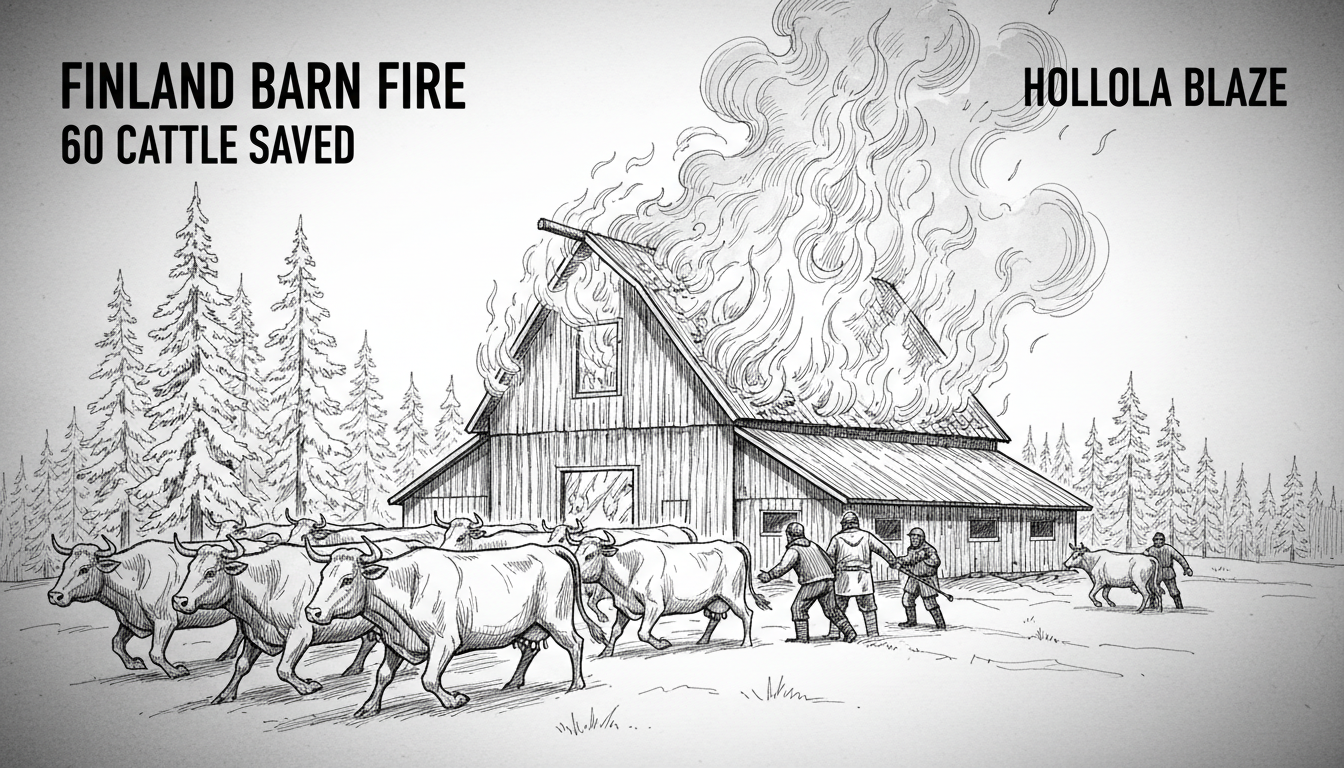
Finland's emergency services responded to a major barn fire in Hollola early Wednesday morning, successfully rescuing most of the 60 cattle inside the burning structure. The Päijät-Häme Rescue Department received the alarm at 4:08 AM local time, finding the approximately 1,400-square-meter barn fully engulfed in flames. Firefighters faced a prolonged battle to contain the blaze, which highlights the persistent risks to Finland's agricultural sector.
A Pre-Dawn Emergency Call
The first alert reached the regional rescue service center in the quiet hours before dawn. Crews from Hollola and surrounding municipalities were dispatched immediately to the rural location. Upon arrival, they confronted a severe and well-developed fire, with the large timber-framed barn structure already in what firefighters term a 'full fire phase.' The primary and most urgent task became the evacuation of the livestock trapped inside. Working quickly amid intense heat and smoke, responders managed to guide the majority of the 60 dairy cows to safety. The successful rescue operation prevented a significant animal welfare tragedy and represents a key success in an otherwise devastating incident.
The Challenges of Rural Firefighting
Containing a fire in a structure of this scale presents formidable logistical hurdles. A barn measuring 1,400 square meters, roughly equivalent to a third of a football field, requires massive volumes of water and sustained personnel deployment. The Päijät-Häme Rescue Department anticipated a long-duration operation, a common scenario in rural agricultural fires. Access to sufficient water sources is often a critical factor; firefighters may need to shuttle water via tanker trucks from distant lakes or hydrants. Furthermore, the combustible materials present in a barn—dry hay, wooden beams, and feed—create an intense fuel load that burns ferociously and can cause rapid structural collapse. These conditions demand defensive firefighting strategies, focusing on preventing the spread to other buildings rather than attempting a risky interior attack.
Agricultural Fire Safety in the Finnish Context
This fire in Hollola is not an isolated incident but part of a recurring challenge for Finnish farmers. While comprehensive national statistics on agricultural building fires are not centrally compiled in real-time, insurance companies and rescue services consistently identify them as a major risk. Common causes include electrical faults in older wiring systems, spontaneous combustion in improperly dried hay, and heating equipment malfunctions. The economic impact is severe for individual farm families, often involving the loss of not just a building but also crucial machinery, stored harvests, and, in the worst cases, livestock. Beyond the immediate damage, such fires disrupt milk production cycles and breeding programs for years, threatening the viability of family-run farms that form the backbone of Finland's rural economy.
Expert analysis points to a combination of prevention and preparedness as the solution. 'Modern fire detection systems, including heat and smoke alarms that are monitored, can provide an early warning that is absolutely vital,' says Marko Tuominen, a safety engineer specializing in agricultural infrastructure. 'But equally important are structural measures: compartmentalizing large barns with fire-resistant walls, ensuring clear access roads for emergency vehicles year-round, and maintaining electrical systems to current standards.' Many older barns, built decades ago, were constructed before modern fire safety codes were implemented, creating a legacy of vulnerability. Government and agricultural organizations run periodic awareness campaigns, but retrofitting old buildings remains a significant financial burden for farmers.
The Human and Economic Aftermath
For the farm family in Hollola, the coming days will involve assessing the total extent of the loss. While the rescue of the cattle is a tremendous relief, the destruction of the barn itself is a catastrophic blow. Such a building houses not just animals but also milking parlors, feed storage, and expensive equipment. Rebuilding will be a lengthy and costly process, involving insurance assessments, planning permissions, and construction that could span well over a year. The psychological toll on farmers who lose a multigenerational asset in a matter of hours is profound, compounding the financial stress. The local community typically rallies around affected farms, offering temporary housing for animals and practical support, showcasing the solidarity of rural Finland.
The incident also draws attention to the resource strain on Finland's regional rescue services. These departments must maintain readiness for a wide array of emergencies, from urban apartment fires to forest fires and traffic accidents, often across vast and sparsely populated areas. A major, protracted fire like the one in Hollola ties up personnel and equipment for an entire shift or longer, highlighting the need for sustained investment in rural emergency response capabilities. The Päijät-Häme Rescue Department's effective response demonstrates their training and coordination, but such events test the limits of any system.
A National Conversation on Prevention
While the investigation into the specific cause of the Hollola fire will take time, the event inevitably renews a necessary national discussion. Is the current framework of guidelines and subsidies for improving farm fire safety adequate? Could broader use of technology, such as automated fire suppression systems in high-risk storage areas, be more actively encouraged? The Finnish Ministry of Agriculture and Forestry, alongside groups like the Central Union of Agricultural Producers and Forest Owners (MTK), periodically reviews safety protocols. However, advocates argue that preventing the loss of livelihood, animal life, and cultural heritage requires a more proactive and funded national strategy, moving from advisory guidelines to supported action plans.
As the smoke clears over Hollola, the story transitions from breaking news to a longer narrative of recovery and resilience. The saved cattle are a testament to the skill and speed of Finland's rescue services. The charred remains of the barn, however, stand as a stark reminder of a vulnerability that smolders across the countryside. The question for policymakers and the agricultural sector is whether this incident will simply be recorded as another unfortunate accident or serve as a catalyst for a strengthened, unified approach to protecting Finland's farms from fire. The answer will determine if other families will face the same pre-dawn alarm in the future.