
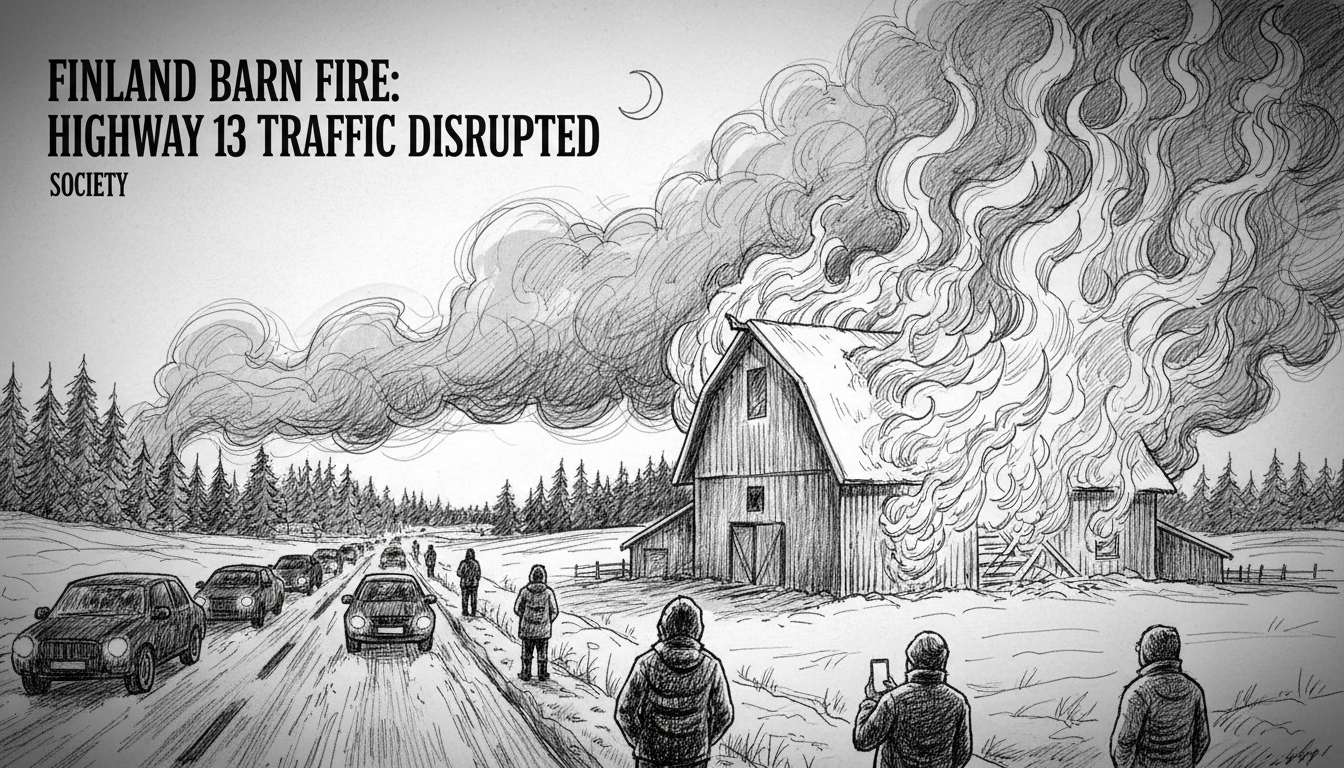
Finland barn fire in Lappeenranta has disrupted traffic on a major national highway and drawn a significant emergency response. A substantial agricultural building, a traditional 'navetta' or cowshed, caught fire on Mikkelintie road in the southeastern border city. The blaze prompted a major deployment by the local rescue service, which remains on scene working to extinguish the flames and contain the damage. The incident highlights the persistent fire risks associated with Finland's agricultural infrastructure and the cascading effects such emergencies can have on regional transport networks.
Emergency Response and Traffic Impact
The immediate consequence of the fire has been significant disruption on Valtatie 13, or Highway 13. This road is a crucial north-south artery in the South Karelia region, connecting Lappeenranta to other population centers and serving as a key transport route for goods and commuters. Authorities have established traffic controls around the fire zone on Mikkelintie, which feeds into the highway. Drivers are being advised to seek alternative routes to avoid the area, with delays expected to continue until the rescue operation is complete and any structural hazards are cleared. The concentration of emergency vehicles and potential smoke drift across the roadway necessitates these measures for public safety.
Lappeenranta's rescue department is leading the firefighting effort. Tackling a blaze in a large barn structure presents distinct challenges. These buildings often contain highly combustible materials such as dry hay, straw, wooden beams, and stored equipment. Fires can spread with alarming speed through such environments, generating intense heat and posing a risk of structural collapse. The rescue service's strategy will focus on both extinguishing the main fire and preventing its spread to any adjacent buildings or surrounding vegetation, a critical concern in a region where forestry is a major industry.
Agricultural Fire Risks in Finnish Context
This incident in Lappeenranta is not an isolated event but part of a recurring pattern of agricultural building fires in Finland. Each year, rescue services respond to dozens of such blazes across the country. The traditional construction materials of many older barns—primarily wood—combined with their contents make them inherently vulnerable. Dust from hay and grain can be highly explosive under the right conditions, and electrical systems in older farm buildings may not always meet modern safety standards. The financial and emotional toll on farmers from such losses can be devastating, often wiping out livestock, equipment, and harvests in a single event.
Fire safety experts consistently emphasize prevention as the first line of defense. 'Regular maintenance of electrical installations, proper storage of flammable materials, and clear emergency plans are non-negotiable for farm safety,' says a senior instructor from the Finnish Rescue Services. 'These buildings are often the heart of a farm's operation. A fire doesn't just destroy a structure; it can end a livelihood that has been built over generations.' The National Emergency Supply Agency and insurance companies frequently run awareness campaigns targeting farmers, highlighting simple steps to reduce risk, such as keeping areas around heat sources clear and ensuring functional smoke alarms.
Lappeenranta's Economic and Geographic Profile
Understanding the location of this fire adds depth to the story. Lappeenranta is a city of approximately 73,000 people situated on the shore of Lake Saimaa, close to the Russian border. Its economy has diversified significantly with technology and education, notably through Lappeenranta-Lahti University of Technology (LUT). However, agriculture and forestry remain deeply embedded in the surrounding region's identity and economy. South Karelia features numerous family-run farms and large tracts of forest, making the loss of an agricultural building a blow to local primary production.
The city's position near the border also gives Highway 13 added strategic importance for regional connectivity. While major international freight traffic uses other routes, the highway is vital for intra-regional logistics. Any prolonged closure or disruption has a tangible impact on local businesses that rely on just-in-time deliveries or need to move perishable goods. The fire on Mikkelintie, therefore, resonates beyond the immediate property damage, touching on themes of rural resilience, infrastructure vulnerability, and economic continuity in eastern Finland.
Policy and Prevention: A National Conversation
While this is an active emergency response story, it inevitably connects to broader policy discussions in Finland. The Ministry of the Interior and the Finnish National Rescue Association (SPEK) continuously work on updating fire safety regulations. For new agricultural buildings, codes are strict. The greater challenge lies in the existing stock of older barns and sheds, where retrofitting for full modern compliance can be prohibitively expensive for many farmers. This creates a gap between ideal safety standards and on-the-ground reality.
Some political voices, particularly from agrarian-centered parties like the Centre Party, have called for enhanced state support or tax incentives for farmers to invest in fire safety upgrades. They argue that protecting food production security is a national interest. Conversely, budget-focused officials point to the need for personal responsibility and the efficient use of public funds. This fire in Lappeenranta will likely reignite these debates in municipal and perhaps national forums, as local officials assess the response and look for ways to prevent future occurrences. The role of comprehensive property insurance is also a key part of the recovery equation for affected farmers.
Looking Ahead: Recovery and Resilience
The final phase of this incident will shift from response to recovery and investigation. Once the fire is fully extinguished and the site is safe to enter, rescue officials will begin the process of determining the cause. This investigation is standard procedure and can take considerable time, involving interviews and forensic examination of the scene. The findings will be crucial for the property owner and for insurance purposes. They also contribute valuable data to national statistics, helping safety authorities identify common causes and trends in agricultural fires.
For the farmer or business that owned the barn, the path forward is difficult. Beyond the physical loss, there may be operational catastrophe if the barn housed livestock or critical machinery. The community often rallies around affected farms in such times, a testament to the strong social cohesion in Finnish rural areas. Neighbors may offer spare barn space, help with salvage, or provide other support. The ultimate rebuilding decision will weigh the costs, insurance payouts, and the long-term viability of the operations housed there. This single fire on Mikkelintie is a dramatic event, but its echoes—the traffic snarls, the safety discussions, the personal loss—will linger in South Karelia long after the smoke clears. It serves as a stark reminder of the fragile balance between traditional livelihoods and modern risks in the Finnish countryside.