
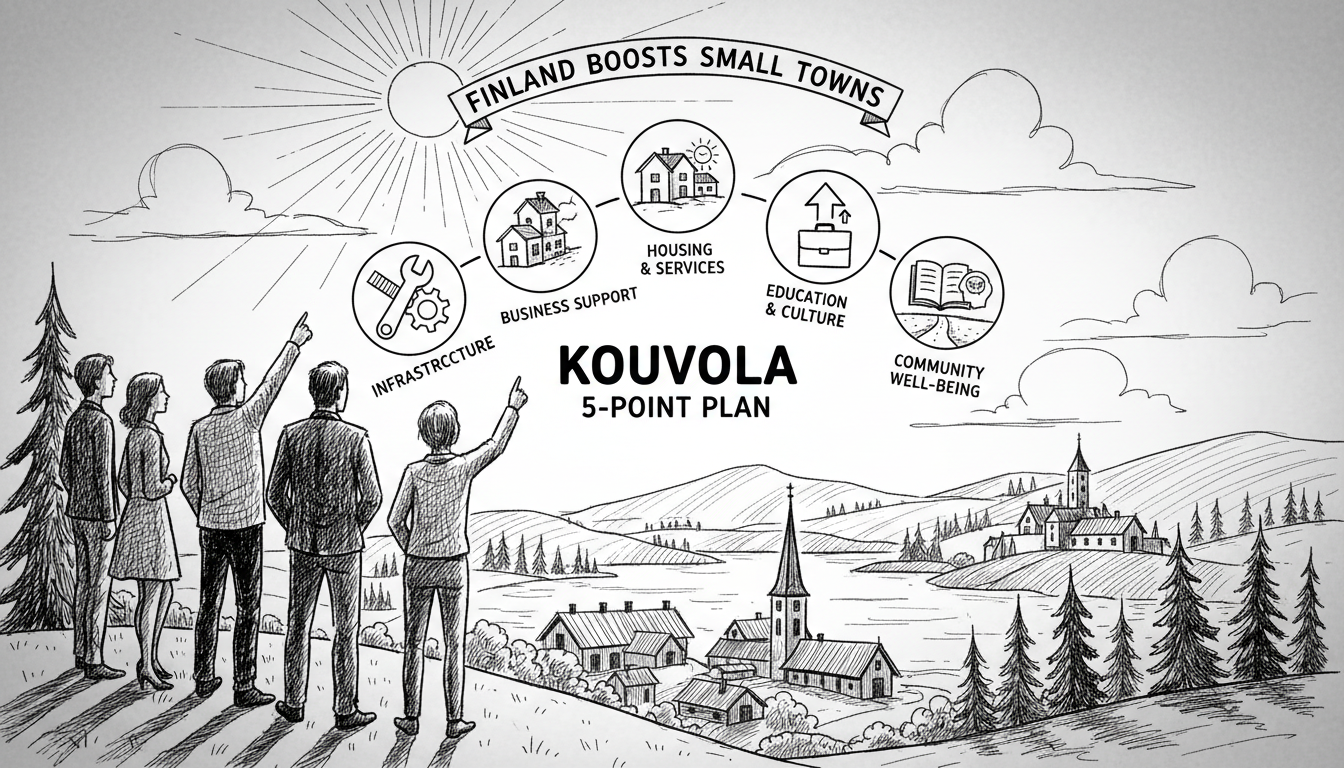
Finland's southeastern city of Kouvola is launching a five-point plan to retain its residents and anchor local businesses. The municipal government formally approved a 'Vitality Promise' agreement this week, partnering with local entrepreneur groups and the development agency Kouvola Innovation. This coordinated effort targets the persistent challenges of regional depopulation and economic stagnation faced by many Finnish towns outside the capital region.
Mayor Marita Toikka described the pact as a necessary commitment to reverse negative trends. "This is a concrete promise from the city to our entrepreneurs and residents that we are serious about improving the conditions for living and doing business here," Toikka said in a statement following the council's decision. The agreement signals a shift from reactive municipal policy to a proactive, partnership-based strategy for local economic survival.
A Pledge to Reverse the Trend
Kouvola, a logistics hub with a population of approximately 80,000, epitomizes the struggle of Finland's midsize regional centers. For years, it has grappled with a slowly declining population as younger residents migrate to university cities or the Helsinki metropolitan area for education and jobs. This outflow creates a vicious cycle, reducing the local customer base for businesses and straining municipal finances. The new Vitality Promise, or elinvoimalupaus, is a direct attempt to break this cycle by making the city more competitive and responsive.
The pact itself is a non-binding political commitment, but its significance lies in the formal collaboration it establishes. The key partners are the City of Kouvola, which controls zoning, permits, and local services; several local entrepreneur associations representing small and medium-sized enterprises (SMEs); and Kouvola Innovation, the area's publicly funded business development company. This tripartite model aims to ensure business community input directly shapes municipal policy.
The Five-Point Blueprint
While the full details of the five specific measures are being finalized, the framework focuses on key pain points for local businesses. Based on similar initiatives in other Finnish municipalities, the plan is expected to include streamlining bureaucratic processes for establishing and operating a company. This could involve faster building permit decisions and more flexible interpretations of zoning rules. A second measure will likely center on enhancing local skills training and improving access to a skilled workforce, a common bottleneck for growing firms.
Third, the city has pledged to act as a more proactive partner in business development. This means municipal officials will work alongside Kouvola Innovation to support companies seeking to expand or export. The fourth pillar involves targeted improvements to the urban environment and digital infrastructure, making the city a more attractive place to live and work. The fifth and final point commits to regular, structured dialogue between the city leadership and the entrepreneur associations to monitor progress and adjust course.
"The value is in creating a common language and shared goals," said a policy advisor familiar with such municipal agreements. "When the city, the entrepreneurs, and the development agency sit at the same table with a signed document, it changes the dynamic. It moves complaints into a framework of collaborative problem-solving."
The Broader Finnish and EU Context
Kouvola's strategy is not an isolated case. Across Finland, from Kajaani in the north to Pori on the west coast, cities are crafting similar local agreements to boost entrepreneurial activity. This trend reflects a broader national policy focus on regional balance and the vital role of SMEs, which employ over 60% of Finland's private sector workforce. The Finnish government's regional development goals explicitly encourage such bottom-up, municipal-level initiatives.
The effort also intersects with European Union cohesion policy, which aims to reduce economic disparities between regions. Southeastern Finland, including the Kymenlaakso region where Kouvola is located, is eligible for EU structural funds designed to support smart specialization and business growth. Local agreements like Kouvola's Vitality Promise can strengthen funding applications by demonstrating clear local coordination and commitment, making projects more attractive to EU and national financiers.
However, experts caution that the promise is only a first step. "The document itself changes nothing," notes Dr. Laura Ahlqvist, a researcher in regional studies at the University of Turku. "Its success is entirely dependent on implementation. The measures must be specific, resourced, and monitored. The real test will be whether a business owner in Kouvola feels a tangible reduction in bureaucratic hurdles or sees an improvement in talent availability over the next two to three years."
On-the-Ground Business Hopes
Local business owners express cautious optimism. Pekka Virtanen, who runs a small manufacturing firm in Kouvola, says the biggest issue is predictability. "If I want to expand my workshop, the permit process needs to be clear and timely. Uncertainty is the enemy of investment," he explains. For him, a successful Vitality Promise would mean the city planning department provides reliable timelines and guidance. Another entrepreneur, a cafe owner in the city center, hopes the plan includes support for revitalizing the urban core to attract more foot traffic.
The involvement of Kouvola Innovation is seen as crucial. The organization acts as a bridge, translating business needs into actionable proposals for the city administration while also connecting companies with funding and export opportunities. Their role will be to ensure the five-point plan moves from political rhetoric to practical business support services.
A Model for Regional Survival?
As Finland's population continues to concentrate around its largest cities, the survival of its regional heartlands depends on strategies like Kouvola's. The Vitality Promise represents a recognition that municipalities cannot be passive administrators; they must be active market-shapers and partners. The five-point plan is a focused attempt to improve the local business ecosystem across multiple fronts simultaneously.
The coming months will see the partners working to flesh out the concrete actions behind each point. The city council will need to allocate resources, and the working groups will need to establish clear metrics for success. For Kouvola's residents, the ultimate measure will be simple: are more young people choosing to stay, and are new businesses choosing to open their doors? The Vitality Promise has set the stage, but the hard work of delivering on that promise is just beginning. Can this type of localized pact become a sustainable model for reversing regional decline in Finland and beyond?