
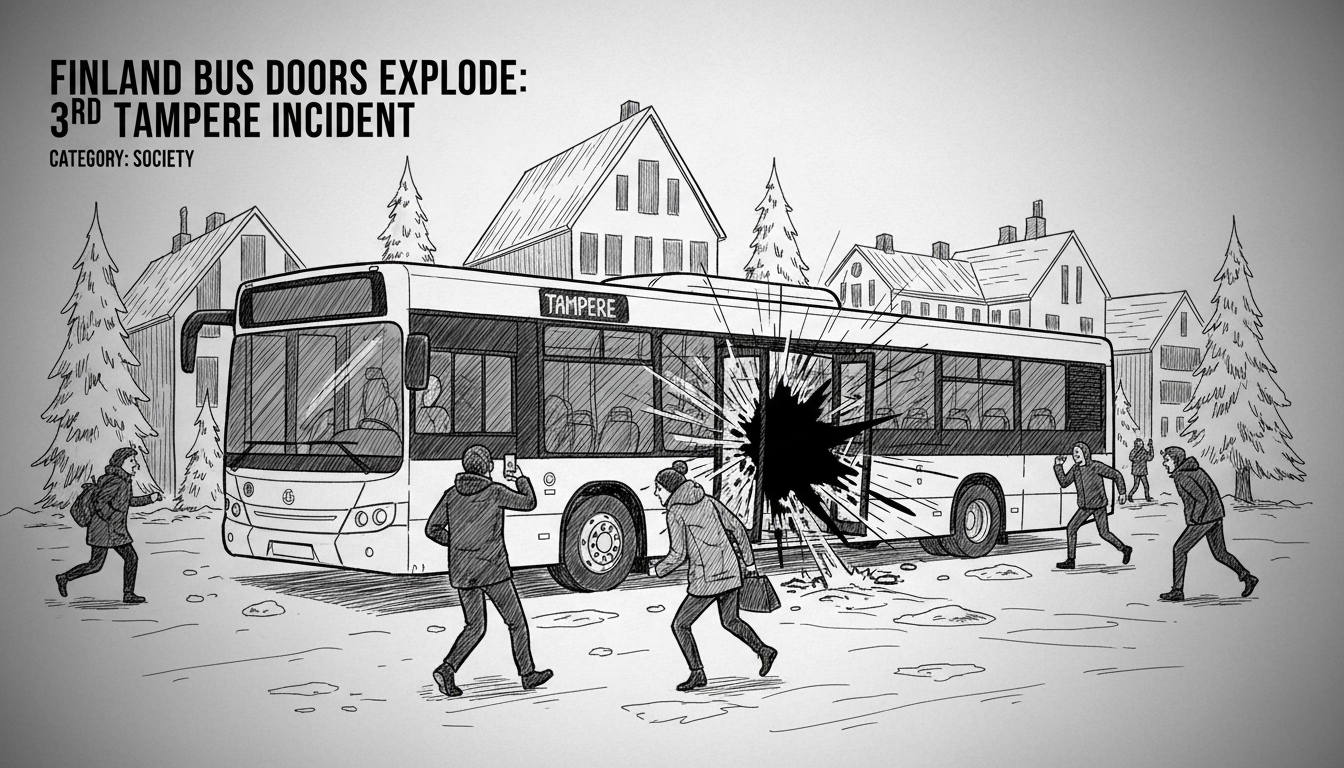
Finland's third-largest city has recorded its third major bus collision with construction obstacles in six months, raising urgent safety questions as a massive tram project reshapes Tampere's streets. A bus operating on route 12 had its rear and center doors violently shattered on Hatanpään valtatie on Tuesday afternoon, forcing the driver to halt service and evacuate passengers at the next stop. Witness Aarne Alanaatu, 17, described hearing a huge bang that completely destroyed windows in both doors while he sat in the front with a friend.
Tommi Arvonen, assistant traffic manager for the city-owned operator Tampereen Kaupunkiliikenne Oy (TKL), confirmed the incident occurred in a narrow traffic lane at a tram construction site. "Unfortunately, this is not the only nor the last time there will be damage in this work zone," Arvonen stated. "Doors, tires, and windows have broken. This has happened even to very experienced drivers."
A Recurring Problem on a Major Artery
Hatanpään valtatie is a crucial traffic corridor in Tampere, a city of nearly 250,000 people. The ongoing construction of the Tampere tramway, known locally as ratikka, has transformed sections of this and other roads into complex, confined pathways for all vehicles. Arvonen suspects the bus struck a concrete barrier or construction fence, though the exact object remains unidentified. The driver, described as highly experienced, followed procedure and no injuries were reported among passengers.
This incident is not isolated. TKL records indicate at least two other significant collisions between buses and construction zone infrastructure on the same stretch in recent months. Each event resulted in substantial vehicle damage and service disruptions. The frequency points to a systemic challenge in managing public transport safety amidst large-scale urban renewal. Tampere's tram project, a flagship infrastructure initiative, is creating unavoidable friction between construction efficiency and daily mobility.
Infrastructure Boom Tests Safety Protocols
The Tampere tramway represents a billion-euro investment in modernizing the city's public transport. The first phase began operation in 2021, and subsequent expansions have placed extensive construction zones in the heart of the urban landscape. Finnish national safety regulations and EU-derived directives on workplace and traffic safety govern these sites. They require clear signage, adequate barriers, and safe passage for all road users.
Professor of Transportation Engineering, who spoke on condition of anonymity as they are not directly involved with the project, told Nordics Today that such repeated incidents suggest a possible review is needed. "When heavy vehicles like buses, with their standardized widths, repeatedly strike fixed objects in a designated lane, it raises questions about the lane's design width, the placement of protective barriers, and the clarity of guidance for drivers," the professor explained. "The margin for error in these temporary arrangements appears to be critically thin."
The Finnish Transport and Communications Agency, Traficom, sets national vehicle and traffic safety standards, which align with broader European Union frameworks. While EU law sets high-level goals for worker and citizen safety, member states implement detailed national rules. In Finland, the Ministry of Transport and Communications and local urban planners bear responsibility for integrating these standards into dynamic construction environments.
Political Accountability and Passenger Confidence
The repeated incidents place political pressure on local government. The City of Tampere owns TKL, and the city board, led by Mayor Anna-Kaisa Ikonen, ultimately oversees both the transport operator and the tram project's execution. Opposition councilors are likely to demand accountability in the next council meeting. Questions will focus on whether cost or schedule pressures are compromising safety mitigations at construction sites.
Public confidence is a tangible concern. Reliable, safe public transport is a cornerstone of Finnish urban policy and a key tool for achieving climate goals. Each disruption and dramatic incident risks pushing commuters towards private cars, increasing congestion and emissions. "Every time a bus is taken out of service for repairs, and every time passengers feel unsafe, it damages the ecosystem of public trust we need for sustainable cities," the transportation professor noted.
TKL's Arvonen emphasized that driver training and vehicle safety are rigorously maintained. The fault, he implied, lies in the challenging interface between moving vehicles and static construction. The company is in constant dialogue with the tram project's construction managers to improve conditions. Solutions may include enhanced buffer zones, improved barrier visibility, or adjusted traffic flow patterns during peak construction phases.
The EU Context: Safety in Urban Transition
Finland's situation reflects a wider European challenge. Cities from Helsinki to Lisbon are upgrading infrastructure, cycling networks, and public transit to meet green transition targets. This often means building in densely populated areas without shutting down city life. The EU's Strategic Transport Research and Innovation Agenda emphasizes safe, inclusive mobility during this transition. Tampere's difficulties serve as a real-time case study in managing these competing priorities.
National funding, partly sourced from EU cohesion and regional development funds, supports projects like the Tampere tramway. This financial link creates an indirect layer of European accountability. While the EU does not manage local construction sites, its overarching goals for safe, efficient, and sustainable urban mobility provide a benchmark against which local implementation is measured.
For now, passengers on route 12 may view their daily trip with heightened anxiety. The shattered doors on Hatanpään valtatie are a visible symptom of a city straining to build its future while maintaining safe operations in the present. As Tampere continues its transformation, the city's ability to prevent a fourth, or fifth, such incident will be a clear test of its operational and political competence. The coming weeks will show if revised safety measures can protect both the ambitious vision for a tram-connected city and the immediate physical safety of its citizens on their daily commutes.