
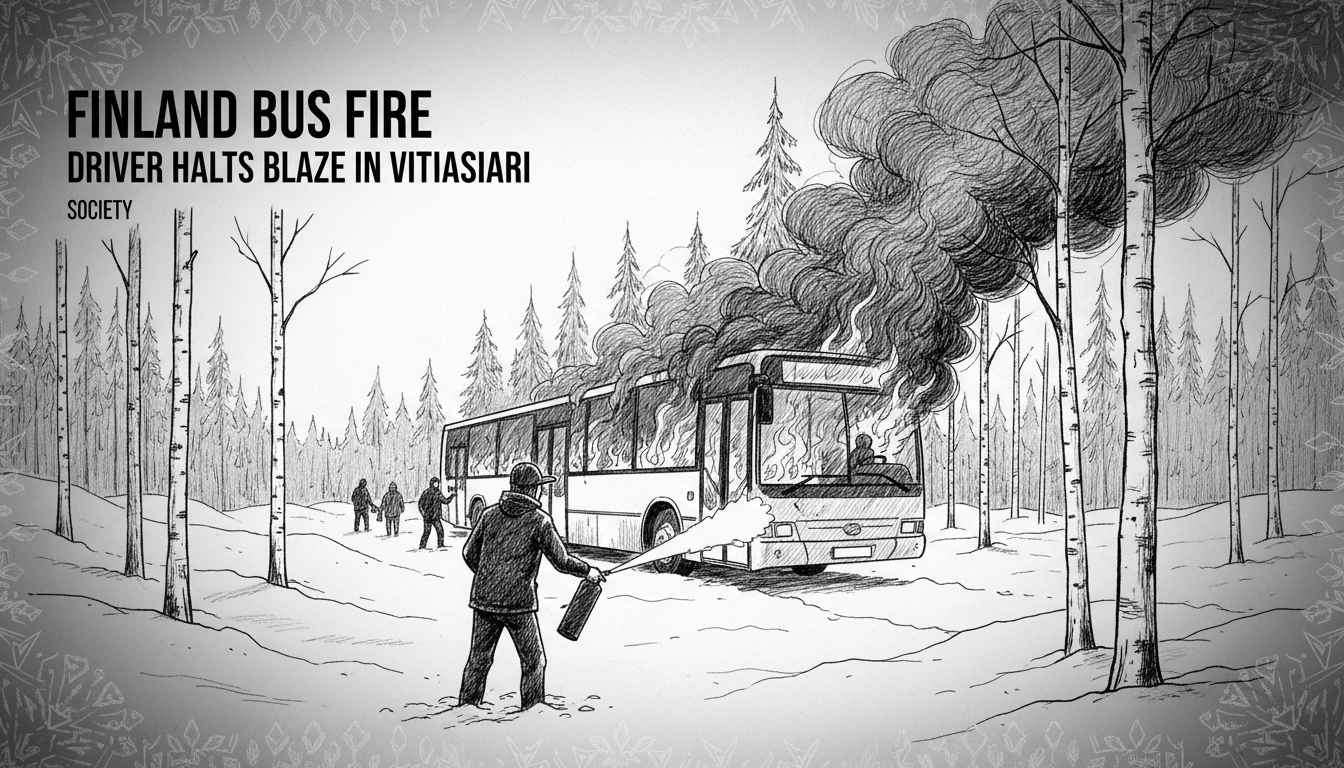
Finland bus fire in Central Finland was contained by a driver's quick actions Tuesday evening, preventing injuries and traffic disruption. The incident occurred around 8 PM on Rantatie road at the Matkahuolto transport yard in the town of Viitasaari. The Central Finland Rescue Department responded to what was classified as a medium-sized vehicle fire, but the driver had already extinguished the flames using on-board firefighting equipment. No one was injured in the event, which concluded with rescue services ensuring the fire was completely out.
This minor incident opens a window into the extensive safety protocols and maintenance regimes that underpin Finland's reliable public transport network. While a single bus fire in a regional yard might seem insignificant, it triggers a chain of mandatory inspections, reports, and potential policy reviews at both municipal and national levels. For international observers, understanding this process reveals why Finnish public transport consistently ranks among the world's safest.
A Routine Response to an Uncommon Event
Vehicle fires, while alarming, are statistically rare events within Finland's transport ecosystem. The Central Finland Rescue Department's response followed standard protocol for such calls. Their primary task shifted from active firefighting to verification and safety assurance, a common outcome when initial suppression by trained personnel is successful. This efficient resolution reflects high levels of preparedness among both professional responders and transport staff.
Finland's rescue services operate on a regional model, with Central Finland's unit being well-versed in incidents across its largely forested and lake-dotted territory. The response in Viitasaari, a town of roughly 6,000 inhabitants, demonstrates the nationwide reach of emergency service standards. Every rescue department in Finland operates under the same framework of the Rescue Act, ensuring consistent response quality from Helsinki to rural municipalities.
The Driver's Role as First Responder
The successful initial fire extinguishing by the bus driver was not mere luck. It is a direct result of stringent Finnish and EU-wide regulations governing professional driver training and vehicle safety standards. All commercial vehicle drivers in Finland undergo safety training that includes basic fire response procedures. Furthermore, regular vehicle inspections mandated by the Finnish Transport and Communications Agency, Traficom, ensure fire extinguishers are present, accessible, and in working order.
“The first minutes are critical in any vehicle fire,” explains safety instructor Mikael Koskinen, who trains transport professionals. “Drivers are trained to assess the situation, ensure passenger evacuation if necessary, and attempt safe initial suppression if possible. This incident in Viitasaari is a textbook example of that protocol being executed correctly, preventing what could have been a total loss of the vehicle and possible infrastructure damage.” The design of Finnish buses also incorporates fire-resistant materials and electrical system protections to delay the spread of flames, buying crucial time for response.
From Local Incident to National Safety Log
Following the incident, a formal process begins. The bus operator, likely a local subcontractor for a national line like Matkahuolto or OnniBus, is required to file an incident report. This report feeds into national safety databases maintained by Traficom. While a single fire may not prompt new legislation, patterns emerging from aggregated data directly influence future safety directives and inspection criteria.
Finland’s approach is proactive and data-driven. The country participates in EU-wide vehicle safety monitoring programs, and findings from domestic incidents contribute to that collective knowledge base. Any technical fault discovered in the subsequent investigation of the Viitasaari bus could be shared with other operators and manufacturers, creating a ripple effect that enhances safety far beyond the local yard. This systematic reporting culture is a cornerstone of the Nordic model of preventive safety management.
The Broader Context of Transport Safety in Finland
To understand the significance of this minor fire, one must consider Finland's exemplary road safety record. The country has consistently been among the world leaders in low traffic fatalities per capita. This achievement stems from a holistic “Safe System” approach that encompasses infrastructure, vehicle standards, enforcement, and education. Public transport vehicles are held to particularly high standards due to their responsibility for passenger groups.
Regular technical inspections for buses are more frequent and rigorous than for private cars. These checks include braking systems, which are a common source of vehicle fires globally due to heat buildup. While the cause of the Viitasaari fire remains unspecified, the braking system will undoubtedly be a focal point of the technical investigation. Finland’s cold climate can also present unique challenges, with electrical systems and pre-heaters requiring robust maintenance to prevent faults.
Economic and Operational Resilience
The swift containment of the fire minimized economic disruption. A severe bus fire can take a vehicle out of service for months, creating gaps in regional transport networks that are vital for commuting, education, and commerce in areas like Central Finland. The Matkahuolto network is a backbone of intercity travel, especially in regions not served by rail. The quick resolution allowed the yard’s operations to continue normally, avoiding scheduling delays for other routes.
This resilience is built into the system through contingency planning. Transport companies maintain reserve vehicles and flexible scheduling to manage unexpected outages. The public service obligation funding model for many regional routes also includes provisions for unexpected events, ensuring communities are not left isolated. The incident underscores how robust logistical planning at the corporate and municipal level supports everyday reliability.
A Model of Quiet Competence
The Viitasaari bus fire story is ultimately one of non-news. It is a story about a system working so well that a potential crisis becomes a minor footnote. There was no dramatic rescue, no heroic intervention by firefighters, and no tragic outcome. Instead, there was a trained professional performing a practiced routine, supported by equipment that functioned as designed, backed by emergency services that verified the result. This quiet competence is the hallmark of a high-trust, high-functioning society.
In many countries, a vehicle fire makes headlines because of tragedy or systemic failure. In Finland, it is noteworthy for its unremarkable and safe conclusion. The real story is not the fire itself, but the invisible lattice of regulations, training, and cultural commitment to safety that prevented it from becoming a disaster. It reinforces a national identity built on preparedness and collective responsibility, where safety is not left to chance but is engineered into daily life.
As the bus in Viitasaari undergoes its post-incident checks, life in the town continues uninterrupted. The event will be logged, analyzed, and filed away, contributing another data point to Finland’s relentless pursuit of safety improvement. For the rest of the world, it serves as a compelling case study in how to build transport systems where even emergencies are managed with calm efficiency. The question for other nations is not how Finland responds to a fire, but how it builds a system where such responses are consistently, and uneventfully, successful.